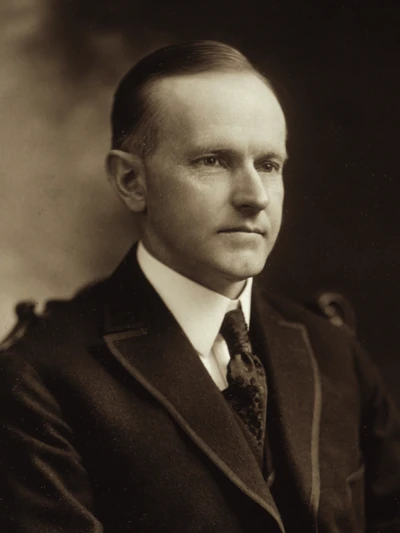
Calvin Coolidge
| Name | Calvin Coolidge |
| Title | president of the United States from 1923 to 1929 |
| Gender | Male |
| Birthday | 1872-07-04 |
| nationality | United States of America |
| Source | https://www.wikidata.org/wiki/Q36023 |
| pptrace | View Family Tree |
| LastUpdate | 2025-11-17T06:43:36.992Z |
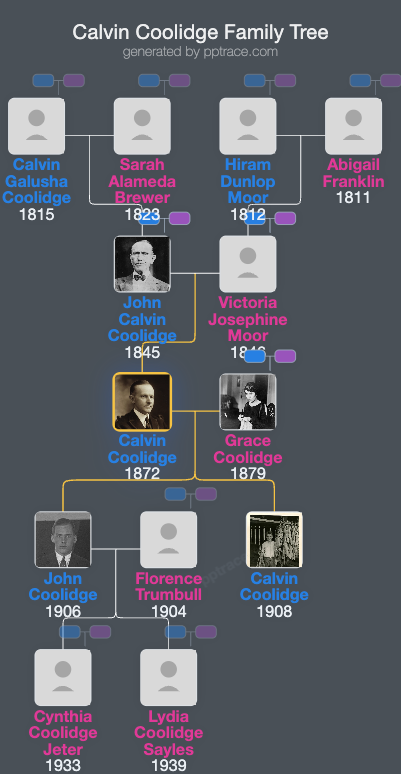
Family Tree
Tap  to expand more relatives
Introduction
John Calvin Coolidge Jr., born on July 4, 1872, in Plymouth Notch, Vermont, was the 30th president of the United States, serving from 1923 to 1929. He was the only U.S. president born on Independence Day. Coolidge was the elder of two children of John Calvin Coolidge Sr. and Victoria Josephine Moor. His family lineage includes ancestors such as John Coolidge, who emigrated from Cottenham, Cambridgeshire, England, around 1630, and Samuel Appleton, a leader in the Massachusetts Bay Colony during King Philip's War. Coolidge's great-great-grandfather, also named John Coolidge, participated in the Revolutionary War and served as one of the first selectmen of Plymouth. His grandfather, Calvin Galusha Coolidge, served in the Vermont House of Representatives.
Coolidge's early life was marked by the deaths of family members; his mother died at age 39 when he was 12, and his younger sister Abigail Grace died at age 15 when Coolidge was 18. He was educated at Black River Academy, St. Johnsbury Academy, and Amherst College, where he was a member of the Phi Gamma Delta fraternity and graduated cum laude. Influenced by philosophy professor Charles Edward Garman, Coolidge adopted a moral philosophy emphasizing righteousness, service, and property as a responsibility to the larger community.
Following college, Coolidge apprenticed with the law firm Hammond & Field in Northampton, Massachusetts, and was admitted to the Massachusetts bar in 1897. He established himself as a country lawyer specializing in commercial law, maintaining a reputation for diligence and integrity.
In 1903, Coolidge met Grace Goodhue, a teacher at Northampton's Clarke School for the Deaf; they married on October 4, 1905. They had two sons: John, born in 1906, and Calvin Jr., born in 1908. Calvin Jr. died in 1924 at age 16 from sepsis caused by a blister sustained during a tennis game, a loss that deeply affected Coolidge.
Coolidge entered politics through local offices, beginning with his election to Northampton's City Council in 1898. He served as city solicitor from 1899 to 1902, gaining experience in legal and municipal affairs. His political career progressed as he became more active in the Republican Party, with early campaigns supporting William McKinley in 1896.
He was elected governor of Massachusetts in 1918, serving from 1919 to 1921. As governor, he gained national recognition for his handling of the Boston police strike in 1919 and for his fiscal conservatism, support for women's suffrage, and opposition to Prohibition.
In 1920, Coolidge was chosen as the vice-presidential candidate on the Republican ticket with Warren G. Harding, which won the presidential election in a landslide. He served as vice president from 1921 until Harding's death in 1923, at which point Coolidge assumed the presidency.
During his presidency, Coolidge worked to restore confidence in the executive branch, signing legislation such as the Indian Citizenship Act of 1924, which granted U.S. citizenship to Native Americans. His administration oversaw a period of economic expansion known as the "Roaring Twenties." Known for a governing style that emphasized limited government intervention and pro-business policies, Coolidge was often referred to as "Silent Cal" due to his reserved personality and dry humor.
In 1928, Coolidge declined to seek re-election, citing the length of his tenure as sufficient. His presidency is associated with a period of economic growth but also with debates concerning the causes of the subsequent Great Depression. Opinions on his policies vary among historians, with some criticizing him for not supporting struggling industries and others acknowledging his influence on smaller government principles.
Coolidge remained engaged in political and civic activities after leaving office until his death. He passed away on January 5, 1933.
Throughout his life, Coolidge's philosophy and political actions reflected a commitment to fiscal conservatism, limited government, and support for individual enterprise, with his legacy shaped by both his governance style and the historical context of the early 20th century.