Grace Coolidge
| Name | Grace Coolidge |
| Title | First Lady of the United States from 1923 to 1929 |
| Gender | Female |
| Birthday | 1879-01-03 |
| nationality | United States of America |
| Source | https://www.wikidata.org/wiki/Q234287 |
| pptrace | View Family Tree |
| LastUpdate | 2025-11-17T06:43:40.549Z |
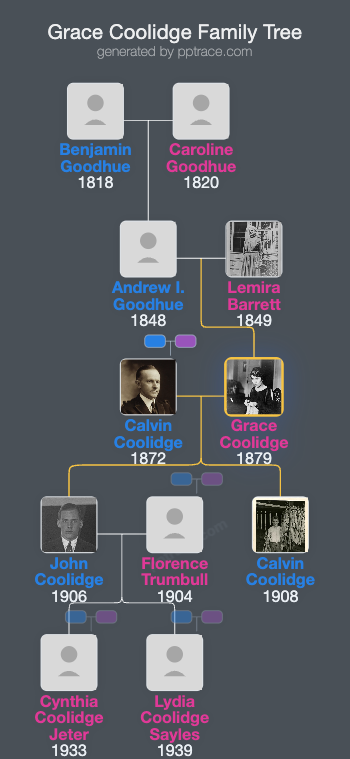
Family Tree
Tap  to expand more relatives
Introduction
Grace Anna Coolidge (née Goodhue) was born on January 3, 1879, in Burlington, Vermont. She was the only child of Andrew Issachar Goodhue and Lemira Barrett Goodhue. Her family was descended from 17th-century colonist William Goodhue and congressman Benjamin Goodhue. Throughout her childhood, she participated in annual family reunions in Hancock, New Hampshire, until 1899, and spent summers visiting her maternal grandfather, listening to Civil War stories. Her family rented a home near a mill, where her father was a milling engineer and later co-founded a machine shop after a work injury. Her father was appointed by President Grover Cleveland as a steamboat inspector in 1886.
Grace was raised in a religious household with Puritan values, initially Methodist, but later her family converted to Congregationalism during her adolescence. She attended Burlington High School, where she studied Latin and French, and received private lessons in piano, speech, and singing. In 1897, she delivered the commencement speech titled "Tramp Instinct." She enrolled at the University of Vermont in 1897 but temporarily dropped out due to an eye condition, returning the following year. During her university years, she was involved in various activities, including dance, skating, theater, Bible study, Christian Endeavor, poetry, and the glee club, where she performed as a contralto. She served as her class vice president in her second year and was known for her outgoing personality.
Goodhue developed a relationship with Frank Joyner, which was informally agreed upon for marriage, but she ultimately ended the relationship. She befriended Ivah Gale, whom she co-founded the University of Vermont's chapter of Pi Beta Phi, a women's fraternity. She graduated from the university in 1902 and moved to Northampton, Massachusetts, to teach at Clarke School for the Deaf, where she spent three years instructing primary and middle school students. The school emphasized lip reading rather than sign language, aiming to integrate deaf students into broader society.
In Northampton, Goodhue met Calvin Coolidge during her second year at the school. Their first encounter was outside her dormitory, where she saw him shaving and heard her laugh. He was introduced to her through mutual acquaintances. Their relationship developed through shared interests, including politics and public service, despite contrasting personalities—his reserved, hers outgoing. They bonded over their Vermonter backgrounds, sense of humor, religious values, and work ethic. Calvin Coolidge was actively involved in Republican politics, and Grace converted from Democrat to Republican. He proposed marriage to her in 1905, and they were married later that year, despite her mother's reservations. The couple had two sons.
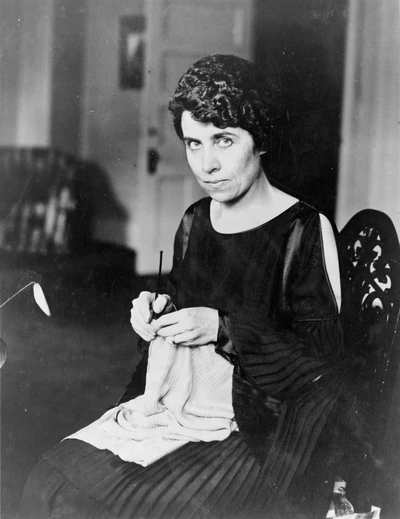
Grace Anna Coolidge became the First Lady of the United States when her husband assumed the presidency in 1923 following the death of Warren G. Harding. She served as the Second Lady from 1921 to 1923 and as the First Lady of Massachusetts from 1919 to 1921. During her tenure in the White House, she hosted numerous guests annually and made regular public appearances in her husband's stead. She was recognized for her appealing manner and style, influencing fashionable trends among American women with her choice of hats and modest clothing. Her role was characterized by a preference for a non-political, supportive profile, although she showed interest in women's groups and the deaf community.
In 1924, her younger son died, an event that affected her deeply. Despite personal grief, she continued her duties as White House hostess for a few weeks. During her husband's presidency, she was also affected by kidney disease, which temporarily impaired her health. The Coolidges returned to Northampton in 1929, where she began publishing poetry and autobiographical essays. After her husband's death in 1933, she adopted a more independent lifestyle, traveling and engaging in public service. She supported American involvement in World War II, providing her house to the WAVES. She remained active in the Clarke School and deaf programs until her death on July 8, 1957.