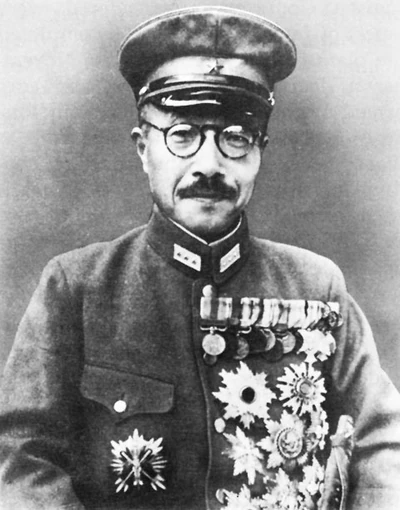
Hideki Tojo
| Name | Hideki Tojo |
| Title | Japanese politician, army officer, and convicted war criminal (1884–1948) |
| Gender | Male |
| Birthday | 1884-12-30 |
| nationality | Japan |
| Source | https://www.wikidata.org/wiki/Q160847 |
| pptrace | View Family Tree |
| LastUpdate | 2025-11-17T10:09:09.535Z |
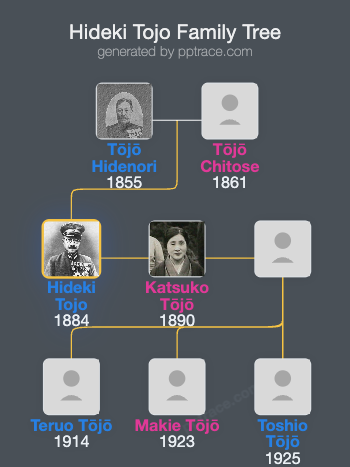
Family Tree
Tap  to expand more relatives
Introduction
Hideki Tojo (東條 英機, Tōjō Hideki) was born on December 30, 1884, in the Kōjimachi district of Tokyo. His father, Hidenori Tojo, was a lieutenant general in the Imperial Japanese Army, and his mother was the daughter of a Buddhist priest. The family belonged to the samurai caste, which had historically held social prestige despite their relatively modest status as warrior retainers.
Tojo attended the Imperial Japanese Army Academy, entering in 1899, and graduated in 1905. He was commissioned as a second lieutenant in the infantry of the Imperial Japanese Army (IJA) in that year. In 1905, he participated in the aftermath of the Russo-Japanese War, influenced by the Treaty of Portsmouth, which was unpopular in Japan and contributed to anti-American sentiment among Tojo's contemporaries.
His early military career included serving as a military attaché in Germany from 1919 to 1922. During his time abroad, he observed the German military's approach to preparing for total war, which influenced his own views on military organization and strategy. In 1922, he traveled across the United States, where he formed a negative impression of American society, believing Americans to be materialistic and hedonistic.
In the 1920s, Tojo rose through the ranks, becoming a colonel by 1928 and serving as bureau chief of the Japanese Army. He began developing an interest in militarist politics and was known for his stern demeanor, obsession with etiquette, and dedication to duty. He believed in a strict martial discipline, often employing face-slapping as training in his early command.
In 1934, Tojo was promoted to major general and held the position of chief of the personnel department within the Army Ministry. During this period, he advocated for Japan to transform into a totalitarian "national defense state," emphasizing militarism and national strength. That same year, he contributed a chapter to a book titled *Hijōji kokumin zenshū* (“Essays in time of national emergency”), which promoted the idea of Japan becoming a totalitarian state.
By March 1937, Tojo served as chief of staff of the Kwantung Army, leading military operations in Inner Mongolia and the Chinese provinces of Chahar and Suiyuan during the Second Sino-Japanese War. His role in these campaigns involved significant military action against Chinese forces, and he became known for his aggressive military policies.
Following his service in China, Tojo was recalled to Tokyo, where he served as vice-minister of the army in 1938, gaining influence within the military establishment. In July 1940, he was appointed Minister of the Army under Prime Minister Fumimaro Konoe. During this period, Tojo was an outspoken advocate of preemptive strikes against the United States and European powers, reflecting increasingly aggressive Japanese militarism.
On October 17, 1941, Tojo was appointed Prime Minister of Japan. His tenure as Prime Minister coincided with Japan's entry into World War II, following the attack on Pearl Harbor on December 7, 1941. As Prime Minister, Tojo oversaw Japanese military campaigns across Southeast Asia and the Pacific and was associated with numerous wartime atrocities, including war crimes against prisoners of war and civilians.
Tojo’s leadership during the war lasted until July 18, 1944, when he resigned amid mounting military defeats and internal political pressures. Following Japan's surrender in September 1945, he was arrested by Allied authorities. He was subsequently tried by the International Military Tribunal for the Far East, known as the Tokyo Trials. He was convicted of war crimes, sentenced to death, and executed by hanging on December 23, 1948.
Throughout his life, Tojo was characterized by his strict discipline, unwavering militarism, and dedication to Japanese nationalism. His involvement in the invasion of China, the attack on Pearl Harbor, and numerous acts of mass violence have led his legacy to be closely associated with Japan's aggression during the early Showa era.