William, Count Of Schaumburg-Lippe
| Name | William, Count Of Schaumburg-Lippe |
| Title | Count of Schaumburg-Lippe |
| Gender | Male |
| Birthday | 1724-01-09 |
| nationality | Kingdom of Portugal |
| Source | https://www.wikidata.org/wiki/Q566099 |
| pptrace | View Family Tree |
| LastUpdate | 2025-11-12T01:15:11.093Z |
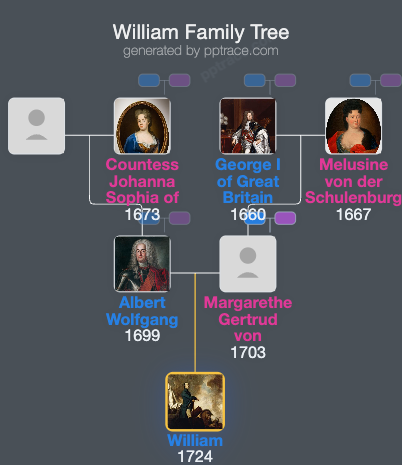
Family Tree
Tap  to expand more relatives
Introduction
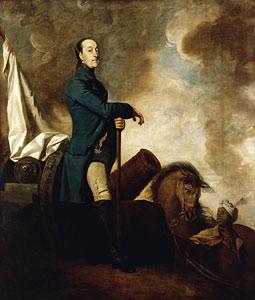
Wilhelm, Count of Schaumburg-Lippe-Bückeburg (9 January 1724 – 10 September 1777), born Friedrich Wilhelm Ernst Graf zu Schaumburg-Lippe-Bückeburg, was a German nobleman and military figure active during the 18th century. He is recognized as a ruler of the County of Schaumburg-Lippe-Bückeburg, a military commander during the Seven Years' War, and served as Generalfeldzeugmeister of the Electorate of Brunswick-Lüneburg. He also held the rank of British field marshal (Generalfeldmarschall) and was a grandson of King George I of Great Britain.
**Early Life**
He was born in London, the son of Albrecht Wolfgang, Count of Schaumburg-Lippe, and his first wife, Countess Margarete Gertrud of Oeynhausen (1701–1726). Margarete Gertrud was alleged to be a bastard daughter of King George I of Great Britain and his mistress Ehrengard Melusine von der Schulenburg.
**Military Career and Succession**
Wilhelm accompanied his father in military campaigns during the War of Austrian Succession (1740–1748), participating in the Battle of Dettingen in 1743. Subsequently, he fought in Austrian service during their Italian military campaigns. He succeeded his father as Count of Schaumburg-Lippe-Bückeburg on 25 October 1748.
**Seven Years' War**
During the Seven Years' War, Wilhelm held the position of Generalfeldzeugmeister (General of the Artillery) and supported Prussia. He distinguished himself at the Battle of Minden by leading the allied artillery and was promoted to overall command of the allied artillery units.
**Campaigns in Portugal**
In 1762, at the request of the Portuguese Secretary of State, the Marquis of Pombal, Wilhelm led the allied forces in Portugal as Generalissimus against Spanish invasions. His defensive strategy involved conducting marches and counter-marches that leveraged the terrain, enabling defending forces to avoid engagement with the numerically superior Spanish army. His campaign was notable for its tactical effectiveness, as the terrain and strategic positioning prevented the Spanish from launching successful full-scale attacks.
Wilhelm remained in Portugal for a year after the signing of the peace treaty in 1763.
**Theoretical Contributions**
He was an influential military theorist advocating for defensive warfare, emphasizing the legitimacy and ethical justification of such strategies. Wilhelm promoted the concept of "fortified landscapes," which integrated strongholds, locally armed populations, and soldiers engaged in agriculture during peacetime, to prepare regions against invasions. His writings include the slogan: "Kein anderer als der Defensivkrieg ist rechtmäßig!" ("Only defensive warfare is justified!")
His ideas contributed to the reform movements in military strategy and influenced later plans for people's war and military reforms in Germany, notably connecting to the figures of Scharnhorst and Gneisenau.
**Family and Personal Life**
By 1764, Wilhelm had two children, Joseph and Olimpia Petronellia, born in Elvas, Portugal. Olimpia was baptized in Campo Maior on 24 June 1764, and after her recognition by her father's cousin, Philip II Ernst, her name was changed to Olímpia Patronellia Ernestina de Schaumburg-Lippe. Olimpia died on 25 November 1822.
Wilhelm married Countess Marie Barbara Eleonore of Lippe-Biesterfeld (1744–1776) on 12 November 1765 in Stadthagen. The marriage produced two children: Countess Emilie (1771–1774) and an unnamed son born in 1772.
**Death and Legacy**
Wilhelm died at Wölpinghausen. His contributions to military theory and strategy, particularly his advocacy for defensive warfare, mark him as a significant figure in 18th-century military history. He is commemorated by a bust in the Walhalla temple, a hall of fame for distinguished Germans.
**Additional Contributions**
He is associated with structures and innovations such as the Conde de Lippe Fort—a fortress in Portugal during the Seven Years' War; Wilhelmstein, an artificial fortified island constructed on Lake Steinhuder Meer to his orders; and the Steinhuder Hecht, an experimental submarine built at Wilhelmstein.
**See also**
- Conde de Lippe Fort
- Wilhelmstein
- Steinhuder Hecht
**References and External Links**
Further information can be found through sources on Schaumburg-Lippe nobility.