Jingshou
| Name | Jingshou |
| Title | one of the Eight Regents of Xianfeng Emperor, Qing dynasty |
| Gender | Male |
| Birthday | 1831-02-05 |
| nationality | Qing dynasty |
| Source | https://www.wikidata.org/wiki/Q8189753 |
| pptrace | View Family Tree |
| LastUpdate | 2025-10-27T03:40:27.528Z |
Family Tree
Tap  to expand more relatives
Introduction
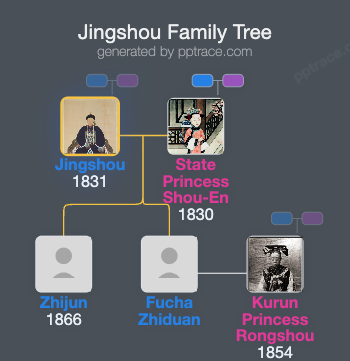
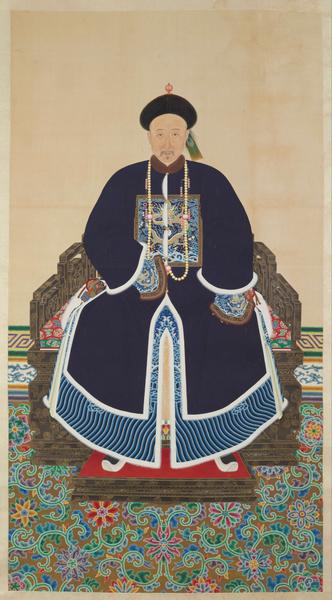
Jing Shou (1829–1889), Manchu banner yellow within flag, was an imperial son-in-law of the Qing Dynasty. He was born on the 23rd day of the twelfth month in the 10th year of Daoguang (December 23, 1829). His father was Boqitu, a first-rank duke and Minister of Works. Jing Shou was a son born out of wedlock and initially held no noble title. In the 24th year of Daoguang (1844), he was granted the top-ranked official hat and his name was inscribed in the imperial study. In the same year, he was betrothed to Princess Shou’en Gu Lun, the sixth daughter of Emperor Daoguang. The princess married him the following year, and they completed their marriage.
In the 5th year of Xianfeng (1854), in July, he was recommended as the Mongolian Altan Knight-Commander. In the 6th year of Xianfeng (1855), in January, he was promoted to Grand Secretary of the Forbidden Palace and was granted purple reins. Subsequently, he served as the Commander of the Imperial Bodyguard. In the 6th year of Xianfeng, Jing Shou’s elder brother, First-Rank Duke Jing Qing, who had no heirs, died, and Jing Shou inherited his nobility. In August of the 10th year of Xianfeng (1854), Jing Shou accompanied the emperor on an imperial tour to Rehe. In July of the 11th year (1855), he, along with Prince Yihe Zaiyuan and seven others, served as Administrators of Political Affairs. During the “Qixiang Coup” initiated by Empress Dowager Cixi and Empress Dowager Cian, he was demoted in October but retained his duke title and status as imperial son-in-law.
In the first year of the Tongzhi reign (1862), in February, he was appointed Mongolian Altan Knight-Commander, and in March, he was promoted to Grand Advisor. In July of the third year of Tongzhi (1863), he was again granted purple reins, and in October, he was appointed as Leader of the Imperial Bodyguard. By the twelfth month of the 13th year of Tongzhi (1874), he was appointed to oversee affairs of the Shenji Camp. In the 15th year of Guangxu (1889), he died in June, and was posthumously titled "Duan Qin."
Regarding his family, records indicate that Jing Shou had at least four sons and six daughters, but there is no evidence that any of his children were born to Princess Shou’en Gu Lun. His son, Zhiduan, married Princess Rong Shou Gu Lun in 1870 and died in 1875. As for his daughters, there were six, each married to prominent figures: one daughter was the primary wife of the Hešuo Ruiqin Prince Kwai Bin; another was the primary wife of the Hešuo Zhuang Gong Prince Zhaigong; another was the primary wife of the Hešuo Zhengke Prince Kaitai; another was the primary wife of the Feng’en Zhen Guo Gong Zai Gu; another daughter was the primary wife of a member of the imperial clan Pu Shuang; and the last was the secondary wife of the official Zongshi Wenliang.