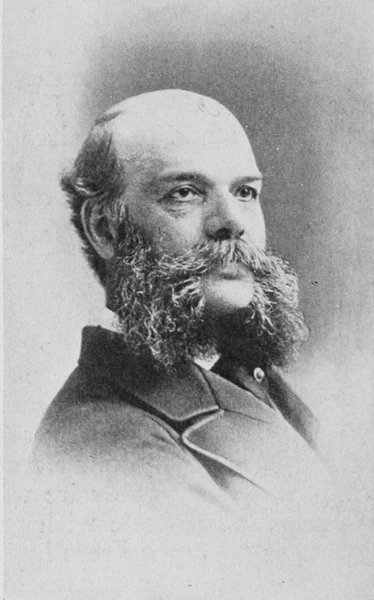
James Dunwoody Bulloch
| Name | James Dunwoody Bulloch |
| Title | Civil War Confederate Veteran (1823-1901) |
| Gender | Male |
| Birthday | 1823-06-25 |
| nationality | United States of America |
| Source | https://www.wikidata.org/wiki/Q3161042 |
| pptrace | View Family Tree |
| LastUpdate | 2025-11-29T01:01:03.106Z |
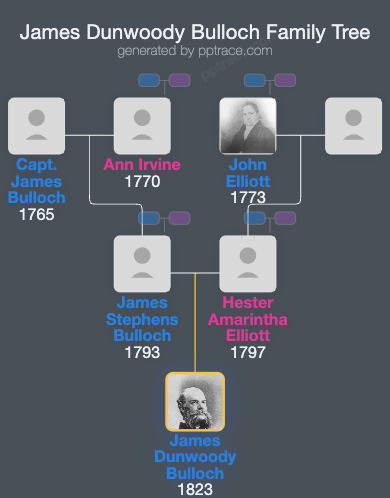
Family Tree
Tap  to expand more relatives
Introduction
James Dunwoody Bulloch (June 25, 1823 – January 7, 1901) was an American who served as the Confederacy's chief foreign agent in Great Britain during the American Civil War. His primary base of operations was in Liverpool, where he facilitated the procurement of ships, war supplies, and financial resources for the Confederate States of America. Bulloch's activities included managing blockade runners and commerce raiders, which played a significant role in providing the Confederacy with its only substantial source of hard currency through the sale of cotton to British merchants. He was involved in the construction and acquisition of several notable Confederate ships, including CSS Florida, CSS Alabama, CSS Stonewall, and CSS Shenandoah. These vessels targeted Union shipping during the conflict.
Due to his role as a Confederate secret agent, Bulloch was not included in the general amnesty granted after the Civil War. As a result, he chose to remain in Liverpool, where he became the director of the Liverpool Nautical College and the Orphan Boys Asylum. His familial relationships included his half-brother Irvine Bulloch, a Confederate naval officer, and his half-sister Martha Roosevelt, who was the mother of U.S. President Theodore Roosevelt and the paternal grandmother of First Lady Eleanor Roosevelt.
Born on a plantation near Savannah, Georgia, in 1823, James D. Bulloch was the son of Major James Stephens Bulloch and Hester Amarintha Elliott. After the death of his mother, he attended a private school in Hartford, Connecticut. His father remarried in 1832 to Martha Stewart, the widow of Senator John Elliott, and the family subsequently moved to Cobb County in Georgia, where Major Bulloch became a partner in a cotton mill enterprise. The family resided in Bulloch Hall, a prominent home in Roswell, Georgia, completed in 1839, though James D. Bulloch had already signed articles in the U.S. Navy prior to its completion.
Bulloch married Elizabeth Caskie in 1851; following her early death, he married Mrs. Hariott Cross Foster, a widow from Baton Rouge, Louisiana, in 1857. He and his second wife had five children.
He served in the United States Navy for about fifteen years before resigning his commission in 1854 to join a private shipping enterprise. At the onset of the Civil War in 1861, Bulloch offered his assistance to the Confederate States and was designated as a secret agent operating from Liverpool. His task was to leverage British commercial interests for Confederate military and economic benefit, including the procurement of ships and weapons and the conduct of naval warfare through the construction and deployment of commerce raiders.
During the war, Bulloch coordinated with British firms such as Fraser, Trenholm & Company, which acted as the Confederacy's financiers. He participated in the acquisition and outfitting of ships like CSS Alabama and CSS Florida, which disrupted Union maritime commerce. Bulloch also financed the conversion of a steamship, SS Fingal, into the CSS Atlanta, transporting ordnance to support Confederate military efforts. His operational scope included instructing captains like James Iredell Waddell to disrupt Yankee whaling ships and commerce in distant waters.
Following the conflict, Bulloch and his brother Irvine did not receive amnesty and chose to remain in Liverpool, where they became successful cotton importers and brokers. In 1883, Theodore Roosevelt, then a young man, persuaded Bulloch to publish an account of his wartime activities, titled "The Secret Service of the Confederate States in Europe," in two volumes. Roosevelt later drew upon Bulloch's expertise and publications for his own historical work, "The Naval War of 1812."
In 1905, during a period of reconciliation between North and South, Theodore Roosevelt, who by then was President, visited Georgia and spoke publicly about his family’s Civil War history. Roosevelt identified James Bulloch as his maternal uncle and included him among relatives who served heroically in the conflict, highlighting Bulloch's role as a Confederate naval commander.