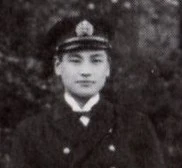
Sadatomo Okada
| Name | Sadatomo Okada |
| Title | Japanese military personnel (1908-1944) |
| Gender | Male |
| Birthday | 1908-03-04 |
| nationality | Japan |
| Source | https://www.wikidata.org/wiki/Q6281072 |
| pptrace | View Family Tree |
| LastUpdate | 2025-11-17T10:08:46.669Z |
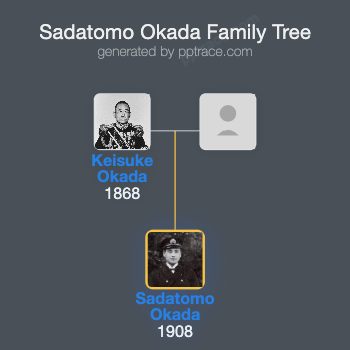
Family Tree
Tap  to expand more relatives
Introduction
Sadatomo Okada (March 4, 1908 – December 26, 1944) was a Japanese naval officer. He graduated from the 55th class of the Imperial Japanese Naval Academy and attained the final rank of Captain in the Navy. His father was Keisuke Okada, the 19th Prime Minister of Japan. He was born as the eldest son. His wife was Akiko, the daughter of Tetsutarō Sato.
[Life and Career]
Background
He graduated from the former Takachiho Middle School and subsequently entered the 55th class of the Naval Academy. At graduation, he was the second in his class and received the Imperial Award. Among his classmates was his brother-in-law, Hideo Suzuki. Okada continued his studies at the Naval Torpedo School’s advanced course, graduating top of his class with the Imperial Award. As a torpedo officer, he served on the destroyer "Fumetsu," where he received specialized torpedo training.
In 1936 (Showa 11), he was abroad in China during the February 26 Incident. After returning to Japan, he served at the Yokosuka Naval Base and worked as a naval instructor for two years. He then entered the 37th class of the Naval War College, Class A, graduating second in his class with the Imperial Award. Among his classmates were Chikako Nakajima and Sakuo Mikami, with whom he developed important relationships that influenced his later career.
In 1940 (Showa 15), he was posted to the U.S. West Coast for intelligence activities. During the incident involving Tachibana Tadao’s exposure by U.S. authorities, Okada and Tachibana were declared persona non grata and forbidden re-entry to the U.S., returning to Japan instead. After his return, he was appointed as torpedo staff officer of the 4th Fleet. At this time, tensions between Japan and the United States were escalating towards war, with Vice Admiral Inoue Nagatoshi serving as fleet commander.
Following the Battle of Midway in June 1942 (Showa 17), operations in Southeast Asia were transferred to the Eighth Fleet, and Okada was assigned to the Operations Division of the Naval General Staff. That same year, he participated in the Kiska Island withdrawal operation, serving as a chief officer. During this operation, which was later canceled, he met with Vice Admiral Kenzo Kobayashi, Chief of Staff of the Combined Fleet, and the Fifth Fleet responsible for the operation, effectively supervising and overseeing the execution.
In November 1943 (Showa 18), he was promoted to the rank of Commander (Midshipman), and he was killed in action on December 26, 1944. At the time of his death, he was a Commander, but due to the circumstances of his death, he was posthumously promoted one rank to Captain (Ole). The cause of death was reported to be an aircraft crash during an inspection mission in Manila.
During the war, he, along with Ryuzō Sejima and Hisashige Sakaimizu, reported military situation details to his father, Keisuke Okada.
[Involvement in Prisoner Executions]
It is alleged that during the Pacific War, as a staff officer of the Naval General Staff, Okada implied the execution of prisoners to Takasato Abe, the commander of the Sixth Base Force on Kure Coral Reef. The prisoners consisted of nine American soldiers. Following this suggestion, the prisoners were executed, and Abe was tried as a war criminal and sentenced to death. Since Okada died in action, there are no direct testimonies confirming his involvement, but the matter is mentioned in military records and war histories.
[Family and Relatives]
His father was Keisuke Okada. His wife was Akiko, daughter of Tetsutarō Sato.
He had siblings including an elder sister, Kimiko, and his brother-in-law, Hideo Suzuki (a Commander in the Navy, Imperial Japanese Naval Academy 55th class with Imperial Award, Naval War College 38th class). His grandfather was Kantarō Suzuki, an Army General. The family included individuals with distinguished military careers.
[Other Details]
Many members of Okada’s family were civil servants or military personnel with notable achievements. The names Minoruho and Atsu also appear among his relatives.
This concludes the main records of Sadatomo Okada’s life and career.