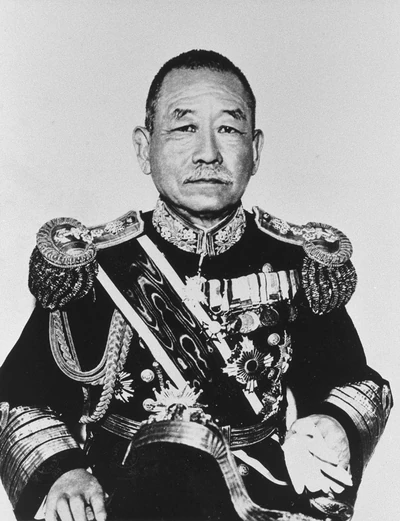
Keisuke Okada
| Name | Keisuke Okada |
| Title | admiral in the Imperial Japanese Navy (1868-1952) |
| Gender | Male |
| Birthday | 1868-02-14 |
| nationality | Japan |
| Source | https://www.wikidata.org/wiki/Q714951 |
| pptrace | View Family Tree |
| LastUpdate | 2025-11-17T10:08:45.869Z |
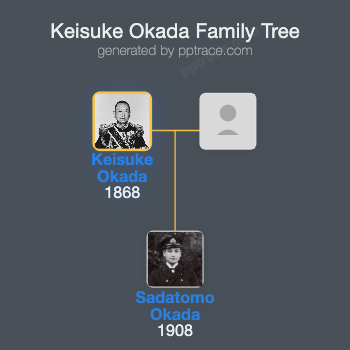
Family Tree
Tap  to expand more relatives
Introduction
Keisuke Okada (岡田 啓介, Okada Keisuke) was born on 20 January 1868 in Fukui Prefecture, Japan. He was the son of a samurai belonging to the Fukui Domain. Okada graduated from the 15th class of the Imperial Japanese Naval Academy in 1889, ranking seventh out of a class of eighty cadets.
Okada's early military career included service aboard the ironclad warship Kongō and the cruiser Naniwa as a midshipman. He was commissioned as an ensign on 9 July 1890. Subsequently, he served as lieutenant aboard the Itsukushima, Takachiho, and the corvette Hiei. During the First Sino-Japanese War, Okada served on the battleship Fuji. After graduating from the Naval Staff College, he served on the ships Shikishima and Yaeyama, occupying roles including executive officer. He was promoted to lieutenant on 9 December 1894, lieutenant commander on 29 September 1899, and commander on 13 July 1904.
During the Russo-Japanese War, Okada served as executive officer on vessels including the Chitose, Kasuga, and Asahi. He was promoted to captain on 25 September 1908 and assumed command of the cruiser Kasuga on 25 July 1910. He later transferred to the Kashima in 1912. Promoted to rear admiral on 1 December 1913, Okada held various desk jobs, notably in the Naval Shipbuilding Command. He was promoted to vice admiral on 1 December 1917 and to full admiral on 11 June 1924. In 1924, he became commander-in-chief of the Imperial Japanese Navy's Combined Fleet.
Okada served as Minister of Navy in the administrations of Prime Minister Tanaka Giichi from 1927 to 1929, and again under Prime Minister Saitō Makoto from 1932 to 1933. He was supportive of the London Naval Treaty of 1930, which aimed at naval arms reduction, and contributed to its negotiation and ratification. He entered the reserves on 21 January 1933 and retired from active service five years later.
In July 1934, Okada was appointed Prime Minister of Japan, holding office until 1936. During his premiership, he also served as Minister of Colonial Affairs. Briefly in September 1935, he held the portfolio of Minister of Post and Telecommunications. As a moderate politician opposing the rise of militarism, Okada was targeted by extremist military factions. He narrowly escaped death during the February 26 incident of 1936, after rebel troops killed Colonel Denzō Matsuo, who was Okada's brother-in-law and personal secretary, under mistaken identity. Okada went into hiding on 29 February 1936 but resigned several days later.
Following his tenure as Prime Minister, Okada maintained opposition to Japan’s involvement in war with the United States. During World War II, he formed a group of politicians and military officers advocating for an early end to hostilities with the Allies. After pivotal battles such as Midway and Guadalcanal, he pushed for negotiations with the Allied powers and played an active role in the overthrow of the Hideki Tōjō cabinet in 1944.
Keisuke Okada died on 7 October 1952. His remains are interred at Tama Cemetery in Fuchū, Tokyo. His honors include the Grand Cordon of the Order of the Rising Sun (1920), the Grand Cordon of the Order of the Paulownia Flowers (1933), and foreign awards such as the Knight's Cross and the Golden Cross of the War Order of Virtuti Militari from Poland. He was also awarded the Order of the Golden Kite, 3rd class, in 1915.