Miankai
| Name | Miankai |
| Title | Prince Duanhuai of the First Rank (1795-1838) |
| Gender | Male |
| Birthday | 1795-08-06 |
| nationality | Qing dynasty |
| Source | https://www.wikidata.org/wiki/Q7213242 |
| pptrace | View Family Tree |
| LastUpdate | 2025-10-27T02:30:50.633Z |
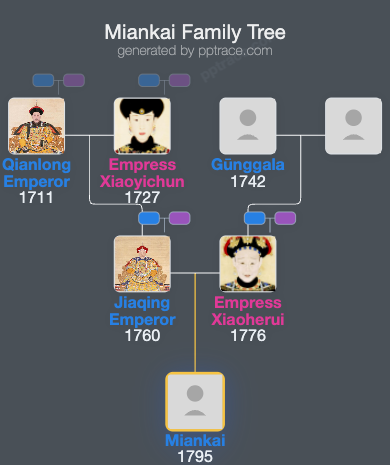
Family Tree
Tap  to expand more relatives
Introduction
Miankai (綿愷; 6 August 1795 – 18 January 1838) was a prince of the Qing Dynasty. He was the third son of the Jiaqing Emperor and was the first holder of the peerage Prince Dun of the First Rank. He was an elder brother of Mianxin, born from the same consort, Empress Xiaoherui.
Biographical details indicate that Miankai was born in August 1795 during the 60th year of Qianlong's reign. His father was Aisin Gioro Yongyan, known as Prince Jia of the First Rank, and his mother was Lady Niohuru, identified as a secondary consort. In 1813, during the eighteenth year of Jiaqing's reign, Miankai participated in the arrest of Cang Zhenmen alongside Mianmin. In 1823, he was appointed as the "Prince of the Second Rank" with the designation Dun; the following year, he was elevated to a prince of the first degree when Minning ascended the throne.
His personal conduct drew scrutiny in 1823 when his wife, Lady Niohuru, entered the palace through the central gate rather than through the lateral doorways. Miankai attempted to deny or evade the charge, resulting in a reprimand for insolence and the removal of several administrative posts. By 1826, he was appointed presiding controller of the Imperial Clan and was entrusted with oversight of various bureaus, including the Imperial Printing Press and the Summer Palace. In 1827, he assisted a eunuch hiding from the Imperial household; as a consequence, his offices were revoked.
Miankai was known for his interests in music and theater but showed little interest in study or archery. Despite his elder half-brother’s efforts to assign him important posts, Miankai's disinterest persisted. The Daoguang Emperor sanctioned a downgrade in his title to "Prince of the Second Rank." A subsequent reinstatement restored his title to "Prince of the First Rank" a year later. In 1836, he resumed the role of controller of the Imperial clan court. His conduct, however, remained unrestrained; he kept actors within his estate and often abused his princely privileges, including incarcerating individuals who offended him.
The Empress Dowager Gongci, his mother, intervened by ordering the release of the prisoners and the eviction of actors from Miankai’s estate. Nonetheless, he reinstated the actors after initial compliance. In 1838, an investigation by the Censorate uncovered over ninety prisoners held in his manor, alongside illicit actors. Both prisoners and actors were subsequently released. Following these events, Miankai was again demoted to "Prince of the Second Rank" and lost some privileges due to his conduct, though his title was posthumously restored after his death.
Miankai died in 1838, with no surviving sons to inherit his peerage. The Daoguang Emperor designated his son, Yicong, as the heir to Miankai's princedom.
Regarding his family, Miankai's primary consort was from the Niohuru clan (嫡福晋 钮祜禄氏), and they had a son, Yizuan (奕纘), born in 1818 and died in 1821. He also had secondary consorts, including one from the Gao clan (侧福晋 高佳氏) and another from the Niohuru clan.
Sources include the Draft History of Qing (Qing Shi Gao) by Zhao Erxun and "The Last Emperors: A Social History of Qing Imperial Institutions" by Evelyn S. Rawski.