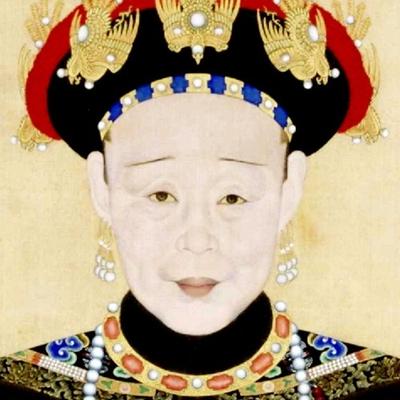
Empress Xiaoherui
| Name | Empress Xiaoherui |
| Title | Qing Dynasty empress (1776-1850) |
| Gender | Female |
| Birthday | 1776-11-20 |
| nationality | Qing dynasty |
| Source | https://www.wikidata.org/wiki/Q579490 |
| pptrace | View Family Tree |
| LastUpdate | 2025-10-27T03:40:31.953Z |
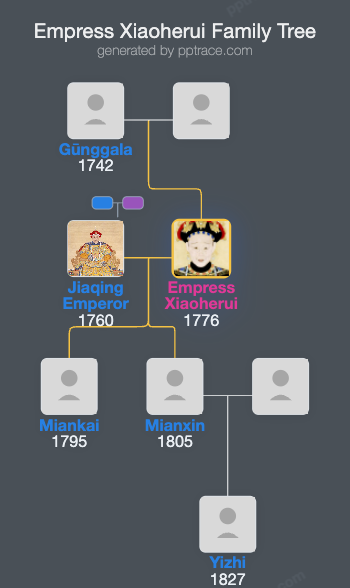
Family Tree
Tap  to expand more relatives
Introduction
Empress Xiaoherui (20 November 1776 – 23 January 1850) was a prominent figure in the Qing dynasty, originating from the Manchu Bordered Yellow Banner Niohuru clan. Her personal name has not been recorded in historical documents. She was the wife of Yongyan, who became the Jiaqing Emperor, and served as empress consort from 1801 until his death in 1820. Following her husband's death, she was honored as Empress Dowager Gongci during the reign of her step-son, the Daoguang Emperor. Her tenure as empress consort is noted as the longest in Qing history.
Family Background:
Her father was Gūnggala, who held several high-ranking government positions, including Minister of Works (1810–1811), Minister of War (1811–1812), and Minister of Rites (1804–1810, 1812–1813). He held the noble title of a first-class duke. Her paternal grandfather was Gongbao, and her paternal grandmother was Lady Nara. Her mother was Lady Yehe Nara. She had an elder brother, Ningwutai, and two younger brothers—Heshitai, who served as Minister of Works in 1819, and Jiluntai. Her younger sisters included the Primary Princess Consort Ruiqin of the First Rank, wife of Duan'en, and another sister whose name is not specified.
During the Qianlong era:
Born during the 41st year of Emperor Qianlong's reign (corresponding to 20 November 1776), she was designated as Lady Niohuru. In 1790, she became a secondary consort to Yongyan, the 15th son of Emperor Qianlong. She bore his seventh daughter in 1793, who died in 1795, and his third son, Miankai, on 6 August 1795.
Jiaqing era:
Following Emperor Qianlong’s abdication in favor of Yongyan on 9 February 1796, Yongyan ascended as the Jiaqing Emperor. Lady Niohuru was granted the title "Noble Consort" on 12 February 1796. After the death of the Empress Xiaoshurui in 1797, she was promoted to "Imperial Noble Consort" on 14 June 1797. The Emperor initially intended to make her his new empress but waited until mourning periods concluded. Her promotion to Empress occurred on 27 May 1801. As Empress, she was responsible for the upbringing of Minning, her stepson, and shared a harmonious relationship with him. She also bore the Emperor’s fourth son, Mianxin, on 9 March 1805.
Daoguang era:
After the death of the Jiaqing Emperor on 2 September 1820, she became Empress Dowager Gongci and played a key role in the imperial succession. She proclaimed Minning as emperor before an official edict was issued, leading to his accession as the Daoguang Emperor. The Daoguang Emperor expressed respect for her decision, noting her broad-mindedness. She resided in the Palace of Longevity and Health within the Forbidden City. Her 60th birthday was celebrated in 1836 with official honors, including a memorial from the Emperor and a court presentation of a scepter. In 1838, she and the Daoguang Emperor visited the Western Qing tombs. She passed away on 23 January 1850 and was posthumously granted the title "Empress Xiaoherui." She was buried in a tomb near the Chang Mausoleum of the Western Qing tombs.
Titles:
Throughout her life, she held various titles: from Lady Niohuru during the Qianlong era, to Secondary Consort in 1790, Noble Consort in 1796, Imperial Noble Consort in 1797, Empress in 1801, Empress Dowager Gongci in 1820, and posthumously Empress Xiaoherui in 1850.
Issue:
As a secondary consort, she bore the seventh daughter and the third son, Miankai. As Empress, she bore her fourth son, Mianxin.
In popular culture:
She has been portrayed in various television series and films, including "The Rise and Fall of Qing Dynasty" (1988), "War and Beauty" (2004), "Legend of Jiaqing" (2005), "Curse of the Royal Harem" (2011), and "Succession War" (2018).