Cornelia J. Randolph
| Name | Cornelia J. Randolph |
| Title | granddaughter of Thomas Jefferson (1799-1871) |
| Gender | Female |
| Birthday | 1799-01-01 |
| nationality | — |
| Source | https://www.wikidata.org/wiki/Q60536111 |
| pptrace | View Family Tree |
| LastUpdate | 2025-11-16T10:01:58.951Z |
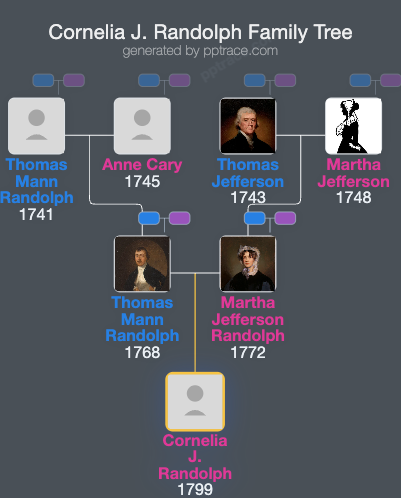
Family Tree
Tap  to expand more relatives
Introduction
Cornelia Jefferson Randolph was born on July 26, 1799, at Monticello, Virginia. She was the daughter of Martha Jefferson Randolph, often referred to as Acting First Lady, and Thomas Mann Randolph Jr., who served as Governor of Virginia. As a granddaughter of Thomas Jefferson, the third President of the United States, she was part of the Jefferson family lineage.
From an early age, Randolph received education and mentorship from her grandfather, Thomas Jefferson. Jefferson communicated with her through letters, often including poems he had cut from newspapers and magazines, indicating an early engagement with literature and arts. As she grew older, Jefferson personally instructed her in architectural drawing. Her skill in this area is evidenced by existing architectural renderings of the University of Virginia, a university designed by Jefferson himself. In addition to architecture, Randolph also learned painting and sculpture.
In 1817, Jefferson remarked on Randolph and her sister Ellen’s diligence as students, describing them as "the severest students I have ever met with," and noted their limited leisure time, often spent on evenings outdoors. Randolph was characterized by a reserved nature, showing disdain for superficial courtship rituals, and she did not marry. She resided at Monticello and later at Edge Hill, the estate of her brother Thomas Jefferson Randolph.
By 1825, Randolph expressed dissatisfaction with her domestic roles in correspondence with her sister, lamenting her wish to support herself independently rather than continue with what she described as "unprofitable drudgery of keeping house." Societal expectations during that period limited her ability to fully employ her talents. However, after Thomas Jefferson's death, she and other family members operated a school at Edge Hill, providing educational services.
Randolph contributed to horticultural literature by translating and editing the work titled "The Parlor Gardener: A Treatise on the House Culture of Ornamental Plants," which was published in 1861. The book was a translation from French and adapted for American use, reflecting her interest and knowledge in botanical cultivation and domestic gardening.
Following the American Civil War, Randolph relocated to Alexandria, Virginia, to live with her niece, Martha Jefferson Trist Burke. She died there on February 24, 1871. In recognition of her heritage and contributions, a terra-cotta bust of Cornelia Randolph by the sculptor William Coffee is housed in the South Square Room of Monticello.