Nicholas Trist
| Name | Nicholas Trist |
| Title | American diplomat (1800-1874) |
| Gender | Male |
| Birthday | 1800-06-02 |
| nationality | United States of America |
| Source | https://www.wikidata.org/wiki/Q1985012 |
| pptrace | View Family Tree |
| LastUpdate | 2025-11-29T01:00:05.464Z |
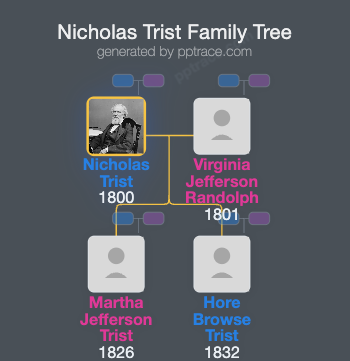
Family Tree
Tap  to expand more relatives
Introduction
Nicholas Philip Trist was born on June 2, 1800, in Charlottesville, Virginia. He was the son of Hore Browse Trist, a lawyer, and Mary Brown. His paternal grandfather was of English origin, and his maternal grandmother, Elizabeth House Trist, was acquainted with Thomas Jefferson. Trist initially attended the United States Military Academy at West Point but did not graduate. Subsequently, he studied law under Thomas Jefferson and served as Jefferson's personal secretary during the 1820s. He also became an executor of Jefferson's estate.
On September 11, 1824, Trist married Virginia Jefferson Randolph, the granddaughter of Thomas Jefferson. The couple had three children: Martha Jefferson Trist Burke (1826–1915), Thomas Jefferson Trist (1828–1890), and Hore Browse Trist (1832–1896).
From 1828 to 1832, Trist worked as a clerk in the U.S. State Department. In 1831, he served a year as a private secretary to President Andrew Jackson, whom he admired. During this period, Trist acted as a communication conduit for James Madison to President Jackson.
In 1833, Trist was appointed by President Jackson as the U.S. consul in Havana, Cuba, a Spanish territory at the time, a position he held until 1841. Shortly after arriving in Havana in 1833, Trist invested in a sugar plantation that later failed. His pro-slavery views were publicly known, and British sources later accused him of involvement in creating false documents to cover illegal slave sales from Africa, which was part of the broader illegal slave trade. Trist also served as consul for Portugal during his tenure in Cuba, and his activities drew criticism from New England ship captains, who believed he prioritized relations with Cuban officials over their interests.
By late 1838 or early 1839, British commissioner Richard Robert Madden accused Trist of misuse of his consulship for personal gain and promoting slavery through fraudulent documentation schemes. Madden's reports, coupled with ship captains' complaints, led to congressional investigations and Trist's recall in 1840. Madden testified before U.S. courts regarding the illegal slave trade and false documents used in Cuba. No depiction of Madden or Trist appears in the 1997 film "Amistad," despite a scene suggesting the illegal slave trade.
In 1845, Trist returned to the United States and was appointed as a chief clerk at the State Department by President James K. Polk. During the Mexican–American War in 1847, President Polk sent Trist to negotiate peace with Mexico. Trist was instructed to arrange an armistice and to attempt to acquire additional territories, including Baja California and southern regions, with a proposed restitution of up to $30 million. However, if these territories could not be obtained, the offer was to be reduced to $20 million.
Trist proceeded with negotiations independently of Polk's direct orders, later advocating for a smaller cession of territory and conducting negotiations with Mexican General Santa Anna. On February 2, 1848, he successfully negotiated the Treaty of Guadalupe Hidalgo, which ended the Mexican–American War. The treaty resulted in the transfer of large territories to the United States, including present-day California, Nevada, Utah, and parts of several other states. The treaty line was drawn from Yuma to Tijuana/San Diego, excluding Baja California from U.S. territory. Polk was displeased with Trist's conduct for ignoring specific instructions, but he ultimately approved the treaty.
Following the treaty, Trist was dismissed from his position for insubordination, and his expenses incurred during the negotiations were not paid initially. He moved to West Chester, Pennsylvania, and later Philadelphia, working as a railroad clerk and paymaster. In 1871, he recovered his expenses at the urging of Senator Charles Sumner. Politically, Trist supported Abraham Lincoln in the 1860 presidential election. During the Grant administration, he served as postmaster of Alexandria, Virginia. Nicholas Philip Trist died in Alexandria on February 11, 1874, at the age of 73.