Lord William Manners
| Name | Lord William Manners |
| Title | British politician |
| Gender | Male |
| Birthday | 1697-11-13 |
| nationality | — |
| Source | https://www.wikidata.org/wiki/Q6680028 |
| pptrace | View Family Tree |
| LastUpdate | 2025-11-26T12:20:36.979Z |
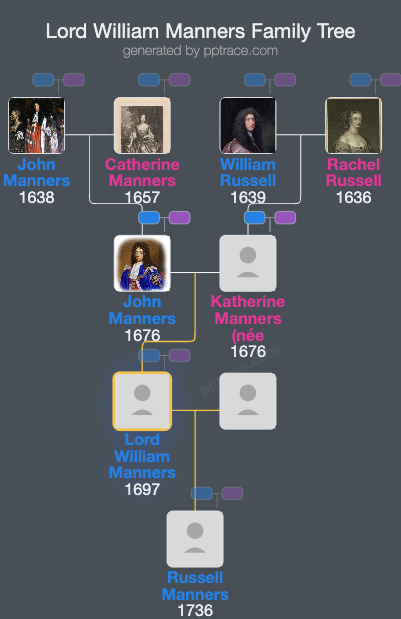
Family Tree
Tap  to expand more relatives
Introduction
William Manners was born on 13 November 1697 and died on 23 April 1772. He was associated with Croxton Park in Leicestershire and was an English nobleman and politician aligned with the Whig party. Manners served in the House of Commons during multiple periods from 1719 to 1754.
He was the second son of John Manners, the 2nd Duke of Rutland, and his first wife, Catherine Russell. His siblings included John, Robert, and Sherard Manners, all of whom also served as Members of Parliament.
Manners' parliamentary career began with his election as MP for Leicestershire in a contested by-election held on 7 December 1719. He was returned unopposed for the same constituency in the 1722 general election. Around that time, he was appointed as a Gentleman of the Bedchamber to the Prince of Wales. Following the accession of King George II in 1727, Manners became Lord of the Bedchamber to the King and was returned unopposed in the 1727 general election. Throughout this period, he consistently voted with the Administration on all recorded occasions. He did not stand for election in 1734, which disappointed his supporters, and he resigned his court office in 1738.
Subsequently, Manners was elected as MP for Newark in a by-election on 31 January 1738, supported by his brother John Manners, the 3rd Duke of Rutland. His political stance shifted towards opposition, and he voted against the Spanish convention in 1739 and the place bill in 1740. However, he supported the government on the motion for the dismissal of Sir Robert Walpole in February 1741, and he was re-elected at the 1741 general election. Despite being offered a position on the Treasury Board in 1743 by Henry Pelham, a family relative and politician, Manners declined the post. He continued to serve as MP for Newark, being re-elected in 1747, often aligning with opposition parties and supporting Prince Frederick, the Prince of Wales. Manners decided not to run in the 1754 general election, and his son John succeeded him.
Apart from his political career, Manners was known for his success in gambling, accumulating a considerable private fortune through gaming activities. He is reputed to have won 1,200 guineas in a single evening during New Year celebrations in 1728. He is believed to have been depicted in the gambling scene of William Hogarth’s painting "The Rake’s Progress." Manners also maintained large racing studs and was involved with the Belvoir foxhounds.
He died in 1772 due to a riding accident.
Manners never married but had ten children with Corbetta Smyth, who was his mistress. Corbetta was the daughter of William Smyth, an apothecary from Shrewsbury. Their children included:
- Corbetta Manners (1728–before 1753), who eloped with Captain George Lawson Hall. Their daughter was Corbetta Hall, who was a beneficiary in her grandmother’s will.
- John Manners (1730–1792), a politician who married Louisa Tollemache, the 7th Countess of Dysart, and had children.
- Rev. Thomas Manners (1731–1812), who was married twice, first to Susannah Buckland and then posthumously to another woman.
- William Manners (1734–1827), who married Frances Whichcote and had descendants.
- Robert Manners (born 1740), who died young.
- Caroline Manners (1741–1800), married Jeremiah Ellis.
- Robert Manners (1743–1810), married Elizabeth White, with whom he had children, including Rear Admiral Sir Errol Manners (1883–1953).
Speculation by David Drew-Smythe suggests that Manners and Smyth did not marry due to inheritance clauses that restricted marriage, which might have influenced their decision to maintain a long-term unmarried relationship while recognizing all their children.