George Washington
| Name | George Washington |
| Title | president of the United States from 1789 to 1797 |
| Gender | Male |
| Birthday | 1732-02-22 |
| nationality | Great Britain |
| Source | https://www.wikidata.org/wiki/Q23 |
| pptrace | View Family Tree |
| LastUpdate | 2025-11-29T00:59:37.981Z |
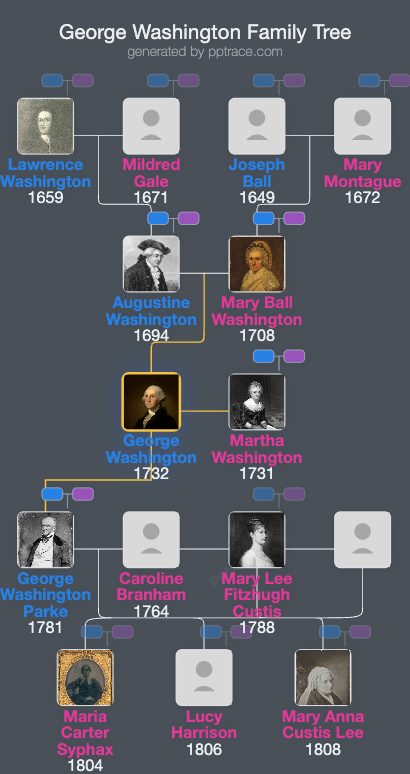
Family Tree
Tap  to expand more relatives
Introduction
George Washington was born on February 22, 1732 (Old Style calendar: February 11, 1731), at Popes Creek in Westmoreland County, Virginia. He was the first child of Augustine Washington and Mary Ball Washington. His father was a justice of the peace and a prominent landholder, and he had five siblings. Washington's early childhood included a move to a plantation on Little Hunting Creek in 1735, followed by a settlement at Ferry Farm near Fredericksburg, Virginia, in 1738. Upon his father's death in 1743, Washington inherited Ferry Farm and ten slaves, while his half-brother Lawrence inherited Little Hunting Creek, which he renamed Mount Vernon.
Educational opportunities for Washington were limited compared to his older half-brothers; instead of formal schooling abroad, he attended the Lower Church School in Hartfield, Virginia. He developed skills in mathematics, land surveying, and mapmaking during his youth. Among his early influences was William Fairfax, whose plantation in Belvoir served as a mentoring site for Washington and with whom he spent significant time, including survey work in the Shenandoah Valley. By 1748, Washington received a surveyor’s license, and in 1749, he was appointed surveyor of Culpeper County, Virginia. By 1752, he had amassed nearly 1,500 acres in the Shenandoah Valley.
In 1751, Washington traveled to Barbados with his brother Lawrence, seeking treatment for Lawrence's tuberculosis; during this trip, Washington contracted smallpox, which left facial scars. Lawrence died in 1752, and Washington leased Mount Vernon from his widow, Ann, ultimately inheriting it outright after her death in 1761.
Washington's military career began in the colonial militia. Inspired by his brother Lawrence's service, he was appointed major and militia commander by Virginia authorities. During this period, Britain and France competed for control of the Ohio River Valley. In 1753, Governor Robert Dinwiddie sent Washington as a special envoy to demand French withdrawal from disputed territory and to gather intelligence on French forces. Washington's diplomatic mission included contact with the Iroquois Confederacy, and he was given the nickname "Conotocaurius," meaning "devourer of villages," a name originating from his ancestor John Washington.
In 1754, Washington was promoted to lieutenant colonel and second-in-command of the Virginia Regiment. His first combat experience occurred during the French and Indian War, including the Battle of Great Meadows and the surrender at Fort Necessity after an engagement with French forces. The incident at Fort Necessity and the death of Jumonville, a French diplomat, contributed to the escalation of the war. Washington participated in subsequent military campaigns, including serving as an aide to General Edward Braddock during the British expedition against French-held territory.
Following his early military career, Washington continued to serve in Virginia's colonial government, including being elected to the Virginia House of Burgesses. His involvement in leadership during the colonial resistance against British policies grew, culminating in his role as commander-in-chief of the Continental Army during the American Revolutionary War, beginning in 1775.
In 1787, Washington presided over the Constitutional Convention that drafted the United States Constitution. Subsequently, he was unanimously elected as the first President of the United States in 1788 and re-elected in 1792. His presidency lasted from 1789 to 1797. During his tenure, Washington established many presidential precedents, including the peaceful transfer of power and the use of the title "Mr. President." He maintained a policy of neutrality during European conflicts, such as the French Revolution, and supported the Jay Treaty with Britain.
Washington's farewell address in 1796 emphasized national unity and warned against internal divisions and foreign entanglements. His recommendations and decisions helped shape the early political landscape of the United States.
Throughout his life, Washington was a planter at Mount Vernon, owning numerous slaves. Late in life, he began to oppose slavery and arranged in his will for the eventual manumission of his slaves.
George Washington died on December 14, 1799. His legacy as a leader of the American Revolution and the first U.S. president remains central to American historical memory, and his image has been widely memorialized. Several places, including the U.S. capital and the state of Washington, are named in his honor.