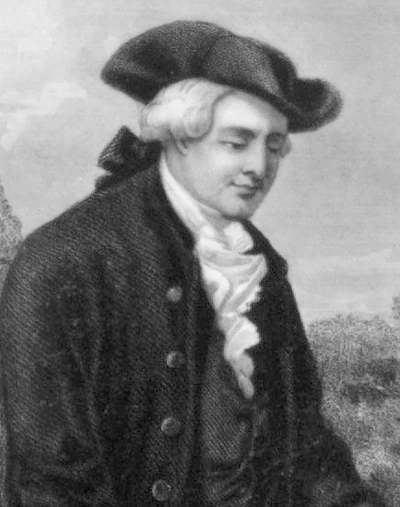
Augustine Washington
| Name | Augustine Washington |
| Title | (1694-1743) British-American planter, slave owner, and the father of George Washington |
| Gender | Male |
| Birthday | 1694-11-12 |
| nationality | Q258532 |
| Source | https://www.wikidata.org/wiki/Q768342 |
| pptrace | View Family Tree |
| LastUpdate | 2025-11-17T06:36:31.864Z |
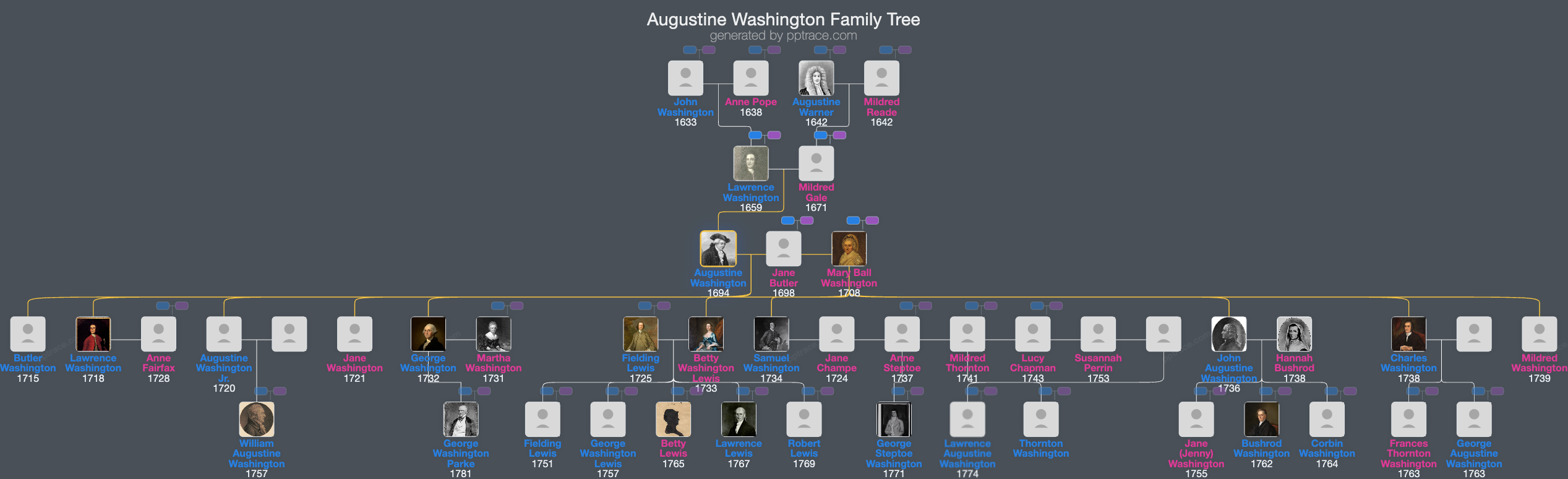
Family Tree
Tap  to expand more relatives
Introduction
Augustine Washington Sr. (1694 – April 12, 1743) was an American planter and merchant active in the British colony of Virginia during the early 18th century. He was born in Westmoreland County, Virginia, to Mildred Warner and Captain Lawrence Washington, a militia captain and member of the Virginia House of Burgesses. His paternal grandparents were Lt. Col. John Washington and Anne Pope, and his maternal grandparents owned Warner Hall and associated plantations in Gloucester County.
Following the death of his father in 1698, Washington's family experienced a transfer of residence to England due to his mother's remarriage. She died when Washington was still young. Their cousin, John Washington, contested the guardianship and brought the children back to Virginia. Augustine Washington came into his inheritance in 1715, at which point he was approximately 21 years old.
In 1715, Washington married Jane Butler, an orphan heiress with a landholding of approximately 640 acres inherited from her father, Caleb Butler. The couple established residence on the Bridges Creek property in Westmoreland County and had four children, two of whom—Lawrence Washington and Augustine Washington Jr.—survived childhood. Jane Butler died in late 1728 or early 1729. In 1731, Washington married Mary Ball, with whom he had five children who survived to adulthood: George Washington, Elizabeth Washington, Samuel Washington, John Augustine Washington, and Charles Washington; a daughter named Mildred died in infancy.
Throughout his career, Augustine Washington inherited approximately 1,000 acres on Bridges Creek, as well as additional land holdings, including property owned by his sister Mildred and land purchased on Pope's Creek in 1718. He owned enslaved people, deriving wealth from several slave plantations. Between 1723 and 1735, he employed a contractor to build a house known as Wakefield, completed around 1726 after the contractor's death. He also engaged in land and industrial ventures, including an agreement with the Principio Company of England in 1725 to establish ironworks on Accokeek Creek in Stafford County, and he owned a stake in Maryland ironworks.
In 1738, Augustine Washington purchased the Strother property, a 150-acre tract across the Rappahannock River, which he moved his family to at the year's end. He was an active participant in community affairs, serving as justice of the peace for Westmoreland County in July 1716 and fulfilling roles such as county sheriff. He was also involved in the Anglican Church and local militia.
Washington died on April 12, 1743. His son George inherited the Strother property, which was later named Mount Vernon, while his son Lawrence inherited the Little Hunting Creek property, which he renamed Mount Vernon to honor Admiral Edward Vernon. His estate included enslaved individuals, totaling 64 at his death.
According to his will, if Lawrence Washington died childless, the Little Hunting Creek property would pass to Augustine Washington Jr., who in turn would relinquish the Pope's Creek property to George Washington. Lawrence's only surviving child, Sarah, lived until 1754, after which George Washington ultimately inherited the property known as Mount Vernon. After Augustine Washington's death, the family properties remained central to the Washington family's estate, and his descendants continued to manage the land and enslaved people according to the legal arrangements established during his lifetime.