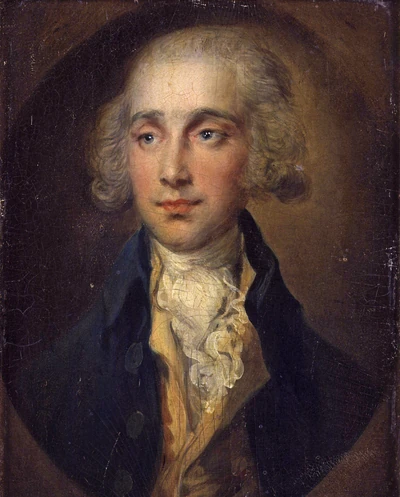
James Maitland, 8th Earl Of Lauderdale
| Name | James Maitland, 8th Earl Of Lauderdale |
| Title | British diplomat (1759-1839) |
| Gender | Male |
| Birthday | 1759-01-26 |
| nationality | Great Britain |
| Source | https://www.wikidata.org/wiki/Q333300 |
| pptrace | View Family Tree |
| LastUpdate | 2025-11-26T23:31:12.503Z |
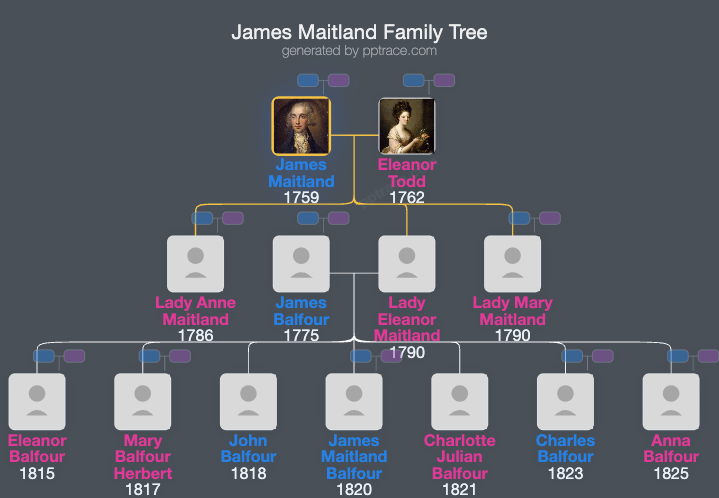
Family Tree
Tap  to expand more relatives
Introduction
James Maitland, 8th Earl of Lauderdale (26 January 1759 – 10 September 1839), was a Scottish nobleman who held the title of Earl of Lauderdale. He served as Keeper of the Great Seal of Scotland and as a Scottish representative peer in the House of Lords. Additionally, he was a writer on political economy.
Born at Haltoun House near Ratho, he was the eldest son of James Maitland, 7th Earl of Lauderdale. He succeeded to the earldom in 1789. Maitland was educated by Dr. Andrew Dalzell and attended the universities of Edinburgh and Glasgow. He completed his education in Paris, where it is said he developed radical political views.
In 1780, Maitland was admitted to the Faculty of Advocates. His father financed his entry into Parliament by paying £3,000. From 1780 to 1784, he represented Newport in the House of Commons, and from 1784 to 1789, he served as Member of Parliament for Malmesbury. During his time in the Commons, he supported Charles James Fox, a prominent Whig politician, and participated actively in debates, including as a manager of the impeachment of Warren Hastings.
In 1789, Maitland transitioned to the House of Lords as a Scottish representative peer. He became known for his opposition to the policies of William Pitt the Younger and the British government concerning France. He was a vocal opponent of the Habeas Corpus Suspension Act and the Sedition Bill, and he frequently spoke on parliamentary issues. During the French Revolution, Maitland appeared in the House of Lords dressed in the rough costume associated with Jacobinism, reflecting his sympathies.
In July 1792, Maitland fought a bloodless duel with Benedict Arnold after questioning Arnold's honor in the House of Lords. In the same year, Maitland traveled to France with John Moore. He arrived in Paris shortly before the attack on the Tuileries Palace and the imprisonment of King Louis XVI. Following the September massacres, Maitland left Paris on 4 September 1792, returning in October. He published a journal describing his experiences in France from August to December 1792, and was known as "Citizen Maitland." He was involved in the founding of the British Society of the Friends of the People in 1792.
In 1806, during the formation of the Grenville administration, Maitland was elevated to the peerage as Baron Lauderdale of Thirlestane and was sworn into the Privy Council. For a brief period from July 1806, he served as Keeper of the Great Seal of Scotland. On 2 August 1806, Maitland traveled to France with full powers to negotiate peace with Napoleon Bonaparte and Talleyrand, a mission he undertook independently after the recall of Lord Yarmouth. The negotiations occurred amidst the context of ongoing hostilities, including the Battle of Copenhagen (1807). According to Eugène François Vidocq, Maitland was nearly lynched by French nationals in Boulogne during this period but was rescued by Vidocq himself.
Following renewed hostilities, Maitland left Paris for London on 9 October 1806. His diplomatic efforts were documented in the London Gazette. He was appointed a Privy Counsellor in 1806 and received the Order of the Thistle in 1821. He was initially a leading figure for the Whigs in Scotland but shifted to a Tory stance in 1821, opposing the Reform Bill of 1832.
The Maitland family held the hereditary title of Bearer for the Sovereign of the Standard of Scotland, a right established in 1672 and retained until 1910. Maitland formally matriculated arms as Hereditary Bearer for both the Standard of Scotland and the National Flag of Scotland in 1790. In 1952, the Queen was advised to confirm this hereditary right.
As a scholar, Maitland authored "Inquiry into the Nature and Origin of Public Wealth" in 1804 and 1819. The work introduced the concept later known as the "Lauderdale Paradox," which posits an inverse relationship between public and private wealth. His other notable publications include "The Depreciation of the Paper-currency of Great Britain Proved" (1812). His writings highlighted early considerations of fiscal policy effects on economic expansion and contraction, influencing later Keynesian economic theories.
James Maitland, 8th Earl of Lauderdale, died at Thirlestane Castle near Lauder, Berwickshire, at age 80. He is buried in the Maitland vault at St Mary's Collegiate Church, Haddington.
He married Eleanor Todd, daughter of Anthony Todd, in 1782. They had ten children, including James Maitland, 9th Earl of Lauderdale, and Anthony Maitland, 10th Earl of Lauderdale. His descendants include figures such as Prime Minister Arthur Balfour, who was a grandson of his daughter Lady Eleanor.