Charles Chetwynd-Talbot, 2nd Earl Talbot
| Name | Charles Chetwynd-Talbot, 2nd Earl Talbot |
| Title | British politician (1777-1849) |
| Gender | Male |
| Birthday | 1777-04-25 |
| nationality | United Kingdom of Great Britain and Ireland |
| Source | https://www.wikidata.org/wiki/Q93594 |
| pptrace | View Family Tree |
| LastUpdate | 2025-11-26T23:29:29.683Z |
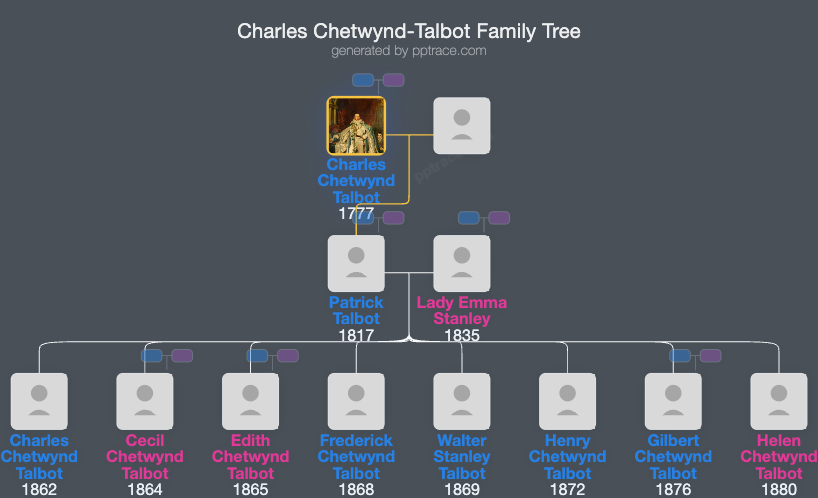
Family Tree
Tap  to expand more relatives
Introduction
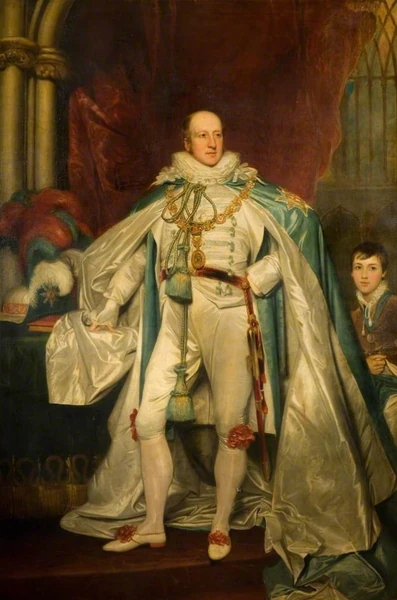
Charles Chetwynd Chetwynd-Talbot, 2nd Earl Talbot (25 April 1777 – 10 January 1849), was an English peer and politician. He was born as Charles Talbot, the eldest son of John Talbot of Ingestre Hall and Lady Charlotte Hill, daughter of Wills Hill, 1st Marquess of Downshire. In 1784, upon his father's elevation to Earl Talbot and Viscount of Ingestre, he adopted the courtesy title Viscount of Ingestre. In 1786, his father added Chetwynd to the family name.
He inherited his father's earldom and the Ingestre estate in 1793. He matriculated at Christ Church, Oxford, in 1794, earning a Master of Arts degree in 1797. Around 1810, he commissioned the architect John Nash for renovation works at Ingestre.
Following his education, Lord Talbot joined the British embassy in Russia under Lord Whitworth, forming a lasting friendship with him. In 1803, he organized a volunteer force in Staffordshire to oppose a potential invasion by Napoleon Bonaparte. He was appointed Lord Lieutenant of Staffordshire in 1812, a position he held until his death. In 1813, he was elected a Fellow of the Royal Society.
In 1817, Talbot was appointed Lord Lieutenant of Ireland and became a member of the Privy Council. During his tenure in Ireland, he was awarded the Freedom of Drogheda and was made a Knight of St Patrick in 1821, coinciding with King George IV's visit. Although he opposed Catholic emancipation, some contemporaries such as Daniel O'Connell acknowledged his impartiality. Despite this, political pressures led to his replacement by Lord Wellesley in December 1821. The street named Lord Talbot Street in Dublin commemorates him and was named in 1821.
In 1833, he was encouraged to stand for the chancellorship of Oxford University but withdrew out of respect for the Duke of Wellington. In 1839, he received a testimonial of £1400 for his service as Lord Lieutenant of Staffordshire, which he used to fund the construction of a church at Salt, Staffordshire. He was a supporter of Sir Robert Peel and in 1844 was appointed a Knight of the Garter, substituting his previous knighthood in the Order of St Patrick, on Peel's recommendation.
Lord Talbot supported the repeal of the Corn Laws and was among the first peers to do so. He contributed land at Hixon for the parish church in 1846 and oversaw the rebuilding of the Red Lion Public House at Brereton in 1847. In the context of the Slave Compensation Act 1837, he received compensation as the executor of Sir Rose Price, whose estate included slave plantations in Saint John Parish, Jamaica.
He married Frances Thomasine, daughter of Charles Lambart, in 1800. The marriage produced eleven surviving children, including his heir, Henry John, styled Viscount Ingestre, who later became the 3rd Earl Talbot and 18th Earl of Shrewsbury. Lady Talbot died in December 1819, shortly after the birth of their youngest child.
Charles Chetwynd Chetwynd-Talbot died at Ingestre Hall in January 1849 at the age of 71. He was succeeded by his eldest surviving son, Henry.