Peng Dehuai
| Name | Peng Dehuai |
| Title | Chinese military leader, Marshal of the People's Republic of China |
| Gender | Male |
| Birthday | 1898-10-24 |
| nationality | Qing dynasty |
| Source | https://www.wikidata.org/wiki/Q381823 |
| pptrace | View Family Tree |
| LastUpdate | 2025-10-01T07:42:30.437Z |
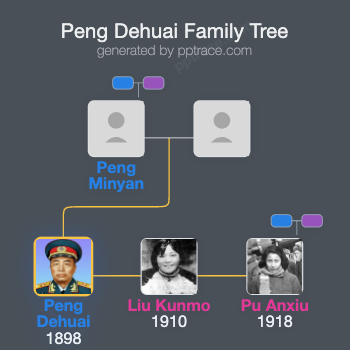
Family Tree
Tap  to expand more relatives
Introduction
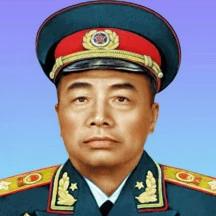
Peng Dehuai (October 24, 1898 – November 29, 1974), was a native of Wushi Village, Wushi Town, Xiangtan County, Hunan Province. He was an important military and political leader of the Chinese Communist Party and the People's Republic of China. Born into a poor family, he attended school for two years in his childhood but later dropped out to farm and work in coal mines due to financial hardship. At the age of fifteen, he participated in a hunger strike protest by impoverished people and was wanted by the authorities; he then escaped to Dongting Lake to work on dike repairs.
In 1916, he joined the Hunan Army. Through his military service, Peng Dehuai gradually recognized the dangers of imperialist invasion and the dark rule of warlords, which inspired him to think about strengthening the country through military development. In 1919, he secretly organized the “Rescue the Poor Society” within his unit; he was arrested after members of the organization killed a tyrant but successfully escaped during transportation. In 1922, he changed his name to Peng Dehuai and was admitted to the Hunan Military Officers’ War College. After graduation, he served as a platoon leader, company commander, and battalion commander in the Hunan Army.
In 1926, he was transferred to the National Revolutionary Army, participating in the Northern Expedition, and met Communist Party member Duan Dechang, beginning to accept communist ideas. In January 1927, he established a soldiers’ committee in his unit, opposing imperialism, warlords, and feudal forces, and defending soldiers’ rights. In 1928, he was promoted to regimental commander and joined the Chinese Communist Party during the period of the Great Revolution's collapse in April of that year. The following year, July 1929, he took part in the Pingjiang Uprising, and helped to establish the Chinese Workers’ and Peasants’ Red Army’s 5th Army, serving as its commander and as commander of the 13th Division, leading his troops to establish revolutionary base areas along the Hunan-Hubei-Jiangxi border and linking up with the Red Army leaders Mao Zedong and Zhu De.
Later, he played a key role in several campaigns against the “Encirclement and Suppression” campaigns. In 1934, he participated in the Long March, supporting Mao Zedong’s leadership, and pushed for strategic military shifts at the Zunyi Conference. In 1935, leading his forces north, he defeated enemy forces and achieved the first victory of the Zunyi Long March, participating in many major battles. During the Anti-Japanese War, Peng Dehuai served as the deputy commander of the Eighth Route Army, leading the guerrilla resistance behind Japanese and puppet forces, jointly commanding with Zhu De to strike at Japanese and collaborationist forces and to expand the Anti-Japanese base areas. In 1940, he launched the Hundred Regiments Campaign in North China, significantly damaging Japanese and puppet army transportation lines.
During the Liberation War, Peng Dehuai commanded the Northwest Field Army, utilizing the “Mushroom Tactic” to effectively resist enemy attacks, gradually recapturing lost territories. By 1948, he had reclaimed Yan'an. After the founding of the People's Republic of China in 1949, he served as the First Secretary of the Northwest Bureau and as Commander of the Military Region in Northwest China. Following the establishment of New China, he was Vice Chairman of the People's Revolutionary Military Committee of the Central People's Government and promoted the modernization of the military. In 1950, he was appointed Commander of the Chinese People's Volunteer Army, leading the volunteer forces to victory in the Korean War.
Subsequently, Peng Dehuai held positions such as Vice Premier of the State Council and Minister of National Defense. He actively promoted the regularization and modernization of the People's Liberation Army, and was awarded numerous honors including Marshal of the People's Republic of China, the First Class August 1 Medal, First Class Liberation Medal, and First Class Independence and Freedom Medal. In 1959, he was dismissed from his posts following the criticism movement during the Lushan Conference. During the Cultural Revolution, he was persecuted until his death in 1974. In 1978, he was posthumously rehabilitated and given honorable recognition.
Throughout his life, Peng Dehuai remained loyal to the Party and the people, demonstrated outstanding military leadership, maintained a strict working style, and cared deeply for the masses. He is regarded as one of the outstanding leaders of the Chinese People's Liberation Army. His legacy is preserved through his former residence, memorial halls, and other commemorative sites, and he remains a significant figure in Chinese revolutionary history.