Richard Boyle, 3rd Earl Of Burlington
| Name | Richard Boyle, 3rd Earl Of Burlington |
| Title | English noble (1694-1753) |
| Gender | Male |
| Birthday | 1694-04-25 |
| nationality | Great Britain |
| Source | https://www.wikidata.org/wiki/Q555723 |
| pptrace | View Family Tree |
| LastUpdate | 2025-11-26T23:22:19.102Z |
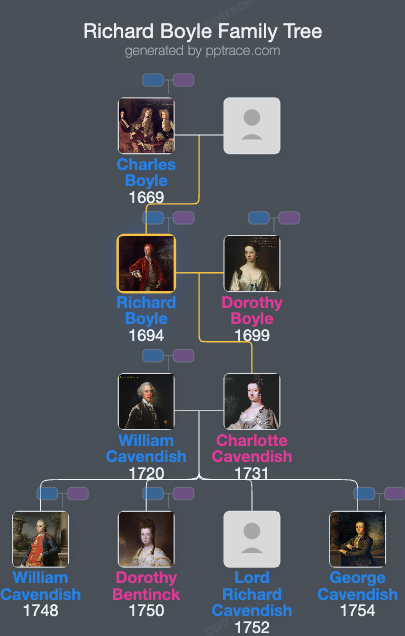
Family Tree
Tap  to expand more relatives
Introduction
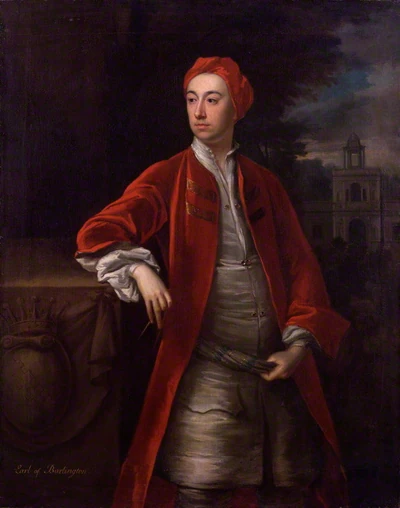
Richard Boyle, 3rd Earl of Burlington (25 April 1694 – 4 December 1753), was a British aristocrat known for his contributions to architecture and landscaping. He was the son of Charles Boyle, 2nd Earl of Burlington, and Juliana Boyle (née Noel). Boyle inherited his titles and estates in Yorkshire and Ireland in 1704 following his father's death when he was nine years old. His mother managed his interests during his minority until 1715.
He was born in Yorkshire into an affluent Anglo-Irish family. His education included extensive travel, with three foreign Grand Tours between 1714 and 1719 and a trip to Paris in 1726, which facilitated the development of his architectural tastes. Boyle displayed early musical interests, and composer Georg Frideric Handel dedicated two operas, "Teseo" and "Amadigi di Gaula," to him during his residence at Burlington House. Francesco Barsanti also dedicated his Op. 1 recorder sonatas to Boyle, likely on the edition sold by Peter Bressan around 1727.
Boyle's influence in architecture was bolstered by his travels and study of Palladian architecture. During his 1719 tour of the Veneto, he carried a copy of Andrea Palladio's "I quattro libri dell'architettura" and made notes, developing a passion for Palladian design. He was a key subscriber to the Royal Academy of Music in 1719, which produced baroque opera.
His first architectural project was Burlington House in London, where he replaced baroque architect James Gibbs with Scottish architect Colen Campbell and engaged William Kent for interior design. The building's courtyard front in Piccadilly became a prominent statement of Neo-Palladianism. In the 1720s, Burlington collaborated with Campbell but later worked with other architects, including Henry Flitcroft, Daniel Garrett, and various draughtsmen.
Burlington relied on Palladio and Scamozzi for inspiration, as he did not conduct personal site inspections of Roman ruins. His drawings included reconstructions of Vitruvius' Roman buildings, intending to publish his findings. His collection of drawings and designs, some inherited by his son-in-law William Cavendish, 4th Duke of Devonshire, are preserved at Chatsworth House.
In 1723, he adapted Palladio-inspired designs for the house of General Wade on Old Burlington Street, London, which appeared in "Vitruvius Britannicus." His influence extended through various completed projects, including Westminster School's Dormitory (1722–1730), Chiswick House (constructed 1727–1729), and Sevenoaks School (1730). Chiswick House is regarded as one of the finest examples of Neo-Palladian architecture in Europe.
Other projects included Tottenham House in Wiltshire, Waldershare Park in Kent, and the York Assembly Rooms. Burlington also designed ornamental buildings in gardens and parks, such as the Belvedere Tower at Waldershare Park. His architectural contributions often involved collaboration, with some ideas credited to other architects who worked under his patronage.
In his personal life, Richard Boyle married Lady Dorothy Savile on 21 March 1720, daughter of William Savile, 2nd Marquess of Halifax, and Lady Mary Finch. Lady Dorothy's ancestry includes connections to the Earls of Nottingham and Warwick.
He was involved in philanthropic activities, such as being a governor of the Foundling Hospital, established in 1739 and completed in 1742, although he did not participate directly in its design. His architectural drawings, which provide significant insights into 18th-century Palladianism, were preserved and studied after his death.