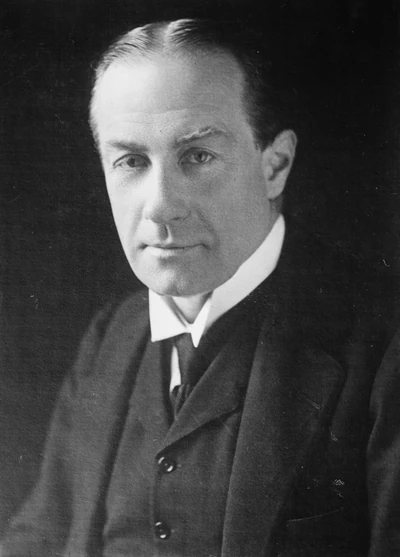
Stanley Baldwin
| Name | Stanley Baldwin |
| Title | British statesman (1867–1947) |
| Gender | Male |
| Birthday | 1867-08-03 |
| nationality | United Kingdom |
| Source | https://www.wikidata.org/wiki/Q166635 |
| pptrace | View Family Tree |
| LastUpdate | 2025-11-26T23:31:57.947Z |
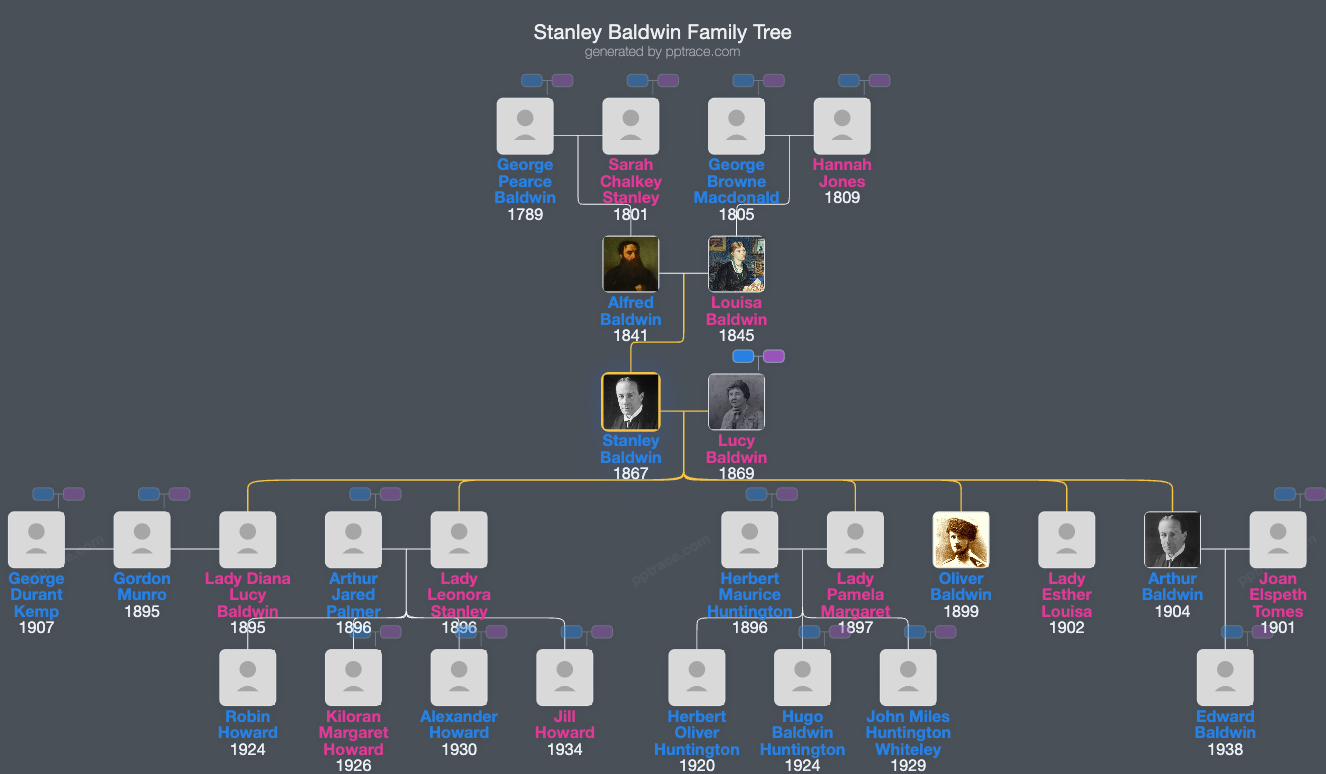
Family Tree
Tap  to expand more relatives
Introduction
Stanley Baldwin, 1st Earl Baldwin of Bewdley (3 August 1867 – 14 December 1947), was a British politician and member of the Conservative Party. He served as Prime Minister of the United Kingdom on three occasions: from May 1923 to January 1924, from November 1924 to June 1929, and from June 1935 to May 1937.
Born in Bewdley, Worcestershire, Baldwin was the only son of Alfred Baldwin and Louisa MacDonald. His family was involved in the iron and steel industry, a business that Baldwin would later inherit. Through his mother, he was a first cousin of the writer Rudyard Kipling. Baldwin's early education included attending St Michael's School in Slough and Harrow School. He pursued higher education at Trinity College, Cambridge, where he studied history and graduated with a third-class degree. During his time at university, he was involved with the debating society known as the Magpie & Stump but was known for his reluctance and lack of participation in class activities.
In 1892, Baldwin married Lucy Ridsdale. The couple had seven children, six of whom survived infancy. Their children included Lady Diana Lucy Baldwin, Lady Leonora Stanley Baldwin, Lady Pamela Margaret Baldwin, Major Oliver Ridsdale Baldwin (later the 2nd Earl Baldwin of Bewdley), Lady Esther Louisa (Betty) Baldwin, and Arthur Windham Baldwin (later the 3rd Earl Baldwin of Bewdley). Baldwin's youngest daughter, Betty, was injured during a bombing raid in 1941, which required facial reconstruction surgery.
Baldwin's professional career began in the family iron and steel business, and he was involved in local politics, becoming a Justice of the Peace in 1897. He entered the House of Commons as the MP for Bewdley in 1908, succeeding his father who had died earlier that year. During the First World War, he served as Parliamentary Private Secretary to Bonar Law and was appointed Financial Secretary to the Treasury in 1917, a role in which he promoted voluntary donations to the war effort.
In 1921, Baldwin was appointed President of the Board of Trade and joined the Cabinet. By late 1922, he became increasingly opposed to the coalition government led by David Lloyd George and publicly announced his support for Conservative independence from the coalition. In 1922, he became Chancellor of the Exchequer under Prime Minister Bonar Law.
When Bonar Law resigned due to health issues in 1923, Baldwin succeeded him as Prime Minister and as leader of the Conservative Party. His first term as Prime Minister was brief, and after losing the December 1923 general election, he formed his second government in 1924. His tenure was marked by domestic reforms including policies on industrial conciliation, unemployment insurance, old-age pensions, slum clearance, and maternal care, some of which were aimed at appealing to Liberal voters.
Baldwin's government faced significant challenges, notably the General Strike of 1926, and responded with legislation aimed at curbing trade union powers, such as the Trade Disputes and Trade Unions Act 1927. After narrowly losing the 1929 general election, Baldwin's leadership was challenged by the press, notably by Lord Rothermere and Lord Beaverbrook.
In 1931, amid the economic downturn of the Great Depression, Baldwin became a leading figure in the National Government, a coalition predominantly composed of Conservatives, which won a large majority in the subsequent election. He served as Lord President of the Council and assumed many duties of the Prime Minister as Ramsay MacDonald's health declined. During this period, Baldwin was involved in significant legislative acts, including those granting greater self-governance to India and establishing the Statute of Westminster 1931, which acknowledged the independence of several Dominions.
Baldwin became Prime Minister again in 1935, winning another large majority, and during his third term, he oversaw the initial stages of rearmament and responded to international crises such as the remilitarization of the Rhineland and the Spanish Civil War. His government also dealt with public controversies like the Hoare–Laval Pact and the abdication of King Edward VIII.
He resigned as Prime Minister in May 1937 and was succeeded by Neville Chamberlain. Baldwin continued to hold the title of Earl Baldwin of Bewdley until his death in 1947. His legacy remains complex, with evaluations differing widely over his policies and leadership, particularly regarding his responses to the interwar international challenges and domestic economic issues.