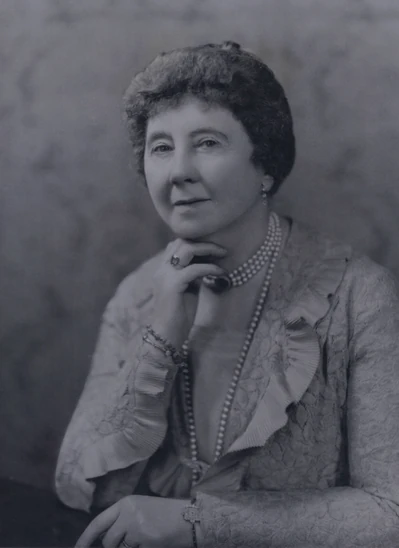
Lucy Baldwin, Countess Baldwin Of Bewdley
| Name | Lucy Baldwin, Countess Baldwin Of Bewdley |
| Title | campainer for maternity care; wife of British Prime Minister Stanley Baldwin (1869-1945) |
| Gender | Female |
| Birthday | 1869-01-19 |
| nationality | United Kingdom |
| Source | https://www.wikidata.org/wiki/Q6698188 |
| pptrace | View Family Tree |
| LastUpdate | 2025-11-26T23:32:02.432Z |
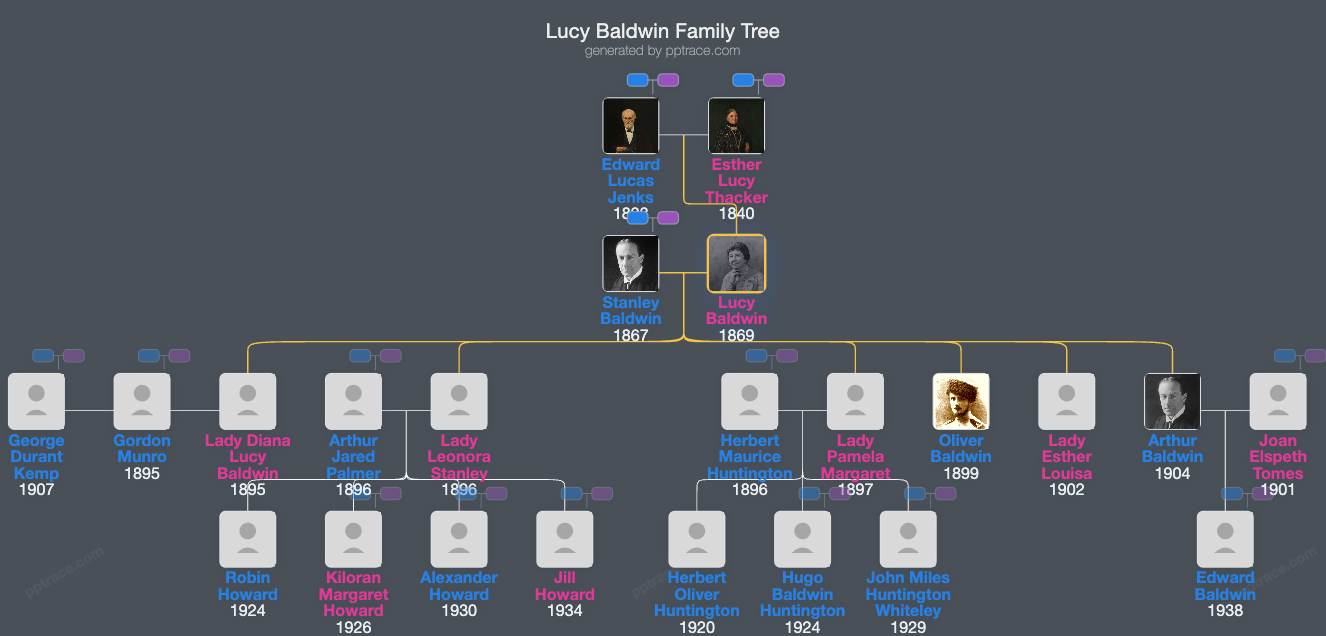
Family Tree
Tap  to expand more relatives
Introduction
Lucy Baldwin, Countess Baldwin of Bewdley (née Ridsdale), was born on 19 June 1869 in Bayswater, London. She was the eldest daughter of Edward Lucas Jenks and Esther Lucy Ridsdale (née Thacker). Her childhood was spent in Rottingdean, Sussex, where she grew up with a sister and three brothers, including Aurelian Ridsdale, who later served as a Member of Parliament for Brighton. Known early on as "Cissie," she participated in the White Heather Club, established in 1887 at Nun Appleton Hall near Appleton Roebuck, Yorkshire. This club was notable as the first women's cricket club, and it was on the cricket field there that she met her future husband.
On 12 September 1892, she married Stanley Baldwin in Rottingdean. The wedding was attended by influence figures including Baldwin’s aunt Alice and Rudyard Kipling. Their union produced seven children: an unnamed son (stillborn in January 1894), Lady Diana Lucy (born April 8, 1895; died 1982), Lady Leonora Stanley (born July 10, 1896; died 1989), Lady Pamela Margaret (born September 16, 1897; died 1976), Major Oliver Ridsdale Baldwin, 2nd Earl Baldwin of Bewdley (born March 1, 1899; died 1958), Lady Esther Louisa Baldwin (born 1902; died 1981), and Arthur Windham Baldwin, 3rd Earl Baldwin of Bewdley (born March 22, 1904; died 1976). Her children married into notable families, such as Lady Diana’s marriage to Capt Sir Richard Gordon Munro and Capt George Durant Kemp-Welch, and Lady Pamela’s marriage to Sir Herbert Huntington-Whiteley, 2nd Baronet.
Apart from her duties as a wife and mother, Lucy Baldwin was active in social and charitable work. She held progressive views and engaged in activities related to women's and maternal health. She was involved with the Young Women’s Christian Association (YWCA) and focused on improving maternity care, especially after experiencing difficult pregnancies and the loss of her first child. Her advocacy led to her becoming vice-chairman of the National Birthday Trust Fund in 1928, an organization established to support maternity hospitals and promote midwifery practices. She also helped found the Anæsthetics Appeal Fund in 1929, aimed at reducing childbirth pain by making anaesthesia accessible for low-income women. Her efforts contributed to the enactment of the Midwives Act of 1936, which improved standards for midwifery and childbirth.
Baldwin was styled as Countess Baldwin of Bewdley on 8 June 1937, upon her husband's political elevation. Throughout her husband's terms as Prime Minister, she accompanied him on official travels and participated in public speaking, often addressing issues related to women’s health and welfare. She was invested as a Dame of Grace of the Order of Saint John of Jerusalem and a Dame Grand Cross of the Order of the British Empire.
Lucy Baldwin died unexpectedly of a heart attack on 17 June 1945 at Astley Hall, her country residence in Worcestershire, just two days before her 76th birthday. She was cremated, and her ashes, along with those of her husband, who died in 1947, were interred in the nave of Worcester Cathedral.
In recognition of her contributions to maternal health, Julien Cahn funded the construction of the Lucy Baldwin Maternity Hospital in Stourport-on-Severn, Worcestershire. The hospital was dedicated by the Prime Minister on 16 April 1929, with a bronze plaque inscribed: "What she wanted most in the world. Presented to her by Julien Cahn Esq." The facility expanded to serve broader medical needs under the name Lucy Baldwin Hospital until its closure in 2006. In the 1960s, a device used for obstetric analgesia, administering Nitrous oxide and oxygen, was named the Lucy Baldwin Apparatus for Obstetric Analgesia. Additionally, Baldwin authored notes on significant political events, including the fall of the Lloyd George ministry and the Abdication Crisis.