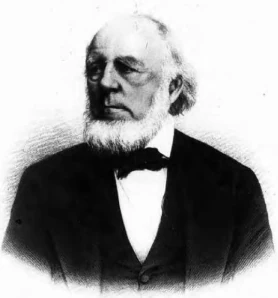
John Appleton
| Name | John Appleton |
| Title | American judge |
| Gender | Male |
| Birthday | 1804-07-12 |
| nationality | United States of America |
| Source | https://www.wikidata.org/wiki/Q43375716 |
| pptrace | View Family Tree |
| LastUpdate | 2025-11-17T06:39:51.240Z |
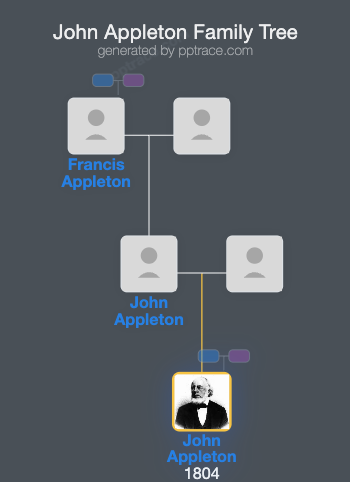
Family Tree
Tap  to expand more relatives
Introduction
John Appleton (July 12, 1804 – February 7, 1891) was an American jurist, legal scholar, and advocate for constitutional economic reform. Born in New Ipswich, New Hampshire, he was the son of John and Elizabeth Appleton. After the death of his mother when he was four years old, he was raised by an aunt and received his primary education at New Ipswich Academy. At age fourteen, he moved to Brunswick, Maine, to live with his uncle Jesse Appleton, who served as president of Bowdoin College. Despite his youth, Appleton attended Bowdoin College, graduating in four years at the age of eighteen.
In 1825, he earned a Master of Arts degree from Bowdoin College and was admitted to the bar in 1826 in Amherst, New Hampshire. That same year, he established a legal practice initially in Dixmont, Maine, and subsequently in Sebec, Maine, in Piscataquis County. In 1832, he relocated to Bangor, Maine, where he remained until his death and established the law firm Appleton & Allen with Elisha Hunt Allen.
Appleton held positions including Reporter of Decisions for the Maine Supreme Judicial Court beginning in 1832, and he practiced law while serving on the court. He formed partnerships with fellow lawyers such as John B. Hill and his cousin Moses L. Appleton. In 1850, he chaired a commission to modernize Maine’s judicial system; his recommendations led to the Court Reorganization Act of 1852, which expanded the court and revised its structure.
On May 11, 1852, Appleton was appointed as an associate justice of the Maine Supreme Judicial Court, a position he held until September 19, 1883. He was appointed Chief Justice on October 24, 1862, by Governor Israel Washburn. His tenure was marked by efforts to reform rules of evidence, advocating for the inclusion of personal testimony and the rights of defendants to testify, leading Maine to become among the first states to permit such testimony in 1856. In 1860, he published a collection of essays on evidence reform, influencing legal standards nationally.
Appleton’s judicial philosophy aligned with classical liberalism. He supported laissez-faire economic policies and believed the U.S. Constitution mandated policies conducive to economic growth. A utilitarian thinker influenced by Jeremy Bentham, he promoted individual responsibility, religious and racial equality, and separation of church and state. He publicly opposed laws that restricted minority testimony, especially laws excluding African-Americans and Native Americans from testifying in court. He corresponded with British philosopher John Stuart Mill and contributed to discussions on minorities’ rights and racial integration following the Civil War.
Appleton married Sarah Newcomb Allen in 1834, with whom he had five children: John, Frederic, Sarah, Henry, and Edward. His eldest son, John, served as a Brigadier General during the Civil War. Sarah died in 1874, and in 1876, Appleton married Annie V. Greeley, with no known children from this marriage. He was a member of the Unitarian Church.
In addition to his legal career, Appleton accumulated wealth through land transactions in Maine, particularly timberland, and engaged unsuccessfully in railroad and banking enterprises. Politically, he identified with Jacksonian Democratic ideas in his early years, supported the Whig Party, and later the Republican Party. He died of heart failure at his home in Bangor on February 7, 1891.