Philip Stanhope, 4th Earl Of Chesterfield
| Name | Philip Stanhope, 4th Earl Of Chesterfield |
| Title | 18th-century British statesman and man of letters; (1694-1773) |
| Gender | Male |
| Birthday | 1694-09-22 |
| nationality | Great Britain |
| Source | https://www.wikidata.org/wiki/Q332487 |
| pptrace | View Family Tree |
| LastUpdate | 2025-11-12T01:15:12.967Z |
Family Tree
Tap  to expand more relatives
Introduction
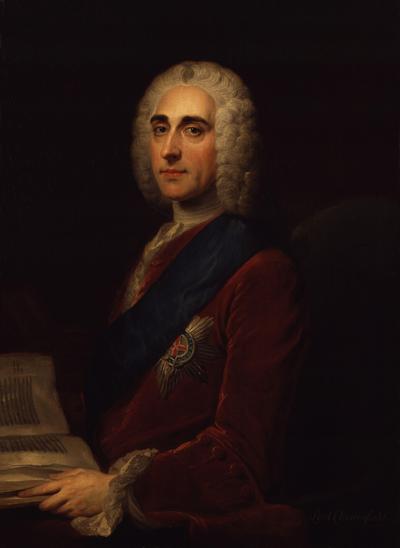
Philip Dormer Stanhope, 4th Earl of Chesterfield (22 September 1694 – 24 March 1773), was a British politician, diplomat, and writer.
Early Life
He was born in London to Philip Stanhope, 3rd Earl of Chesterfield, and Lady Elizabeth Savile. Known by the courtesy title Lord Stanhope until 1726, he was chiefly raised by his grandmother, the Marchioness of Halifax, after his mother's death in 1708. Chesterfield was educated at Trinity Hall, Cambridge, but left after just over a year, focusing on languages and oration. He then undertook the Grand Tour across Europe, which was customary for noblemen, to engage with classical antiquities, Renaissance culture, and European aristocratic society.
Following the death of Queen Anne and the accession of King George I in 1714, Chesterfield returned to England to pursue a political career. He supported the Whigs and entered government service, initially as a courtier to the King, through the influence of James Stanhope, a relative and minister to George I. He was appointed as Lord of the Bedchamber to the Prince of Wales.
Political Career
In 1715, Chesterfield entered the House of Commons as MP for St Germans and held the courtesy title Lord Stanhope of Shelford. His maiden speech in the House was notably fluent but also prompted a warning that he was near his majority age, which at the time was liable to a penalty. While in Paris during a diplomatic mission, he provided intelligence about the Jacobite plot. Returning to Britain in 1716, he became a respected debater and maintained relationships within court and political circles.
He remained sympathetic to the Prince of Wales during the deteriorating relations between the Prince and King George I, which caused personal animosity from the Princess of Wales. In 1723, he was appointed Captain of the Gentlemen Pensioners. When his father died in 1726, he inherited the earldom and moved to the House of Lords. His style of oratory was more appreciated there than in the Commons.
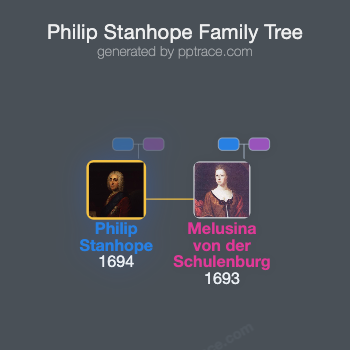
In 1728, Chesterfield was appointed as ambassador to The Netherlands, where he helped negotiate the second Treaty of Vienna and contributed to alliances shifting European diplomacy. In 1732, he fathered an illegitimate son, Philip, with French governess Madelina Elizabeth du Bouchet. Later, Chesterfield married Melusina von der Schulenberg, daughter of the Duchess of Kendal, in 1733.
His political career included supporting Walpole’s government but also opposing certain measures, such as the Excise Bill, which led to his dismissal as Lord Steward. He spent subsequent years in opposition, writing pamphlets under the pseudonym "Jeffrey Broadbottom" and criticizing the government and the King. His efforts contributed to Walpole's fall from power in 1742.
Later Years
Chesterfield served as ambassador in the Netherlands again during the War of the Austrian Succession, successfully securing Dutch cooperation. He was appointed Lord-Lieutenant of Ireland in 1745, where he implemented reforms and worked to pacify Protestant and Catholic factions. His tenure was short, and he was replaced in 1746.
In subsequent years, Chesterfield declined a dukedom and focused on legal and administrative reforms, notably passing the Calendar Act of 1750, which adopted the Gregorian calendar in Britain. Declining health and deafness led him to withdraw from active politics.
He had a well-known dispute with Samuel Johnson regarding patronage and the promotion of Johnson’s Dictionary of the English Language. Chesterfield had invested in Johnson's project but was criticized for insufficient support during its compilation.
He authored the "Letters to His Son" (published posthumously in 1774), a collection of over 400 letters offering advice on social conduct, morality, and manners, written over three decades to his illegitimate son. These letters remain his most enduring literary contribution and provide insight into 18th-century notions of gentlemanly conduct.
Family and Succession
His illegitimate son, Philip, died in 1768. Chesterfield was concerned about securing a legitimate heir; he adopted his distant cousin and godson, Philip Stanhope, as his successor. Chesterfield died in 1773 at Chesterfield House in Westminster, after which his adopted heir inherited the title.
Legacy
His name is associated with Chesterfield sofas, characterized by deep buttoned leather upholstery. The term "Chesterfield" has become a synonym for a particular style of sofa in the UK and North America.
Chesterfield's reputation in literature is also preserved through his appearances in works by Thackeray and Dickens. Several places, including Chesterfield in Virginia and South Carolina, and Chesterfield Street in London, bear his name.
His influence extended into furniture design and cultural references, with the first known Chesterfield sofa believed to have been commissioned by him. His writings, especially the "Letters to His Son," continue to be studied for their advice on social manners and conduct.
Death
He died on 24 March 1773 at Chesterfield House, Westminster. His godson and adopted heir, Philip Stanhope, 5th Earl of Chesterfield, succeeded him.