Ramsay MacDonald
| Name | Ramsay MacDonald |
| Title | British prime minister in 1924 and 1929 to 1935 |
| Gender | Male |
| Birthday | 1866-10-12 |
| nationality | United Kingdom |
| Source | https://www.wikidata.org/wiki/Q166646 |
| pptrace | View Family Tree |
| LastUpdate | 2025-11-26T23:32:08.909Z |
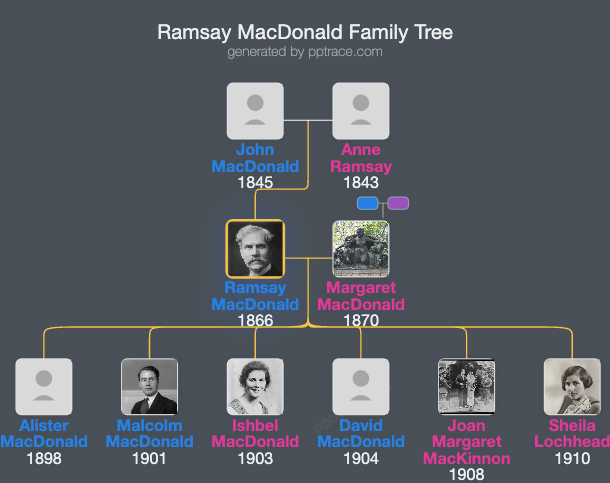
Family Tree
Tap  to expand more relatives
Introduction
James Ramsay MacDonald was born on 12 October 1866 in Lossiemouth, Moray, Scotland. He was the illegitimate son of John MacDonald, a farm labourer, and Anne Ramsay, a housemaid. His birth was registered as James McDonald Ramsay. MacDonald received elementary education at the Free Church of Scotland school in Lossiemouth and later at Drainie Parish School. He left school in 1881 at the age of 15 and began work as a farm worker. Later that year, he became a pupil teacher at Drainie parish school.
In December 1881, MacDonald moved to Bristol to work as an assistant to a clergyman, Mordaunt Crofton, at St Stephen's Church. During this period, he joined the Democratic Federation, which later became the Social Democratic Federation (SDF), and participated in socialist activities. In early 1886, he relocated to London and initially worked addressing envelopes for the National Cyclists' Union, then as an invoice clerk at Cooper, Box and Co.
While in London, MacDonald became engaged with socialist organizations, founding his political ideology on the parliamentary approach advocated by the Socialist Union. He witnessed Bloody Sunday in Trafalgar Square in 1887, which prompted him to publish a pamphlet titled "Remember Trafalgar Square: Tory Terrorism in 1887." He maintained an interest in Scottish politics, supporting Scottish Home Rule early on. In 1888, MacDonald participated in forming the London General Committee of the Scottish Home Rule Association.
MacDonald studied sciences such as botany, agriculture, mathematics, and physics at Birkbeck Literary and Scientific Institution between 1886 and 1887 but had to cease these studies due to health issues. He later became a governor of the institution and maintained a lifelong interest in its mission.
Throughout the 1890s, MacDonald was active in socialist and liberal politics. He worked as a private secretary to Thomas Lough, a Liberal MP, and developed connections within radical and liberal circles. He also worked as a freelance journalist and was a member of the Fabian Society. In 1892, he supported the Labour Electoral Association (LEA) and was adopted as its candidate. He later joined the Independent Labour Party (ILP) in 1894 and was the ILP candidate for Southampton in 1895, though he was not elected.
MacDonald served as Secretary of the Labour Representation Committee (LRC) in 1900, which later evolved into the Labour Party. That year, he stood for Parliament in Leicester but was unsuccessful. He married Margaret Ethel Gladstone in 1896. As part of his political career, MacDonald negotiated agreements with leading Liberal figures to allow Labour to contest elections without Liberal opposition, laying groundwork for Labour's parliamentary presence.
He was among the founding members of the Labour Party in 1900, alongside Keir Hardie and Arthur Henderson. He served as chairman of the Labour MPs before 1914 and led the party from 1922. MacDonald’s political career included serving as Prime Minister of the United Kingdom. His first tenure as prime minister was in 1924 as leader of a minority Labour government that lasted nine months. He was elected again as Prime Minister from 1929 to 1931 during the second Labour government, a period marked by the Great Depression.
In 1931, MacDonald was expelled from the Labour Party after forming a National Government primarily supported by the Conservative Party. His leadership of the National Government lasted until 1935, after which he stepped down as prime minister and served as Lord President of the Council until his retirement in 1937. He died on 9 November 1937.
MacDonald's contributions to socialist theory included speeches, pamphlets, and books. His oratory, characterized by an imposing presence and persuasive delivery, made him a prominent Labour figure. After 1931, he was often criticized by the Labour movement, but some historians from the 1960s onward have reassessed his role in the context of his contributions to the Labour Party and his response to the economic crises of his time.