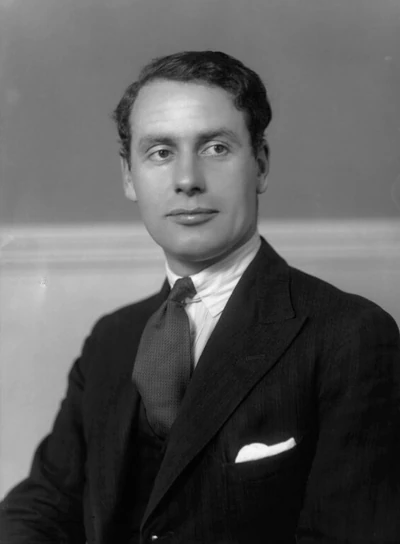
Malcolm MacDonald
| Name | Malcolm MacDonald |
| Title | British politician and diplomat (1901-1981) |
| Gender | Male |
| Birthday | 1901-08-17 |
| nationality | United Kingdom |
| Source | https://www.wikidata.org/wiki/Q333507 |
| pptrace | View Family Tree |
| LastUpdate | 2025-11-26T23:32:10.847Z |
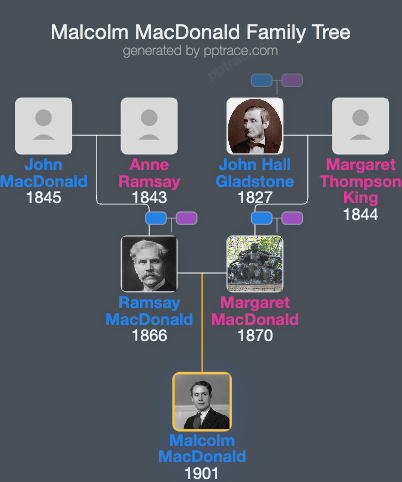
Family Tree
Tap  to expand more relatives
Introduction
Malcolm John MacDonald was born on 17 August 1901 in Lossiemouth, Scotland. He was the second son of Ramsay MacDonald, who would later serve as Prime Minister of the United Kingdom, and Margaret MacDonald. Malcolm had six siblings, including an older sister, Alister, born in 1899, and younger siblings Ishbel, Davis, and Sheila Lochhead, born in 1903, 1904, and 1910, respectively. The family resided in Lossiemouth during his early years, an environment that influenced his interests, including poetry and birdwatching. In his youth, he documented the presence of 252 bird species in the Moray Firth region, publishing a book titled "Birdwatching in Lossiemouth."
His mother, Margaret, was active in social organizations such as the Women's Industrial Council and the National Union of Women Workers. Following her death in 1911 when Malcolm was ten years old, he was influenced by the emphasis on community and friendship taught by his parents. Malcolm was educated at Bedales School and later attended Queen's College, Oxford, where he studied economics and history. During his university years, he participated in debating competitions and represented the United Kingdom at conferences held in Honolulu in 1927 and Kyoto in 1929 under the auspices of the Institute of Pacific Relations.
In 1929, Malcolm MacDonald was elected as a Labour Member of Parliament. However, in 1931, he followed his father in leaving the Labour Party to join the National Government, leading to his expulsion from Labour. In 1935, at the age of 34, he was appointed Secretary of State for the Colonies, becoming the youngest Cabinet minister in the UK at that time.
During World War II, MacDonald served as Winston Churchill's Minister of Health, overseeing the evacuation of children from London amid air raids. In June 1940, he was sent to Dublin to negotiate with Éamon de Valera regarding Ireland's participation in the war and the potential for ending the partition of Ireland. The negotiations did not result in a change in Ireland’s policy.
Between 1941 and 1946, MacDonald served as the High Commissioner to Canada. He played a role in the creation of the University of Malaya, signing the bill in 1949 following the recommendations of the Alexander Carr-Saunders Commission. He subsequently became the university's first Chancellor, serving until 1961. His diplomatic career extended to Southeast Asia, where he was appointed Governor-General of Malaya, Singapore, and Borneo after the war. He also served as High Commissioner to India from 1955 to 1960 and was involved in the founding of the Southeast Asia Treaty Organization in 1955.
From the mid-1940s onwards, MacDonald focused increasingly on decolonization efforts. He was appointed Governor and Commander-in-Chief of Kenya, serving from 1964 to 1965, and participated in diplomatic visits to Nigeria and Rhodesia. He also held various diplomatic roles as a Special Representative for African Commonwealth nations until his retirement in 1969.
MacDonald notably contributed to the political developments in Brunei, where he served as High Commissioner from 1946 to 1948 and as Commissioner-General in Southeast Asia until 1955. He maintained a consistent presence in Brunei beyond his official tenure, visiting frequently until 1979 and engaging with several Sultans, including Ahmad Tajuddin, Omar Ali Saifuddien III, and Hassanal Bolkiah. His diplomatic approach in Brunei emphasized compassion and respect toward local authorities, contrasting with some traditional colonial policies.
In 1939, MacDonald oversaw and introduced the MacDonald White Paper regarding Palestine, which aimed to limit Jewish immigration and oppose the establishment of a Jewish state. The White Paper became a subject of controversy and debate in the UK Parliament, with critics describing it as detrimental to Jewish refugees fleeing Nazi persecution.
Malcolm MacDonald passed away on 11 January 1981.