Shōjirō Ishibashi
| Name | Shōjirō Ishibashi |
| Title | Japanese businessman |
| Gender | Male |
| Birthday | 1889-02-01 |
| nationality | Japan |
| Source | https://www.wikidata.org/wiki/Q4476873 |
| pptrace | View Family Tree |
| LastUpdate | 2025-11-17T06:46:24.394Z |
Family Tree
Tap  to expand more relatives
Introduction
Shōjirō Ishibashi (石橋 正二郎, Ishibashi Shōjirō) was born on February 1, 1889, and died on September 11, 1976. He was a Japanese businessman known for founding the Bridgestone Corporation in 1931 in Kurume, Fukuoka, Japan. Bridgestone became the world's largest manufacturer of tires. The company's name was derived from the Japanese words "ishi" meaning "stone" and "hashi" (voiced as bashi) meaning "bridge," which together form "Bridgestone" in English.
Ishibashi's educational background includes attendance at Waseda University. He established Bridgestone with the motto to "serve society with products of superior quality." The company also led him to create cultural and artistic institutions such as the Ishibashi Cultural Center and the Bridgestone Museum of Art, both located in Tokyo. Additionally, he was a benefactor of the Tokyo National Museum of Modern Art and contributed to its building construction.
Following World War II and the occupation of Japan, Ishibashi became involved in Japanese politics. He was closely associated with Ichiro Hatoyama, a political figure who was a rival to Prime Minister Shigeru Yoshida. Ishibashi served as an advisor to Hatoyama on Japan’s post-war economic development and expressed views on economic policy related to Hatoyama's political party.
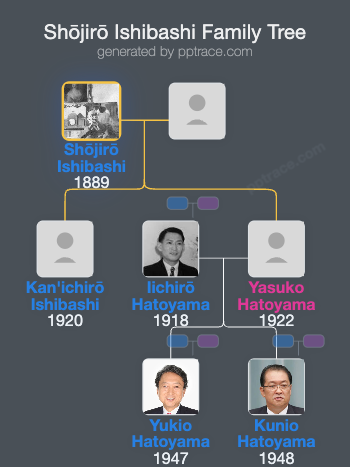
Family connections include his daughter, Yasuko Hatoyama, who inherited Ishibashi's wealth. She married Iichirō Hatoyama, a former Japanese Foreign Minister. They had two sons, who are Ishibashi's grandchildren: Kunio Hatoyama, a politician who served as Minister of Internal Affairs and Communications, and Yukio Hatoyama, who served as Prime Minister from 2009 to 2010.
Ishibashi also had involvement in the automotive industry through the Prince Motor Company. In February 1949, he financed the Tokyo Electric Car Company, which was a successor of the Tachikawa Aircraft Company, and became its chairperson. The company was renamed Tama Electric Car Company in November 1949. In April 1951, Ishibashi acquired a majority stake in Fuji Precision Industries, also a successor of the Nakajima Aircraft Company, and became its chairman. Tama Electric Car Company was renamed Tama Motor Company in November 1951, and subsequently, in 1952, it was renamed the Prince Motor Company.
In the 1950s, Ishibashi played a key role in merging Prince Motor Company and Fuji Precision Industries, culminating in the merger of Prince into Nissan in August 1966. Prior to the merger, in May 1965, Ishibashi, alongside Hidehiko Ogawa, president of Prince, and Katsuji Kawamata, president of Nissan, signed a merger memorandum.
Throughout his life, Ishibashi contributed to the arts and industry, with a focus on corporate and cultural development in Japan.