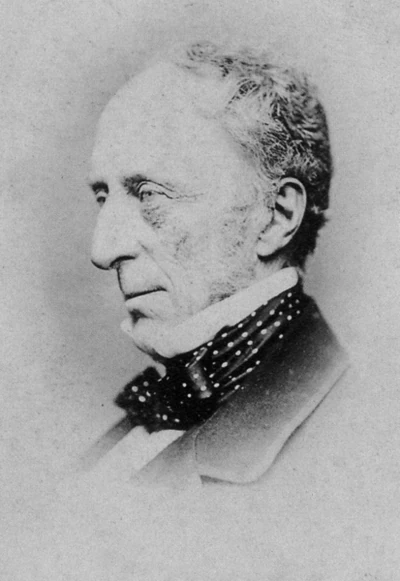
Charles Wood, 1st Viscount Halifax
| Name | Charles Wood, 1st Viscount Halifax |
| Title | British politician (1800-1885) |
| Gender | Male |
| Birthday | 1800-12-20 |
| nationality | United Kingdom of Great Britain and Ireland |
| Source | https://www.wikidata.org/wiki/Q333354 |
| pptrace | View Family Tree |
| LastUpdate | 2025-11-26T23:27:57.195Z |
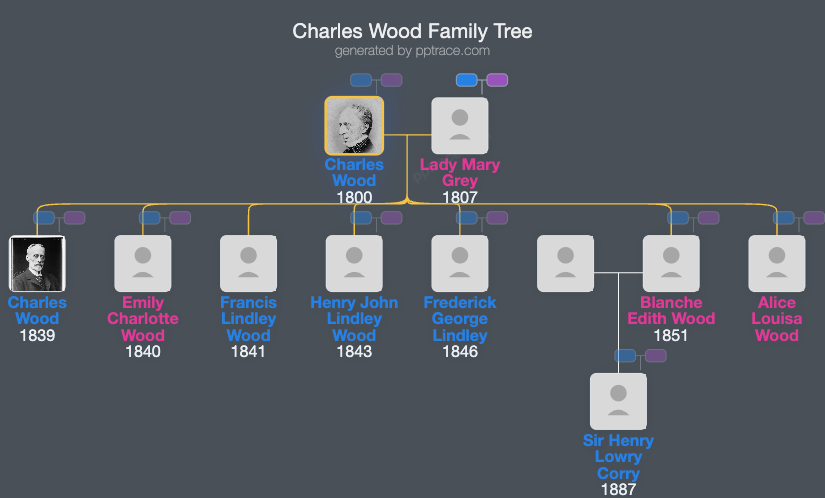
Family Tree
Tap  to expand more relatives
Introduction
Charles Wood, 1st Viscount Halifax (20 December 1800 – 8 August 1885), was a British politician affiliated with the Whig party. He was born as Sir Charles Wood, 3rd Baronet, and held that title from 1846 until his elevation to the peerage in 1866. His father was Sir Francis Wood, 2nd Baronet, of Barnsley, and his mother was Anne, daughter of Samuel Buck.
Wood received his education at Eton College and Oriel College, Oxford, where he studied classics and mathematics.
He served as a Member of Parliament (MP) from 1826 to 1866. Initially representing Great Grimsby, he later represented Wareham, a pocket borough, starting in 1831. He participated actively in the debates surrounding the Reform Bill, voting for its passage at every stage, contributing to its eventual Royal assent in 1832.
In his political career, Wood held several key government positions. He served as Chancellor of the Exchequer in Lord John Russell's government from 1846 to 1852. During his tenure, he advocated for liberal economic policies, including trade liberalization, which involved reducing import duties and tariffs. His 1851 budget reflected these policies and led to increased consumption of goods. His influence in economic policy was recognized by Benjamin Disraeli in 1852, although their views differed, with Disraeli being a former protectionist and Wood advocating free trade.
Following his role as Chancellor, Wood served as President of the Board of Control from 1852 to 1855 under Lord Aberdeen. He was then appointed First Lord of the Admiralty, serving from 1855 to 1858 during Lord Palmerston's administration. Subsequently, he was Secretary of State for India from 1859 to 1866 in Palmerston's second government.
He succeeded to his father's baronetcy in 1846 and was created Viscount Halifax of Monk Bretton in 1866. From 1870 to 1874, he served as Lord Privy Seal in William Ewart Gladstone's first cabinet, his final public office.
Wood played a notable role during the Irish Famine (1845–1851), a period during which approximately one million people died and up to two million emigrated. In June 1846, the Whig government, led by Lord John Russell, replaced Sir Robert Peel's Tory government. Wood and civil servant Sir Charles Trevelyan adhered to laissez-faire principles, opposing relief efforts that involved government intervention. This stance contributed to policies that prioritized economic theories over immediate famine relief, which has been criticized by historians. Wood believed the famine was a divine consequence designed to reform Irish society by eliminating dependence on small-scale farming.
In 1854, as President of the Board of Control, Wood recommended reforms to Indian education in a dispatch to Lord Dalhousie, the Governor-General of India. His proposals led to the establishment of education departments across Indian provinces and the foundation of universities in Calcutta, Bombay, and Madras in 1857, with further expansions in subsequent decades.
Wood married Lady Mary Grey, the fifth daughter of Charles Grey, 2nd Earl Grey, on 29 July 1829. They had seven children: four sons and three daughters. His children included Charles Lindley Wood, 2nd Viscount Halifax. Lady Mary Grey died in 1884, and Wood died on 8 August 1885 at the age of 84. He was succeeded by his eldest son, Charles, who became the father of Edward Wood, 1st Earl of Halifax.