William Scott
| Name | William Scott |
| Title | Irish lawyer |
| Gender | Male |
| Birthday | 1705-00-00 |
| nationality | — |
| Source | https://www.wikidata.org/wiki/Q8018203 |
| pptrace | View Family Tree |
| LastUpdate | 2025-11-26T12:31:26.302Z |
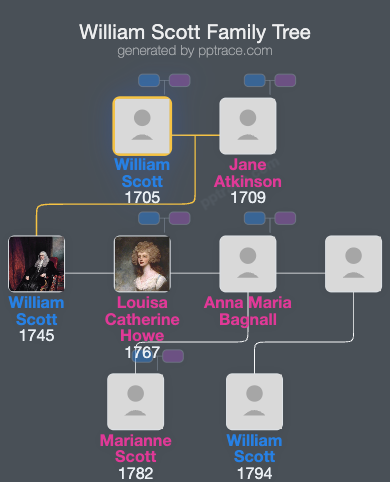
Family Tree
Tap  to expand more relatives
Introduction
William Scott was born in 1705 and died on 17 April 1776. He was an Irish lawyer and judge known for his service within the judicial system of Ireland during the 18th century.
Background and Family:
William Scott was the only son of Reverend Gideon Scott and Jane McNeill. His father, an alumnus of Oxford University, served as an army chaplain alongside William III of England and settled in Ireland's Ulster region. In 1696, King William I granted Gideon Scott the estate of Willsborough in County Londonderry, an estate named after the monarch following a sermon delivered by Gideon Scott that reportedly impressed the king. William Scott’s mother was Jane McNeill, the daughter of John McNeill of Ballintoy in County Antrim and Elizabeth Ruthven. Elizabeth Ruthven was the widow of Sir Dugald Stewart, 2nd Baronet, and was a half-sister of James Stuart, the 1st Earl of Bute.
Education:
William Scott attended school in Raphoe before enrolling at Trinity College Dublin, from which he graduated in 1727. Subsequently, he entered Middle Temple, one of the four Inns of Court in London, in 1729 and was called to the Bar in 1732.
Political and Judicial Career:
In 1739, Scott was elected as a Member of Parliament representing the city of Londonderry in the Irish House of Commons. He was appointed Prime Serjeant at the Irish Bar on 6 October 1757, a senior legal position in Ireland and an indicator of his prominence within the legal community.
His judicial appointments included serving as Recorder of Derry in 1735. In 1759, he was appointed as a Puisne Justice of the Court of King's Bench (Ireland). Later, on 1 August 1768, Scott was transferred to the Court of Exchequer (Ireland) as a Puisne Baron, a role he held until his death. Additionally, on 13 December 1771, he was appointed alongside fellow Barons Foster and Smyth, as well as Lord Chancellor Lifford and the Chancellor of the Exchequer Hamilton, as Commissioners of Accounts for Ireland, through Letters Patent.
Throughout his career, Scott's life was characterized by stability and modesty; he appears to have maintained a low profile and was not noted for any significant controversies or public upheavals.
Family:
William Scott married Hannah Gledstanes, the daughter of Thomas Gledstanes. They had three sons: Thomas, who died in 1770 and was briefly Recorder of Londonderry; James, who inherited the Willsborough estate and married Catherine Leslie, daughter of James Leslie, Bishop of Limerick, Ardfert and Aghadoe, and Joyce Lyster; and Anthony, who also died in 1770.
References:
- F. Elrington Ball, "The Judges in Ireland 1221-1921," London, John Murray, 1926.
- Joseph Haydn and Horace Ockerby, "The Book of Dignities," 3rd edition, London, 1894 (reprinted Bath, 1969).