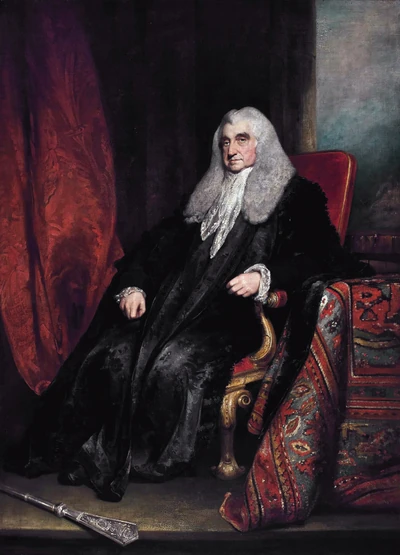
William Scott, 1st Baron Stowell
| Name | William Scott, 1st Baron Stowell |
| Title | British politician |
| Gender | Male |
| Birthday | 1745-10-17 |
| nationality | United Kingdom of Great Britain and Ireland |
| Source | https://www.wikidata.org/wiki/Q6191717 |
| pptrace | View Family Tree |
| LastUpdate | 2025-11-26T23:25:52.208Z |
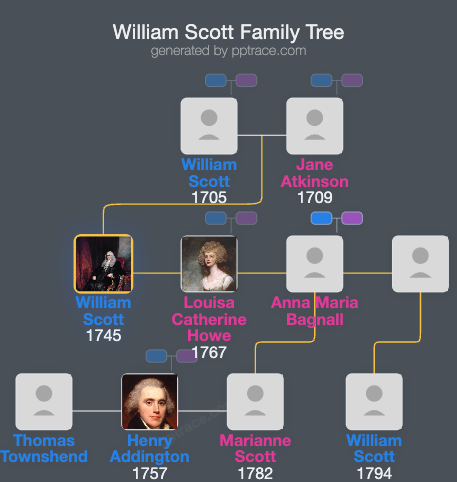
Family Tree
Tap  to expand more relatives
Introduction
William Scott, 1st Baron Stowell (17 October 1745 – 28 January 1836), was an English jurist and judge who served as Judge of the High Court of Admiralty from 1798 to 1828.
**Early life and education**
William Scott was born in Heworth, a village approximately four miles from Newcastle upon Tyne. His father was a tradesman involved in the coal transport business. William had a younger brother, John Scott, who became Lord Chancellor and was created Earl of Eldon. William Scott attended Newcastle Royal Grammar School and subsequently matriculated at Corpus Christi College, Oxford, where he earned a Durham scholarship in 1761. He graduated in 1764 and initially served as a probationary fellow and later as a tutor at University College, succeeding William Jones. As Camden reader of ancient history, he gained recognition comparable to that of Blackstone. Although he joined the Middle Temple in 1762, Scott only commenced the systematic study of law in 1776. In 1783, he dined at Boyd's Inn, also known as the White Horse Inn, on St Mary's Wynd, during Dr. Samuel Johnson's visit to Edinburgh.
**Legal and judicial career**
After graduating with a Doctor of Civil Law degree, Scott practiced law primarily in ecclesiastical courts following a period of silence mandated by customary legal tradition. His practice advanced rapidly; in 1783, he was appointed registrar of the Court of Faculties, and in 1788, he became judge of the consistory court and advocate-general. That same year, he was knighted. In 1798, he was appointed judge of the High Court of Admiralty.
In his capacity as a judge, Scott presided over notable cases related to the abolition of the slave trade. On 22 May 1809, the vessel Donna Marianna was seized by HMS Crocodile under the Act for the abolition of the slave trade. The Vice Admiralty Court at Sierra Leone condemned the vessel, asserting the seizure despite the ship’s Portuguese registration, on the grounds that it was fundamentally a British vessel with fraudulent Portuguese papers.
Another significant case involved the French ship Le Louis in 1816. After seizure by the West Africa Squadron for slave trading, the ship's capture was initially upheld by HMS Queen Charlotte. Scott overturned this decision, ruling that the process was illegal because "No nation can exercise a right of visitation and search on the common and unappropriated parts of the sea, save only on the belligerent claim." He considered that this ruling created a barrier to the suppression of the slave trade and advocated for resolution through international treaties rather than unilateral naval actions.
Scott twice contested elections at Oxford University; unsuccessfully in 1780 and successfully in 1801. He also served as a Member of Parliament for Downton in 1790. In 1793, he was elected a Fellow of the Royal Society.
In 1821, upon the coronation of King George IV, Scott was elevated to the peerage as Baron Stowell, of Stowell Park in Gloucestershire, taking his title from his estate. He retired from his judicial roles—first from the consistory court in August 1821 and subsequently from the High Court of Admiralty in December 1827.
**Personal life and family**
William Scott married twice. His first marriage was in 1781 to Anna Maria, the eldest daughter and heiress of John Bagnall of Erleigh Court near Reading. They had four children, with one daughter surviving him. His second marriage occurred in 1813 to Louisa Catharine Howe, née Louisa Catharine Howe, the dowager Marchioness of Sligo, and the daughter of the Earl Howe; she was the widow of John Browne, 1st Marquess of Sligo.
Scott died on 28 January 1836 at Erleigh Court, aged 90. His barony became extinct upon his death.
**References and further reading**
The information is derived from the 1911 edition of the Encyclopædia Britannica and other historical sources. Additional biographical details can be found in Henry J. Bourguignon’s *Sir William Scott, Lord Stowell: Judge of the High Court of Admiralty, 1798-1828* (Cambridge University Press, 1987) and William Charles Townsend's *The Lives of Twelve Eminent Judges of the Last and of the Present Century*, Volume 2 (London, 1846).