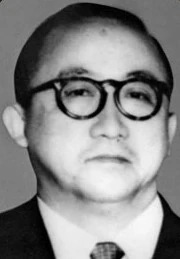
Ryōgo Hashimoto
| Name | Ryōgo Hashimoto |
| Title | Japanese politician |
| Gender | Male |
| Birthday | 1906-06-02 |
| nationality | Japan |
| Source | https://www.wikidata.org/wiki/Q11544086 |
| pptrace | View Family Tree |
| LastUpdate | 2025-11-17T06:48:13.931Z |
Family Tree
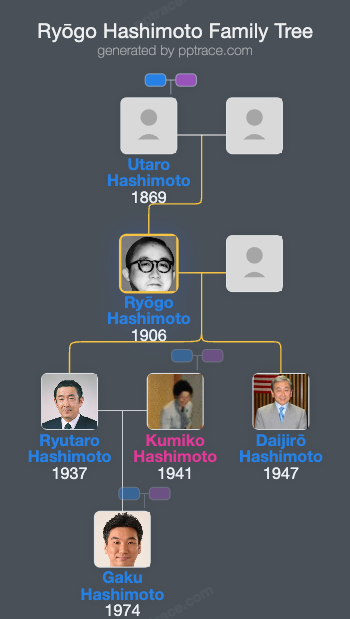
Tap  to expand more relatives
Introduction
Ryōgo Hashimoto (June 2, 1906 – November 21, 1962) was a Japanese finance bureaucrat and politician. He served six terms as a member of the House of Representatives in Japan. His court rank was Senior Third Rank, his order of merit was the First Class of the Order of the Sacred Treasure, and he was awarded the Order of the Rising Sun. He held the degree of Bachelor of Laws.
Life and Family Background
He was born in Meguro Village, Ebara District, Tokyo (now Shibuya Ward, Tokyo), as the fifth son of Utarō Hashimoto and Mats. His registered domicile was Shibuya Ward. His father, Utarō Hashimoto, was an executive at Nippon Beer (now Sapporo Beer); although from a farming background, he completed a higher technical school and was promoted from yeast technician to managing director of the company. His mother, Mats, was from Kumamoto Prefecture and was the sister of Masikiyo Ishikō. The Ishikō family was a samurai family serving the Kumamoto Domain during the feudal era.
Education
Hashimoto attended Zushi Kaisei Junior High School, graduated from the first high school department of liberal arts, and in 1934 graduated from the Faculty of Law, Department of Law, at Tokyo Imperial University.
Health
In his youth, he suffered from tuberculous lumbar kyphosis. After an illness lasting eleven years, he was left with sequelae, and throughout his life, he used a cane.
Career and Bureaucratic Path
After graduating from university, he joined the Ministry of Finance. He served as director of Hiroshima Customs, head of the wartime facilities section in the Minister’s Secretariat of the Ministry of Finance, and director of the Corporate Division of the Financial and Economic Stability Headquarters, among other positions, and was involved in drafting laws such as the Antimonopoly Act. Later, he was appointed Deputy Director of the Cabinet Secretariat under Prime Minister Shigeru Yoshida. He resigned from the civil service to pursue a political career.
Political Activity
In the 1949 general election, he was elected as a Democrat Liberal Party candidate from the Okayama 2nd district. He served as a member of the House of Representatives for six terms thereafter. As a politician, he was appointed Minister of Health and Welfare and Director-General of the Administrative Management Agency during the third Yoshida Cabinet in 1951. In 1958, he became Minister of Health and Welfare in the Second Kishi Cabinet, and in 1959, he was appointed Minister of Education.
Death and Succession
He died of laryngeal cancer at his home in Azabu, Tokyo, on November 21, 1962. The funeral chairman was Prime Minister Eisaku Satō. His grave is at Hōfuku Temple in Sōja City, Okayama Prefecture. At the time of his death, his second son, Dajiro Hashimoto, was expected to succeed him, but since Dajiro was not yet of voting age, his younger brother, Ryutarō Hashimoto, became the successor.
Honors
On the day of his death, he was awarded the First Class of the Order of the Sacred Treasure.
Family and Relatives
His family includes Ryutarō Hashimoto (the 82nd and 83rd Prime Minister of Japan), Dajiro Hashimoto (Governor of Kochi Prefecture), and Gaku Hashimoto (a House of Representatives member). His grandfather was Utarō Hashimoto, his father also Utarō Hashimoto, and his mother was the sister of Masikiyo Ishikō. His siblings include scholars Uichi and Chūji, prosecutor Mitsugu, and younger brother Toraroku.
Other
His hobbies included calligraphy, painting, and collecting antiques. Due to his family’s long-term illness and health conditions, he relied on a cane throughout his life.