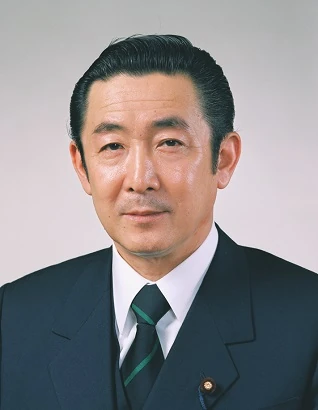
Ryutaro Hashimoto
| Name | Ryutaro Hashimoto |
| Title | 82nd and 83rd Prime Minister of Japan (1937-2006) |
| Gender | Male |
| Birthday | 1937-07-29 |
| nationality | Japan |
| Source | https://www.wikidata.org/wiki/Q309374 |
| pptrace | View Family Tree |
| LastUpdate | 2025-11-17T06:48:12.123Z |
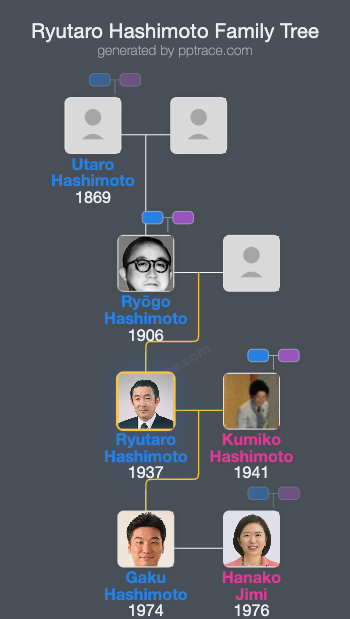
Family Tree
Tap  to expand more relatives
Introduction
Ryutaro Hashimoto (橋本 龍太郎, Hashimoto Ryūtarō) was born on July 29, 1937, in Sōja, Okayama Prefecture, Japan. His father, Ryōgo Hashimoto, served as a cabinet minister under Prime Minister Nobusuke Kishi. Hashimoto graduated from Keio University with a degree in political science in 1960. He further studied Chinese at National Taiwan Normal University.
He was elected to the House of Representatives of Japan in 1963, beginning his political career. Hashimoto was affiliated with the Liberal Democratic Party (LDP) and rose through its ranks over the course of two decades. He served as Minister of Health and Welfare under Prime Minister Masayoshi Ōhira in 1978, and in 1980, he became the LDP's director of finance and public administration. In 1986, he returned as a cabinet minister under Prime Minister Yasuhiro Nakasone. Hashimoto also served as Secretary General of the LDP in 1989, a position second in authority within the party.
He became a prominent figure within the Tanaka/Takeshita faction, which was established by Kakuei Tanaka in the 1970s and later led by Noboru Takeshita. In the early 1990s, Hashimoto's career was marred by a scandal involving a secretary's illegal financial dealings, which led to his retirement from the position of Minister of Finance in the Second Kaifu Cabinet. During the collapse of Japan's bubble economy, the LDP experienced a temporary loss of power in 1993 and 1994 during coalition formations led by Ichirō Ozawa.
In 1994, Hashimoto returned to the cabinet as Minister of International Trade and Industry (MITI) under Prime Minister Tomiichi Murayama. As MITI chief, he gained recognition at meetings such as APEC and at summit conferences. Following the retirement of Yōhei Kōno in September 1995, Hashimoto was elected as the President of the LDP, defeating Jun'ichirō Koizumi with 304 votes to 87. He subsequently became deputy prime minister and was considered a leading candidate for prime ministership.
Hashimoto was elected as Japan’s 82nd prime minister in 1996, succeeding Murayama, and served until 1998. His first cabinet, known as the First Hashimoto Cabinet, was supported by a coalition with the Social Democratic Party and the New Party Sakigake. During his tenure, Hashimoto negotiated the repatriation of Marine Corps Air Station Futenma, a U.S. military base located in Okinawa, with the agreement made in April 1996. The deal faced opposition from some Japanese government agencies and local residents.
His domestic policy included efforts to confront trade disputes with the United States, and he ordered an investigation into opening the Japanese market to foreign competition. In September 1996, Hashimoto dissolved the lower house of the National Diet, leading to a general election in October, in which the LDP gained seats but did not restore a majority in the upper house. His government was the first since 1993 to be a single-party LDP administration.
The government increased the Japanese consumption tax in 1997, a move that negatively affected consumer demand despite prior reductions in personal income taxes. In 1998, the LDP failed to regain its majority in the upper house during the regular election. Hashimoto resigned as prime minister and LDP leader, succeeded by Keizō Obuchi.
After leaving the premiership, Hashimoto remained influential within the LDP, leading his faction for several years. He was a candidate for prime minister in 2001 but was defeated by Junichiro Koizumi. His faction declined in influence by 2003, and in December 2004, Hashimoto resigned as faction leader following a scandal involving a donation from the Japan Dental Association. He announced his retirement from politics in 2005.
In 2004, Hashimoto was appointed chairman of the United Nations global advisory board on Water and Sanitation, and in that capacity, he contributed to water-related initiatives aimed at reducing water disasters globally.
He was married to Kumiko Hashimoto, with whom he had two sons and three daughters, named Ryu, Gaku, Hiroko, Atsuko, and Danko.
In June 2006, Hashimoto was hospitalized for surgery to remove a large part of his colon. He died on July 1, 2006, at the age of 68, from complications related to multiple organ failure and septic shock at the National Center for Global Health and Medicine in Tokyo, shortly before his 69th birthday.