John Thomas Perceval
| Name | John Thomas Perceval |
| Title | British army officer |
| Gender | Male |
| Birthday | 1803-02-14 |
| nationality | United Kingdom of Great Britain and Ireland |
| Source | https://www.wikidata.org/wiki/Q2153404 |
| pptrace | View Family Tree |
| LastUpdate | 2025-11-26T12:32:00.862Z |
Family Tree
Tap  to expand more relatives
Introduction
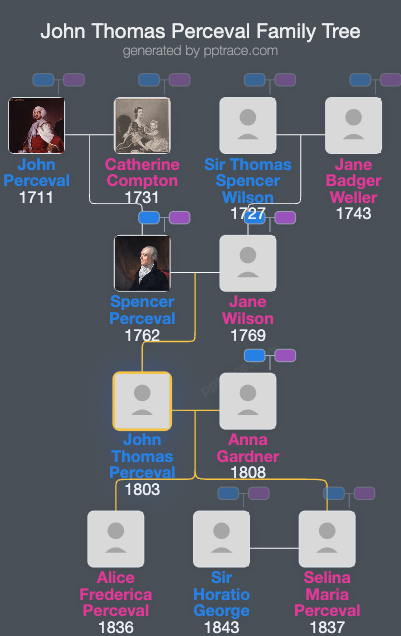
John Thomas Perceval (14 February 1803 – 28 February 1876) was a British army officer and mental health advocate. He was born into the ruling class of the United Kingdom; his father, Spencer Perceval, was a lawyer, politician, and Prime Minister in 1809. Perceval was the tenth of thirteen children, with twelve surviving infancy. At age nine, his father was assassinated in the House of Commons lobby by John Bellingham, a merchant with a grievance against the government. Bellingham was believed to be mentally ill, and he was executed after pleading innocence at his trial. Witnessing his father's death is believed to have influenced Perceval's later mental health struggles.
Perceval attended Harrow School, followed by a year with a private tutor. He received a commission in the army, serving initially in a cavalry regiment and later as a captain in the Grenadier Guards. His military service included tours in Portugal and Ireland; he did not engage in combat. Feeling increasingly alienated from military life due to his sober religious nature, Perceval sold his commission in 1830 and enrolled at Hertford College, Oxford. However, he did not complete a second term and instead embarked on a spiritual journey to Scotland, where he engaged with a radical evangelical sect that claimed to perform miracles and speak in tongues. He believed he was guided by the Holy Spirit during this period.
Following his visit to Scotland, Perceval traveled to Ireland, where he became disillusioned with religion, engaged in sexual activity, and was treated for a sexually transmitted infection with mercury. His behavior became bizarre, leading friends to restrain him, and his brother Spencer arranged for his confinement in a lunatic asylum. His mental health deteriorated to the point that he was admitted to private asylums, notably Brislington House near Bristol and subsequently Ticehurst House in Sussex.
While at Brislington Asylum, Perceval experienced harsh treatment, including deprivation, restraint in a straitjacket, cold baths, and an operation to sever his temporal artery. Once his mental state improved, he was transferred to Ticehurst Asylum, where he sought and eventually obtained his release in early 1834. Afterward, he married Anna Lesley Gardner, a cheesemonger's daughter, with whom he had four daughters: Jane Beatrice (1835–1893), Alice Frederica (1836–1941), Selina Maria (1838–1925), who married Sir Horatio George Walpole, and Fanny Louisa Charlotta (1845–1862). The family resided in Paris for a time, where Perceval authored a book about his asylum experiences.
His book, titled "A Narrative of the Treatment Experienced by a Gentleman During a State of Mental Derangement" (published anonymously in 1838), detailed his treatment in asylums and was later followed by a second volume published in 1840, which included correspondence and his experiences fighting for his independence during confinement. This work was republished by anthropologist Gregory Bateson in 1962 and is recognized in recent years as pioneering mental health advocacy.
Perceval devoted the remainder of his life to campaigning for reform of the lunacy laws and better treatment of inmates in asylums. In 1845, he co-founded the Alleged Lunatic’s Friend Society, serving as its honorary secretary for approximately twenty years. The Society aimed to prevent wrongful confinement, promote humane treatment, and reform mental health legislation. The organization engaged in parliamentary advocacy, court cases, and public lectures, exposing abuses in numerous asylums, including Bethlem Hospital and facilities in Northampton and Gloucester.
Perceval personally assisted patients such as Edward Peithman, a German scholar detained in Bethlem for 14 years, and facilitated his release and repatriation to Germany. He also published pamphlets critiquing mental health practices and the Poor Law. In 1854, he addressed the issue directly in a public lecture in Kensington. In 1859, he provided evidence before a parliamentary select committee on lunacy treatment, advocating for protections against wrongful detention, patient rights, medical consent, and improved asylum conditions. Despite his efforts, the committee's recommendations did not result in new legislation, and the Society eventually declined in influence.
Later, the movement for reform was continued by organizations such as Louisa Lowe’s Lunacy Law Reform Association. Perceval's contributions to mental health reform and survivors' advocacy are recognized historically, with his writings and efforts contributing significantly to the development of psychiatric rights and practices.