John Manners, 3rd Duke Of Rutland
| Name | John Manners, 3rd Duke Of Rutland |
| Title | English nobleman (1696-1779) |
| Gender | Male |
| Birthday | 1696-10-21 |
| nationality | Great Britain |
| Source | https://www.wikidata.org/wiki/Q3809451 |
| pptrace | View Family Tree |
| LastUpdate | 2025-11-26T23:21:34.124Z |
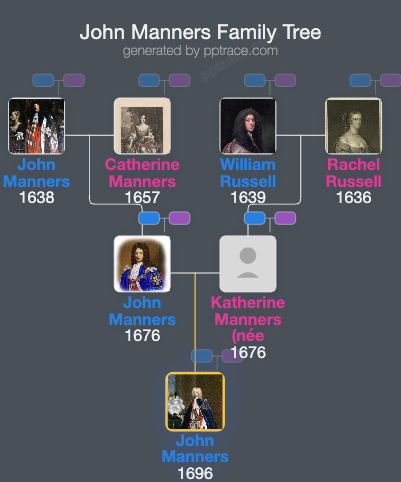
Family Tree
Tap  to expand more relatives
Introduction
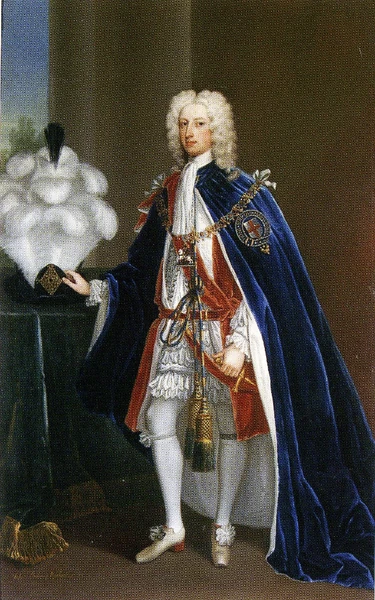
John Manners, 3rd Duke of Rutland KG PC (21 October 1696 – 29 May 1779), was an English nobleman and political figure. He was the eldest son of John Manners, 2nd Duke of Rutland, and Catherine Russell. He was styled Marquess of Granby from 1711 until he inherited the dukedom in 1721.
He was educated in England and briefly served in the House of Commons, representing Rutland as a Whig from January 1719 to February 1721. His parliamentary career was cut short upon inheriting the dukedom in 1721.
Throughout his lifetime, he held various government and court positions, including Lord Lieutenant of Leicestershire (1721–1779), Chancellor of the Duchy of Lancaster (1727–1736), Lord Steward of the Household (1755–1761), and Master of the Horse (1761–1766). He was appointed a Knight of the Order of the Garter in 1722 and was sworn into the Privy Council in 1727. Additionally, he served as a director of the Royal Academy of Music, establishing a London opera company that commissioned works from composers such as Handel and Bononcini. His support extended to social causes; he was one of the founding governors of London's Foundling Hospital, which received its royal charter in 1739.
The city of Rutland, Vermont, is named after him.
In the realm of art collection, John Manners was an active collector from 1742 onwards. He acquired paintings, drawings, and prints through auctions in London, employing agents for private purchases. His inherited collection included Old Masters and ancestral portraits, favoring smaller artworks. He was known to prefer works that he could transport himself, leading him to acquire smaller pieces from major European painters, including Raphael, Titian, Bassano, Veronese, Guido Reni, and Northern Italian artists, particularly Claude and the Poussins. Over time, he spent approximately £3,210 on art purchases, a figure considered approximate. His collection was distinguished not only by its quality but also by the nature of its size and scope. In the mid-1750s, he sold approximately 200 paintings.
In 1747, he introduced an expanded form of chess played on a 140-square board. This variant featured additional pieces such as concubines (combining rook and knight moves), crowned rooks (with diagonal capturing ability), extra bishops, knights, and six pawns, making it more complex than standard chess. The game gained popularity among contemporary players and is still played.
He married Bridget Sutton in 1717, who was the heiress of Robert Sutton, 2nd Baron Lexinton. The couple had eleven children, most of whom died young. Their surviving children included John Manners, Marquess of Granby (1721–1770); Lord Robert Manners-Sutton (1722–1762); Lord George Manners-Sutton (1723–1783); and Lord Frederick Manners (b. 1728). Several of his children died in childhood, including Lady Catherine Rachel Manners, Lady Caroline Manners, twins Lady Frances and Lady Bridget Manners, Lord William Manners, Lady Leonora Manners, and Lady Frances Manners, who died in 1739.
John Manners, 3rd Duke of Rutland, died in 1779 at the age of 82 at Rutland House in Knightsbridge, London. He was buried in the mausoleum at Belvoir Castle.
His coat of arms and further references are documented in various historical and genealogical sources, including scholarly works on British art collectors and noble lineage.