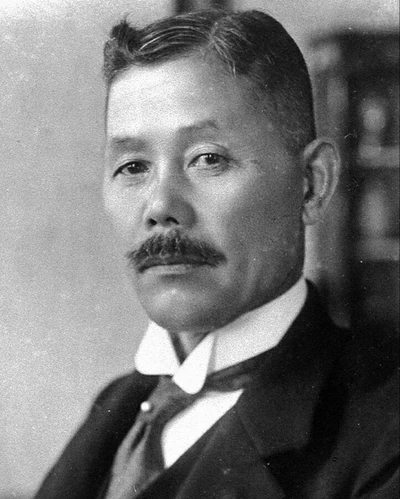
Wakatsuki Reijirō
| Name | Wakatsuki Reijirō |
| Title | Japanese politician |
| Gender | Male |
| Birthday | 1866-03-21 |
| nationality | Japan |
| Source | https://www.wikidata.org/wiki/Q335177 |
| pptrace | View Family Tree |
| LastUpdate | 2025-11-17T10:08:37.909Z |
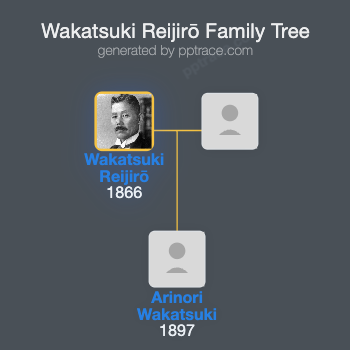
Family Tree
Tap  to expand more relatives
Introduction
Reijirō Wakatsuki (若槻 禮次郎) was born on 21 March 1866 in Matsue, Izumo Province, which is present-day Shimane Prefecture, Japan. He was the second son of Okumura Sensaburō, a samurai foot soldier (ashigaru), and his wife Kura. Despite belonging to a family of samurai heritage, the family was economically disadvantaged and engaged in various side jobs to sustain themselves. Wakatsuki's mother died when he was three years old. His father and eldest brother were ordered to work in Yamazaki, Kyoto, by the Matsue Domain, leading the household responsibilities to be managed by his 11-year-old older sister, Iwa.
The Okumura family was of low-ranking samurai status within the ashigaru class, and they lived in a rented house on the outskirts of Sakaimachi because they could not afford residence near the town center. By the time of Reijirō's birth, his father had constructed a small house in Nishitanaka. During his childhood, he wore only a single wooden sword when commuting to temple school, and his family circumstances limited his educational opportunities. After elementary school, he briefly attended a Chinese literary school before enrolling in a middle school in Matsue; however, he had to withdraw after eight months due to financial difficulties.
Following this, Wakatsuki engaged in manual labor, such as collecting firewood, and assisted with household chores. At 16 years old, he worked as an elementary school substitute teacher. In 1883, he sought to enter the Imperial Japanese Army Academy but failed the physical examination. The following year, he considered applying to the Law School of the Ministry of Justice, which covered tuition costs, but the examination was held in Tokyo, and he lacked funds for travel. With assistance from his uncle, who was the head of Nogi District, he borrowed 30 yen and in 1884 left Matsue at age 19.
In 1892, Wakatsuki enrolled in Tokyo Imperial University, studying law. He adopted the surname Wakatsuki after marrying into a family without a male heir. After graduating, he began working at the Ministry of Finance as a tax bureau director and later served as vice-minister. In 1911, he was appointed to the House of Peers. He served as Minister of Finance under Prime Minister Katsura Takaaki in the early 1910s and was an influential member of the Rikken Dōshikai party, which later evolved into the Kenseikai.
Wakatsuki was appointed Home Minister in June 1924 under Prime Minister Katō Takaaki, during which he contributed to the passage of the Universal Manhood Suffrage Law and the Peace Preservation Law in 1925. Following Prime Minister Katō's death in January 1926, Wakatsuki succeeded him as Prime Minister, serving from 30 January 1926 until 20 April 1927, when he resigned amid the Shōwa financial crisis.
He maintained active involvement in various activities, including jiu-jitsu, archery, fishing, and sailing. In 1928, he was awarded the Order of the Paulownia Flowers. Wakatsuki served as plenipotentiary at the London Naval Conference in 1930, advocating for disarmament treaties, which drew criticism from the military and ultranationalist factions.
He became Prime Minister again in April 1931, serving until December of the same year, during which time he was unable to control the Imperial Japanese Army's actions, including the occurrence of the Manchurian Incident. In April 1931, he was elevated to the peerage as a baron (danshaku), within the kazoku system.
After retiring from the premiership, Wakatsuki served as president of the Rikken Minseitō starting in July 1934. Throughout the increasing militarization of Japan, he opposed the Second Sino-Japanese War and later expressed his desire for the war to end swiftly. In May 1945, he approached Prime Minister Kantarō Suzuki to facilitate negotiations with the United States and participated in a government panel recommending unconditional surrender following Japan's defeat.
Following World War II, Wakatsuki was summoned as a prosecution witness at the International Military Tribunal for the Far East in June 1946. He died of angina pectoris at his summer residence in Itō, Shizuoka, on 20 November 1949. His burial site is located at Somei Cemetery in Tokyo.
Wakatsuki received several Japanese honors, including the Grand Cordon of the Order of the Sacred Treasure in 1911, the Grand Cordon of the Order of the Rising Sun in 1916, and the Grand Cordon of the Order of the Rising Sun with Paulownia Flowers in 1928. He was created a baron (danshaku) in April 1931.