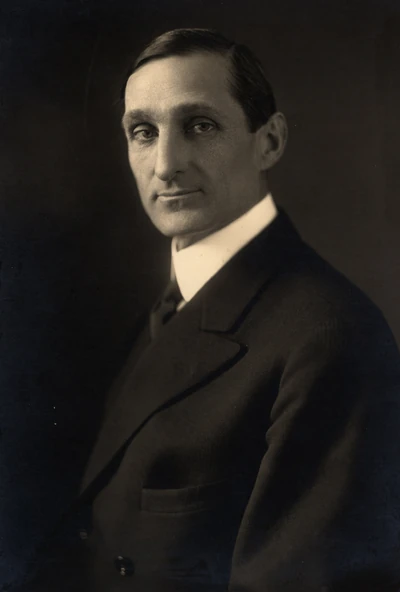
William Gibbs McAdoo
| Name | William Gibbs McAdoo |
| Title | American politician (1863-1941) |
| Gender | Male |
| Birthday | 1863-10-31 |
| nationality | United States of America |
| Source | https://www.wikidata.org/wiki/Q741058 |
| pptrace | View Family Tree |
| LastUpdate | 2025-11-17T06:43:12.117Z |
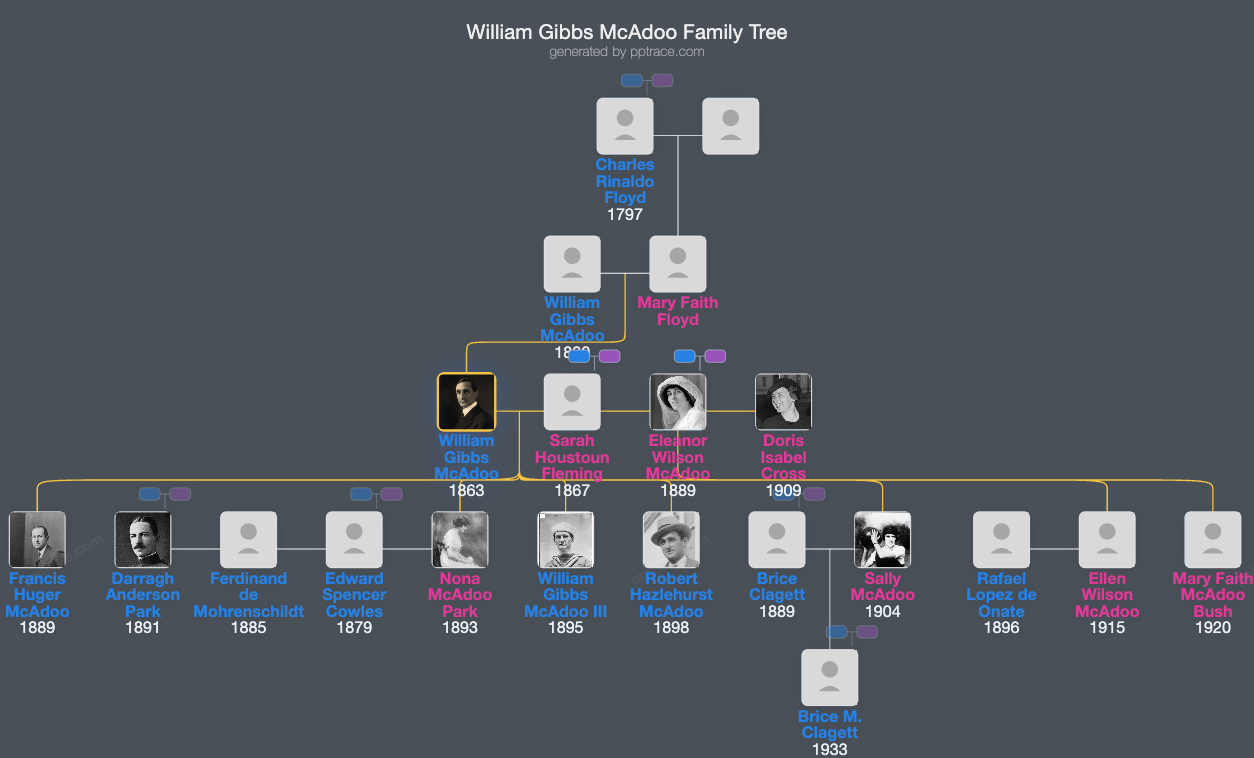
Family Tree
Tap  to expand more relatives
Introduction
William Gibbs McAdoo Jr. (October 31, 1863 – February 1, 1941) was an American lawyer and statesman. He is known for his involvement in the Progressive movement and his roles within the administration of President Woodrow Wilson, who was his father-in-law. McAdoo was affiliated with the Democratic Party and served as a United States Senator representing California.
Born in Marietta, Georgia, McAdoo was the son of author Mary Faith Floyd and attorney William Gibbs McAdoo. During the Civil War era, his family resided in the historic William Gibbs McAdoo House in Marietta. His uncle, John David McAdoo, served as a Confederate general and a justice of the Texas Supreme Court. In 1877, his family relocated to Knoxville, Tennessee, where his father became a professor at the University of Tennessee. McAdoo graduated from the University of Tennessee and was a member of the Lambda chapter of Kappa Sigma fraternity.
In 1882, he was appointed deputy clerk of the United States District Court for the Eastern District of Tennessee. He married Sarah Hazelhurst Fleming on November 18, 1885, with whom he had seven children: Harriet Floyd McAdoo, Francis Huger McAdoo, Julia Hazelhurst McAdoo, Nona Hazelhurst McAdoo, William Gibbs McAdoo III, Robert Hazelhurst McAdoo, and Sarah Fleming McAdoo. He was admitted to the Tennessee bar in 1885 and established a legal practice in Chattanooga, Tennessee.
During the early 1890s, McAdoo experienced financial difficulties while attempting to electrify the Knoxville Street Railroad system. In 1892, he relocated to New York City, where he partnered with Francis R. Pemberton to form the law firm Pemberton and McAdoo, focusing on investment securities. In 1895, he returned to Knoxville to regain control of a bankrupt streetcar company and subsequently engaged in a control struggle over the city's streetcar system, culminating in the incident known as the Battle of Depot Street. After litigation favored his opponent, C.C. Howell, McAdoo abandoned his streetcar pursuits in 1897 and returned to New York.
Around 1900, McAdoo became involved in the development of the Uptown Hudson Tubes—a pair of railroad tunnels under the Hudson River connecting Manhattan and New Jersey. As president of the Hudson and Manhattan Railroad Company, he oversaw the completion and opening of two passenger tubes in 1908, which are now part of the PATH train system. He gained recognition through promotional activities, including giving tours to political leaders and foreign dignitaries.
McAdoo met Woodrow Wilson in 1910, near the end of Wilson’s tenure as Princeton University president. He supported Wilson’s campaign for governor of New Jersey and later served as vice chairman of the Democratic National Committee. In 1912, he played a significant role as co-chair of Wilson's successful presidential campaign.
In 1914, McAdoo married Eleanor Randolph Wilson, the daughter of President Wilson, at the White House. They had two daughters: Ellen Wilson McAdoo (1915–1946) and Mary Faith McAdoo (1920–1988). McAdoo’s second marriage ended in divorce in July 1935, and in September of the same year, he married Doris Isabel Cross, a 26-year-old nurse.
From 1913 to 1918, McAdoo served as the United States Secretary of the Treasury. During his tenure, he was instrumental in establishing the Federal Reserve System. His leadership during the early period of World War I included managing a financial crisis precipitated by the outbreak of the war in Europe. In July and August 1914, he took measures to prevent a market collapse by closing the New York Stock Exchange for four months, averting a potential panic and stabilizing the U.S. economy.
After leaving the Cabinet in 1919, McAdoo co-founded the law firm McAdoo, Cotton & Franklin. He sought the Democratic presidential nomination in 1920, a move opposed by President Wilson, who aimed to secure a third term. In 1922, McAdoo moved to California and again sought the Democratic nomination in 1924, but the party nominated John W. Davis instead.
Later, McAdoo was elected to the United States Senate in 1932 but was defeated in his bid for a second term. He died of a heart attack in 1941 while traveling from the inauguration of President Franklin D. Roosevelt.