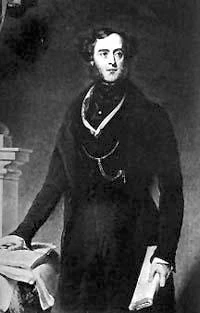
Lord George Bentinck
| Name | Lord George Bentinck |
| Title | British politician (1802-1848) |
| Gender | Male |
| Birthday | 1802-02-27 |
| nationality | United Kingdom of Great Britain and Ireland |
| Source | https://www.wikidata.org/wiki/Q332933 |
| pptrace | View Family Tree |
| LastUpdate | 2025-11-26T23:25:35.349Z |
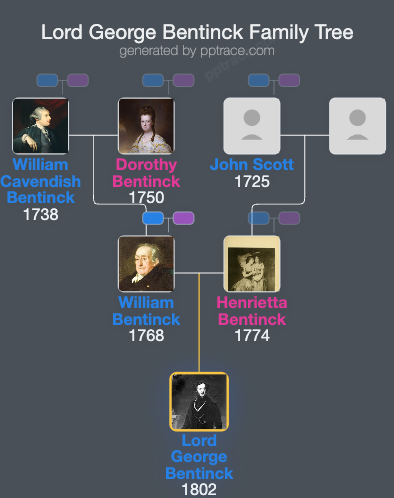
Family Tree
Tap  to expand more relatives
Introduction
Lord William George Frederick Cavendish-Scott-Bentinck, known as Lord George Bentinck, was born on 27 February 1802 and died on 21 September 1848. He was an English politician affiliated with the Conservative Party and was also involved in racehorse ownership and management.
Family Background:
Bentinck was a member of the prominent Bentinck family. He was the fifth child and third son of William Bentinck, the 4th Duke of Portland, and Henrietta Scott. His maternal grandfather was General John Scott of Fife. All male members of his family bore the first name William, he was commonly referred to as George. He was raised primarily on his father's estates at Welbeck Abbey in Nottinghamshire and at Fullarton House near Troon, Ayrshire.
Early Career:
In 1818, Bentinck and his elder brother John joined the British Army. Bentinck served as an officer in the 9th Lancers but experienced conflicts with his superior, Captain John Ker, including a formal charge of insubordination. The incident nearly led to a duel in Paris, which was prevented by intervention from George Canning, Bentinck's uncle. Subsequently, Bentinck returned to England and was transferred between regiments with intentions of proceeding to India. In 1822, he was appointed as aide-de-camp to Canning, who was then the Foreign Secretary. Following the death of their elder brother, Henry, in 1824, Bentinck took a commission in the Life Guards at his father's suggestion, attaining the rank of major but leaving the regiment after a duel over mess accounts in 1825.
Political Career:
Bentinck initially served as a Whig Member of Parliament representing King's Lynn, a position he held until his death. Around 1835–36, he shifted allegiance to the Conservative Party, aligning with the Derby faction. He gained prominence in politics during the 1840s, particularly for his opposition to the repeal of the Corn Laws. In 1846, he, alongside Benjamin Disraeli, led the protectionist faction in Parliament that opposed the repeal, marking a significant shift in his political activity after 18 years of silence in Parliament. His relationship with Disraeli was notable; in 1848, he offered a loan to Disraeli to facilitate the purchase of Hughenden Manor.
Racehorse Ownership and Contributions:
Before focusing on politics, Bentinck was a well-known figure in the horse racing community. He was an avid gambler and owned several successful racehorses. His stable was established at Goodwood and was famous for its quality. In 1845, it was estimated he had won more than £100,000 from racing. Bentinck sought reforms in horse racing, exposing fraudulent practices and proposing new rules, including the invention of the flag start at Goodwood. Despite his aristocratic image and a volatile temper, which once nearly resulted in a duel over an unpaid debt, he was regarded as an innovator in the sport. In 1846, he sold his racing stables to focus on political pursuits.
Political Leadership and Later Activities:
As a protectionist, Bentinck is credited with significantly influencing the opposition to Sir Robert Peel's repeal of the Corn Laws. His speech against repeal was his first in Parliament in 18 years. His partnership with Disraeli helped to push Peel from office, although the repeal ultimately persisted. Bentinck’s leadership of the protectionist Conservative faction was short-lived; he resigned as leader in 1848 due to disagreements over Jewish emancipation, which was unpopular with much of the party, and was succeeded by the Marquess of Granby.
In foreign policy, Bentinck, with Thomas Macaulay, opposed John Stuart Mill’s suggestion to include Indian philosophy and language in education, favoring the promotion of English literature and science instead.
Death and Legacy:
Bentinck died on 21 September 1848 at the age of 46. His body was recovered near Thoresby Hall after he was reported missing. The initial autopsy indicated emphysema and lung congestion; rumors of suicide or foul play existed but were not supported by the autopsy findings. He was unmarried, with reports suggesting a lack of interest in romantic relationships. Bentinck was interred in the Duke of Portland vault at Marylebone Old Church in London. His memorials include a statue in London's Cavendish Square Gardens, a sculpture near Worksop, and a large gothic memorial at Mansfield.
Posthumously, Charles Greville remarked that Bentinck combined vigor and intellect in his political work, but suggested that his fame had possibly peaked before his death. The Department of Manuscripts and Special Collections at the University of Nottingham holds his personal papers and correspondence as part of the Portland Collection.