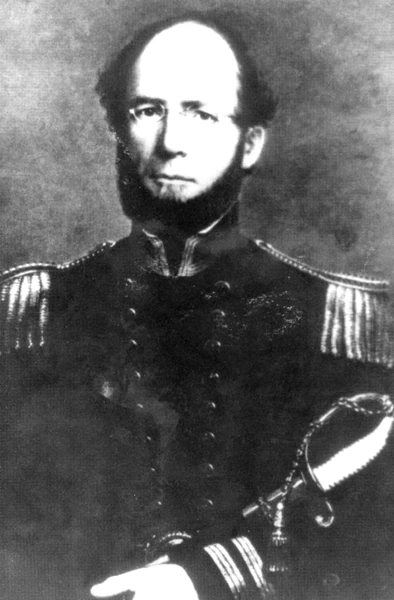
William Lewis Herndon
| Name | William Lewis Herndon |
| Title | American explorer |
| Gender | Male |
| Birthday | 1813-10-25 |
| nationality | United States of America |
| Source | https://www.wikidata.org/wiki/Q8014559 |
| pptrace | View Family Tree |
| LastUpdate | 2025-11-17T06:41:17.916Z |
Family Tree
Tap  to expand more relatives
Introduction
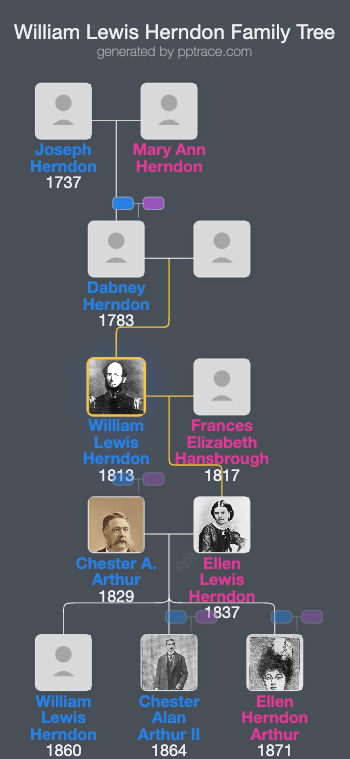
William Lewis Herndon was born on October 25, 1813, in Fredericksburg, Virginia. His parents were Elizabeth (née Hull) and Dabney Herndon; his father was employed as a cashier. He married Frances Elizabeth Hansborough, and together they had a daughter, Ellen Lewis Herndon, who later married Chester A. Arthur, the 21st President of the United States. Herndon’s great-niece was the novelist Lucy Herndon Crockett.
Herndon was appointed midshipman in the United States Navy on November 1, 1828. He was promoted to passed midshipman in 1834 and to lieutenant in 1841. His naval service included cruises in the Pacific, South American, Mediterranean, and Gulf waters from that time until 1842. Between 1842 and 1846, he served at the Depot of Charts and Instruments of the U.S. Naval Observatory alongside his first cousin and brother-in-law, Matthew Fontaine Maury, engaging in oceanographic and scientific work related to navigation.
During the Mexican–American War, Herndon commanded the brig Iris. In 1851, he led an expedition to explore the Valley of the Amazon, an area largely uncharted by Europeans but inhabited by numerous indigenous tribes for thousands of years. The expedition aimed to assess the region’s commercial resources and potential. Departing Lima, Peru, on May 21, 1851, Herndon and his party traveled through the jungles, crossing the Andes mountains, and explored the main trunk of the Amazon River. Lieutenant Lardner Gibbon and five others initially accompanied him, with Gibbon later exploring Bolivian tributaries separately. Herndon’s journey covered approximately 4,366 miles and reached the city of Pará, Brazil, on April 11, 1852.
In 1853, Herndon submitted an extensive report on his Amazon exploration to the Secretary of the Navy, John P. Kennedy. The report, published in 1854 as "Exploration of the Valley of the Amazon," was widely circulated and influential in ethnological and natural history studies.
In 1855, Herndon was assigned as commander of the SS Central America, operated by the Atlantic Mail Steamship Company, on the route between New York and Aspinwall, Panama. At that time, the ship carried large quantities of gold, estimated to be around 15 tons worth approximately two million dollars, along with 474 passengers and 101 crew members.
On September 7, 1857, the ship encountered a three-day hurricane off Cape Hatteras. The storm caused significant damage, including multiple leaks that compromised the vessel’s seaworthiness and extinguished its fires. Recognizing the imminent danger, Herndon raised a distress signal by flying the ship’s flag upside down. On September 12, the Central America sank off Cape Hatteras, resulting in the loss of over 400 lives, the largest in U.S. commercial maritime history. Prior to the sinking, Herndon supervised the rescue of 152 women and children by transferring them to the brig Marine. According to survivor accounts, Herndon was last seen standing at the wheelhouse, with his head bowed in prayer as the ship went down, having refused to abandon his post.
Herndon’s death marked a significant maritime disaster, with the wreckage later discovered in 1987. His actions during the storm and the rescue efforts contributed to his recognition and memorials, including the placement of the Herndon Monument at the United States Naval Academy in Annapolis in 1860. In 2021, the ship’s bell from the Central America was recovered from the wreckage and was subsequently dedicated at the Naval Academy in 2022.
Two U.S. Navy ships have been named USS Herndon in his honor. Additionally, the towns of Herndon, Virginia, and Herndon, Pennsylvania, are named after him.