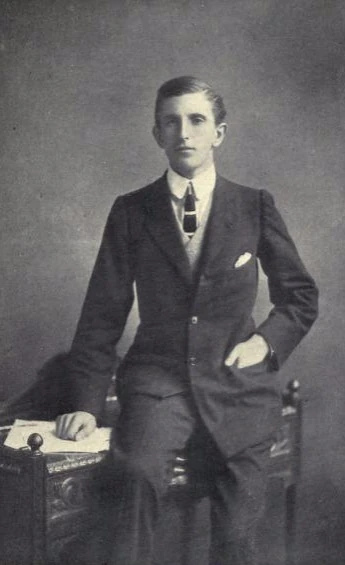
William Glynne Charles Gladstone
| Name | William Glynne Charles Gladstone |
| Title | British politician |
| Gender | Male |
| Birthday | 1885-07-14 |
| nationality | United Kingdom of Great Britain and Ireland |
| Source | https://www.wikidata.org/wiki/Q8009936 |
| pptrace | View Family Tree |
| LastUpdate | 2025-11-26T23:30:19.715Z |
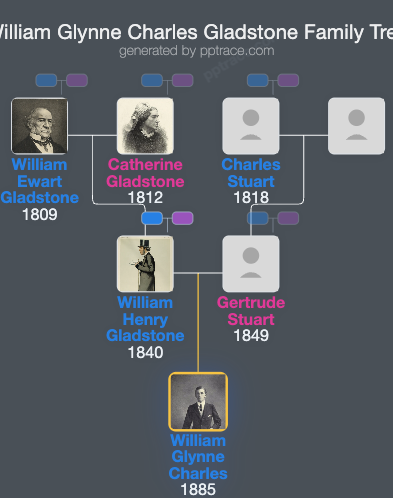
Family Tree
Tap  to expand more relatives
Introduction
William Glynne Charles Gladstone was born on 14 July 1885. He was a member of the Liberal Party in the United Kingdom and was the last of four generations of the Gladstone family to serve in the House of Commons. His great-grandfather was Sir John Gladstone (1764–1851). Gladstone's father was William Henry Gladstone (1840–1891), the eldest son of the Liberal Prime Minister William Ewart Gladstone and his wife Catherine. His mother was the Hon. Gertrude Gladstone, daughter of Charles Stuart, 12th Lord Blantyre.
Gladstone inherited Hawarden Castle from his father. The estate had historical connections to Sir Stephen Glynne, 9th and last baronet, who was related through his grandmother's family. His early education was conducted at home, after which he attended Eton College. He later studied at New College, Oxford, where he was president of the Oxford Union in 1907 and graduated with a second class degree.
In 1909, Gladstone served as Assistant Private Secretary to John Hamilton-Gordon, Earl of Aberdeen, who was the Lord Lieutenant of Ireland. Two years later, in 1911, he spent a few months working at the British Embassy in Washington, D.C., as an honorary attaché to Lord Bryce. That same year, he stood as the Liberal Party candidate in the Kilmarnock Burghs by-election held on 26 September 1911 and was elected as a Member of Parliament (MP). He served as a whip in Prime Minister H. H. Asquith's government and remained in Parliament until 1915.
Gladstone enlisted in the British Army shortly after the outbreak of the First World War. On 15 August 1914, he was commissioned as a second lieutenant (on probation) in the 3rd Battalion, Royal Welsh Fusiliers. He initially wished to enlist as a private but was advised to become an officer. After training in Wrexham, he was deployed to France in March 1915. He first came under fire on 23 March of that year. His commission was confirmed, and he was promoted to lieutenant on 7 April 1915.
William Glynne Charles Gladstone was killed in action on 13 April 1915 near Laventie, France, three weeks after arriving in the country. He was shot by a sniper. He was initially buried in France, but King George V granted permission for his body to be repatriated. On 22 April 1915, his body was disinterred and reburied in the churchyard of St Deiniol's in Hawarden, Flintshire, Wales. His gravestone also commemorates his cousin William Herbert Gladstone, MC, who was killed in action in 1918.
Memorials to Gladstone include a rood installed at St Deiniol's Church and a new theatre and wards at Chester Royal Infirmary. He is also remembered on Panel 8 of the Parliamentary War Memorial in Westminster Hall and by heraldic shields in the House of Commons Chamber. In 1932, a manuscript-style book of remembrance for the House of Commons included a biographical account of his life and death.
In addition to his military and political service, Gladstone was appointed Lord Lieutenant of Flintshire on 8 July 1911, a position that also conferred the title of Custos Rotulorum of Flintshire. His estate was later purchased by his uncle, Henry Gladstone. His uncle Herbert Gladstone authored a memoir published in 1918 recounting his life.