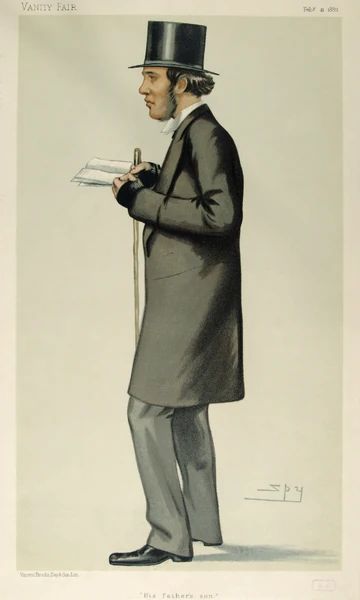
William Henry Gladstone
| Name | William Henry Gladstone |
| Title | British politician (1840-1891) |
| Gender | Male |
| Birthday | 1840-06-03 |
| nationality | United Kingdom of Great Britain and Ireland |
| Source | https://www.wikidata.org/wiki/Q4020043 |
| pptrace | View Family Tree |
| LastUpdate | 2025-11-26T23:30:13.489Z |
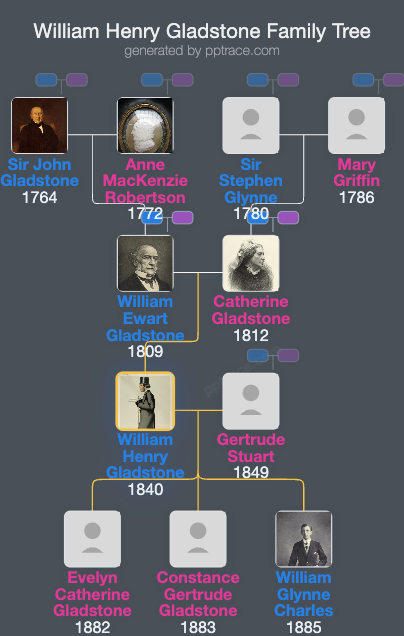
Family Tree
Tap  to expand more relatives
Introduction
William Henry Gladstone (3 June 1840 – 4 July 1891) was a British politician and the eldest son of William Ewart Gladstone, who served as Prime Minister of the United Kingdom, and his wife Catherine Glynne. He was born in Hawarden, Flintshire, Wales.
Gladstone received his education at Eton College and subsequently studied Greek and Latin at Christ Church, Oxford University. His political career included serving as a Member of Parliament (MP) for a total of 20 years, representing three constituencies during his tenure. He was the MP for Chester for three years, Whitby for twelve years, and East Worcestershire for five years.
In addition to his political activities, William Henry Gladstone demonstrated musical talents as a singer and organist. He possessed a comprehensive knowledge of musical history, with particular emphasis on the development of Anglican church music. He authored writings on musical subjects, including opinions on church services and choral singing, notably expressing the view that "the choirs often discourage the congregations from singing." His compositions include the anthems "Gracious and Righteous" and "Withdraw Not Thou," along with various chants, anthems, introits, and organ voluntaries. He also composed hymn tunes such as "Hammersmith," sometimes used for the hymn "Dear Lord and Father of Mankind," and "Ombersley," which is occasionally set for "Lord of All Being, Throned Afar."
Gladstone participated as a football player in the first unofficial England versus Scotland football international match in 1870. Notably, he was one of only two sitting MPs who played for Scotland in this match; the other was John Wingfield Malcolm, MP for Boston.
Following the death of his maternal uncle, Sir Stephen Glynne, in 1874, William Henry Gladstone inherited the Glynne family estates, including Hawarden Castle. The inheritance came after the extinction of the Glynne baronetcy, which had become extinct upon Sir Stephen Glynne’s death without heirs. The Glynne estates had significant historical importance, as Hawarden had been the family seat since his grandfather Sir John Gladstone used his wealth to help the Glynne family during the 1840s.
In 1888, Gladstone was appointed High Sheriff of Flintshire. He died in London on 4 July 1891. His son, William Glynne Charles Gladstone, inherited Hawarden Castle. William Henry Gladstone’s funeral at Hawarden was reported to have been widely attended, with the local community recognizing him as a benefactor.
External references related to William Henry Gladstone include contributions he made in Parliament, portraits at the National Portrait Gallery, and works authored by or about him available on Project Gutenberg and the Internet Archive.