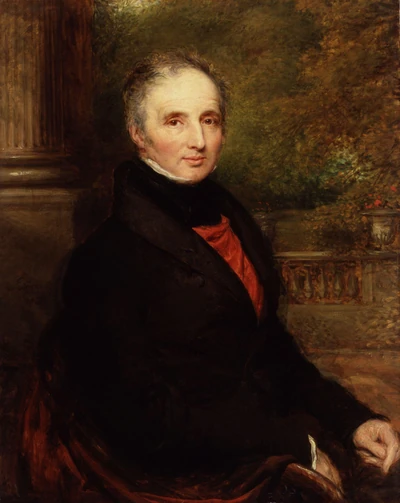
Peter King, 7th Baron King
| Name | Peter King, 7th Baron King |
| Title | English politician and economic writer |
| Gender | Male |
| Birthday | 1776-08-00 |
| nationality | — |
| Source | https://www.wikidata.org/wiki/Q15126940 |
| pptrace | View Family Tree |
| LastUpdate | 2025-11-26T23:23:35.805Z |
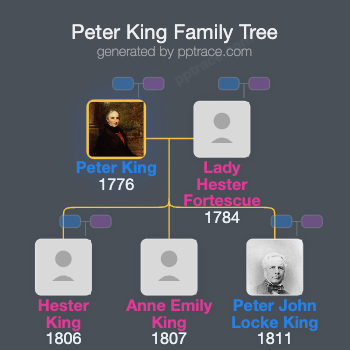
Family Tree
Tap  to expand more relatives
Introduction
Peter King, 7th Baron King (born 31 August 1775, died 4 June 1833), was an English nobleman and writer. He was the eldest son of Peter King, 6th Baron King, and Charlotte Tredcroft. He was born in England and baptized on 18 September 1775. King received his education at Eton College and Trinity College, Cambridge. He succeeded to his father's title in 1793.
Following his inheritance, King undertook a brief tour on the European continent before returning to England upon reaching his majority. He subsequently took his seat in the House of Lords. His political alignment followed the Whig tradition of his family. Early in his parliamentary career, he supported Lord Holland's motion for an inquiry into the failures of the Anglo-Russian invasion of Holland, delivering his maiden speech on 12 February 1800. Nonetheless, his participation in debates was infrequent, with notable exceptions including opposition to bills such as the Habeas Corpus Suspension Bill and legislation relating to the suspension of payments by the Bank of England and Ireland.
On 5 February 1807, King expressed strong opposition to the proposed Slave Trade Act 1807 during a debate in the House of Lords. He argued that the abolition of the Atlantic slave trade was justified, criticizing any defense of the trade as a perversion of justice and humanity. He questioned the reliability of colonial legislatures that defended the trade, implying that reliance upon such institutions was misplaced.
In 1811, King issued notice to his leasehold tenants that he would no longer accept notes in payment of rent unless they were discounted according to the lease terms. This action alarmed the government, leading to the introduction of legislation to make Bank of England and Bank of Ireland notes payable on demand as legal tender, and to limit the acceptance of payment in banknotes. King opposed this bill, defending his conduct in a pamphlet, but the legislation was enacted and subsequently expanded in 1812 to make banknotes legal tender universally.
King's political career was prematurely ended by his unexpected death in 1833.
Throughout his life, King held several views on political and economic issues. He was an early critic of the Corn Laws, condemning them as a “job of jobs.” He supported Catholic emancipation, the reform of tithes, and opposed government grants to religious organizations, including the Society for the Propagation of the Gospel in Foreign Parts. He was suspected of sympathies towards Presbyterianism, which drew attacks from contemporary opponents.
In terms of his written works, King authored several pamphlets and books, notably on currency and political subjects. His notable publications include "Thoughts on the Restriction of Payments in Specie at the Banks of England and Ireland" (1803), which discussed the impact of the Bank restrictions and advocated a return to specie payments. This work was reissued with amendments in 1804 and later collected in a volume edited by Earl Fortescue in 1844. Other writings include "A pamphlet On the Conduct of the British Government towards the Catholics of Ireland" (1807), and "The Life of John Locke," published in 1829 with a second edition in 1830. In 1825, he authored "A Short History of the Job of Jobs," an anti-Corn Law pamphlet first published in 1846.
In his family life, King married Lady Hester Fortescue on 26 May 1804. She was the daughter of Hugh Fortescue, 1st Earl Fortescue. They had five children: Hon. Hester King (who married Sir George Craufurd), Hon. Anne King, Hon. Charlotte King (married Reverend Demetrius Calliphronas), William King (later created Earl of Lovelace in 1838), and Hon. Peter John Locke King.
A monument dedicated to Peter King, 7th Baron King, is located in All Saints' Church, Ockham. The church houses the King Chapel, added in 1735, serving as a family vault for the Lords King of Ockham and their descendants. The monument, created by Sir Richard Westmacott, features a white marble bust of the 7th Baron.