Peter John Locke King
| Name | Peter John Locke King |
| Title | English politician |
| Gender | Male |
| Birthday | 1811-01-25 |
| nationality | United Kingdom of Great Britain and Ireland |
| Source | https://www.wikidata.org/wiki/Q7175198 |
| pptrace | View Family Tree |
| LastUpdate | 2025-11-26T23:23:35.000Z |
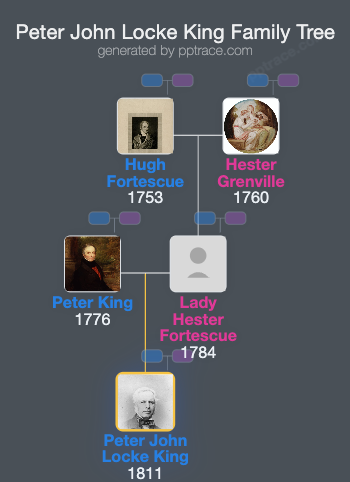
Family Tree
Tap  to expand more relatives
Introduction
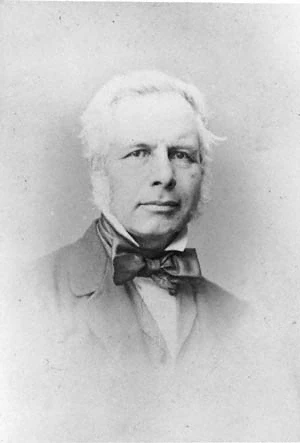
Peter John Locke King was an English politician born on 25 January 1811 in Ockham, Surrey, and died on 12 November 1885 in Weybridge. He was the second son of Peter King, 7th Baron King. His great-great-grandfather was Lord Chancellor Peter King, 1st Baron King. His elder brother was William King-Noel, 1st Earl of Lovelace.
King received his education at Harrow School and later graduated with a Bachelor of Arts degree from Trinity College, Cambridge, in 1831. He obtained his Master of Arts degree in 1833.
In 1837, King contested the parliamentary seat for East Surrey but was unsuccessful. He served as High Sheriff of Surrey in 1840. In the general election of 1847, he was elected as Member of Parliament (MP) for East Surrey on 11 August. He held this seat until the 1874 general election, when he was defeated amid a shift towards more partisan politics and a Conservative resurgence.
Throughout his political career, King was known for advocating legislative reforms. He supported changes to the law of primogeniture and delivered a notable speech on 15 March 1855 emphasizing perceived injustices within the law. On 11 August 1854, he facilitated the passage of the Real Estate Charges Act. This legislation limited mortgages after a debtor’s death to the property involved, thereby protecting bereaved families from excessive losses and reducing fraudulent lending and litigation costs.
In 1856, King contributed to the repeal of 120 "sleeping" statutes—obsolete laws that could be enforced under certain circumstances. He also opposed the Law Reform Commission, criticizing it as a jobs scheme.
King introduced a bill to eliminate property qualifications for parliamentary candidates, which passed the House of Lords on 28 June 1858. He repeatedly proposed bills aimed at franchise reform, including restrictions to county constituencies based on rental value of £10 per annum. His efforts in this regard caused the resignation of the Earl Russell-led government on one occasion (February 1851).
He was an advocate for the secret ballot and the abolition of church rates, and he opposed endowments for religious purposes.
Peter King married Louisa Elizabeth Hoare, daughter of William Henry Hoare of Mitcham Grove, Surrey, on 22 March 1836. Louisa died in 1884. They had six children, including two sons and four daughters. Among his descendants was Hugh F. Locke King, who inherited part of his estate and was known for establishing the Brooklands motor racing circuit and aviation field.
King’s published works include "Injustice of the Law of Succession to the Real Property of Intestates" (1854), among other speeches and letters concerning property law and reform.
At the time of his death, his estate was valued at £266,860, approximately equivalent to £36.4 million in 2023. His London residence was located at 38 Dover Street, Middlesex.