Tony Blair
| Name | Tony Blair |
| Title | Prime Minister of the United Kingdom from 1997 to 2007 |
| Gender | Male |
| Birthday | 1953-05-06 |
| nationality | United Kingdom |
| Source | https://www.wikidata.org/wiki/Q9545 |
| pptrace | View Family Tree |
| LastUpdate | 2025-11-26T23:33:48.528Z |
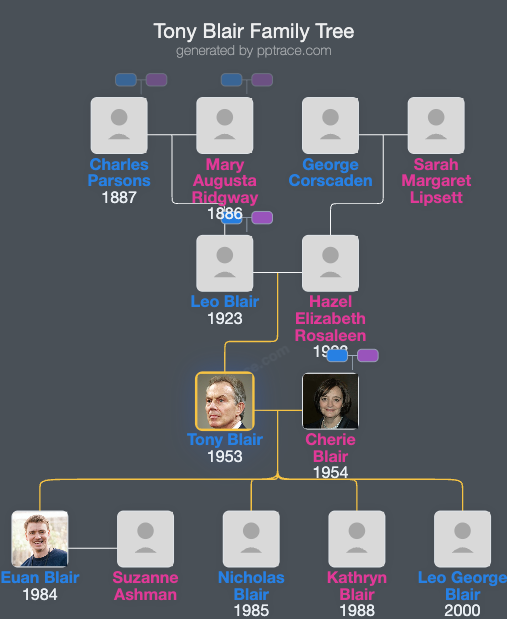
Family Tree
Tap  to expand more relatives
Introduction
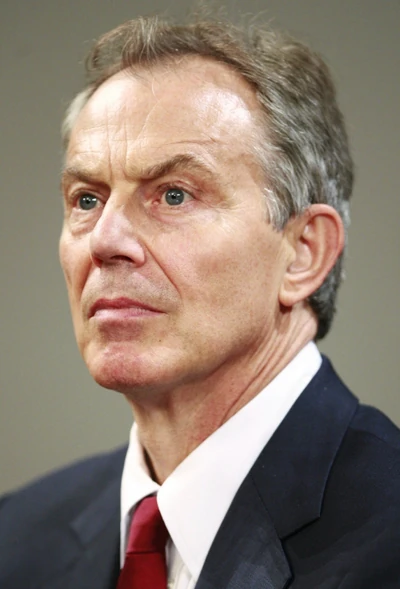
Sir Anthony Charles Lynton Blair, born on 6 May 1953 in Queen Mary Maternity Home in Lauriston, Edinburgh, Scotland, is a British politician who served as Prime Minister of the United Kingdom from 1997 to 2007. He held the position of Leader of the Labour Party from 1994 until 2007. Prior to his tenure as Prime Minister, Blair was the Leader of the Opposition from 1994 to 1997 and served in various shadow cabinet roles between 1987 and 1994. He was elected as Member of Parliament (MP) for Sedgefield in 1983 and held this seat until 2007. After his premiership, he served as special envoy of the Quartet on the Middle East from 2007 to 2015. In 2016, Blair founded the Tony Blair Institute for Global Change, where he functions as the Executive Chairman.
Blair attended Fettes College, an independent school in Edinburgh. He studied law at St John's College, University of Oxford, and subsequently qualified as a barrister after training at the Inns of Court School of Law and serving pupillage at Lincoln's Inn. Blair's early involvement with the Labour Party culminated in his election to the House of Commons in 1983, representing Sedgefield, a constituency in County Durham.
As a backbencher, Blair supported relocating the Labour Party toward the political center. He was appointed to Neil Kinnock's shadow cabinet in 1988 and later served as shadow home secretary under John Smith, who became party leader in 1992. Following John Smith's death in 1994, Blair won a leadership election to succeed him. Under his leadership, the Labour Party underwent rebranding as "New Labour," which facilitated a shift toward centrist policies.
In the 1997 general election, Blair’s Labour Party achieved a significant victory with 418 seats, marking their first parliamentary majority since 1974 and ending 18 years of Conservative government. Blair became the youngest Prime Minister of the 20th century and the second-longest-serving post-war British Prime Minister, with a tenure lasting a decade.
During his first term, Blair enacted substantial constitutional reforms, increased public expenditure on healthcare and education, and introduced market-based reforms. His government implemented policies including the introduction of a national minimum wage, tuition fees for higher education, devolution in Scotland and Wales, expansion of LGBT+ rights, and the passage of the Good Friday Agreement, which contributed to peace in Northern Ireland.
Blair’s foreign policy was marked by military interventions abroad. His government participated in NATO operations in Kosovo (1999) and Sierra Leone (2000). After the September 11 attacks in 2001, Blair supported the United States' war on terror, participating in the Afghanistan conflict, and supported the 2003 invasion of Iraq, based on claims that Saddam Hussein's regime possessed weapons of mass destruction and had links to al-Qaeda. The Iraq War was highly controversial and faced substantial opposition within the UK, including from members of Blair’s own party. The 2016 Iraq Inquiry report criticized Blair’s role in the invasion. As casualties mounted, Blair was accused of misleading Parliament, which led to a decline in his public approval ratings.
Blair was re-elected in 2001 and 2005, securing third consecutive term victories despite reducing majorities. His tenure saw increased public sector reforms and efforts to restore devolution in Northern Ireland. His popularity peaked after the London terrorist bombings in July 2005 but waned due to scandals such as the Cash-for-Honours affair and ongoing military conflicts.
In 2006, Blair announced his intention to resign within a year. He formally stepped down as Prime Minister on 27 June 2007, succeeded by Gordon Brown, and resigned as Labour leader on 24 June 2007.
Following his departure from office, Blair served as the Quartet's special envoy on the Middle East until 2015. He has been active as Chairman of the Tony Blair Institute for Global Change since 2016, engaging in various political and diplomatic activities. In 2009, Blair was awarded the Presidential Medal of Freedom by U.S. President George W. Bush. In 2022, he was appointed a Knight Companion of the Order of the Garter by Queen Elizabeth II.
Blair was born to Leo Blair and Hazel (née Corscadden). His father was a law lecturer and his family moved to Australia for a period during his childhood before returning to the United Kingdom. Blair has an older brother, William, and a younger sister, Sarah. His early education included attendance at the Chorister School and Fettes College. At Oxford, Blair was involved in music and drama, and briefly identified as a Trotskyist. He graduated with a second-class honours degree in jurisprudence in 1975 and went on to qualify as a barrister.