Alexander Gregory Barmine
| Name | Alexander Gregory Barmine |
| Title | GRU officer (1899-1987) |
| Gender | Male |
| Birthday | 1899-08-16 |
| nationality | Russian Empire |
| Source | https://www.wikidata.org/wiki/Q4078370 |
| pptrace | View Family Tree |
| LastUpdate | 2025-11-16T10:21:01.840Z |
Family Tree
Tap  to expand more relatives
Introduction
Alexander Grigoryevich Barmin (Russian: Александр Григорьевич Бармин, romanized: Aleksandr Grigoryevich Barmin; August 16, 1899 – December 25, 1987), commonly known as Alexander Barmine, was a Soviet military officer and diplomat who defected from the Soviet Union during the Stalinist purges. After his defection, he resided in France and later the United States, where he served in various governmental and intelligence roles, including positions with the Office of Strategic Services (OSS), Voice of America (VOA), and the United States Information Agency (USIA). Barmine also provided testimony before congressional committees such as the Subcommittee on Internal Security of the Senate.
**Early Life and Education**
Alexander Barmine was born on August 16, 1899, in Mogilev, within the Mogilev Governorate of the Russian Empire, present-day Belarus. His father, originally bearing the surname Graff, was a teacher from an ethnic German colonist family, and his mother was Ukrainian. Barmine attended a state gymnasium in Kiev and enrolled at St. Vladimir Imperial University. He furthered his education at the Infantry Officers' School in Minsk, the M. V. Frunze Military Academy in Moscow, and the Moscow Institute of Oriental Studies.
**Military and Diplomatic Career in the USSR**
In 1919, Barmine joined the Red Army and participated in the Russian Civil War. He attended a Red Army officer's academy and served in multiple battles. By 1921, he was appointed as a military attaché at the Soviet embassy in Bukhara. He advanced rapidly in his military career, reaching the rank of brigadier general by the age of 22.
In 1935, Barmine transferred from the Red Army to the Main Intelligence Directorate (Glavnoje Razvedyvatel'noje Upravlenie - GRU) of the Soviet Armed Forces. He was assigned to work abroad using diplomatic cover for the Soviet Foreign Office and Trade Ministry. That year, he was posted in Athens, Greece, serving as chargé d'affaires at the Soviet embassy.
During the 1930s, Barmine was closely linked with Soviet officials, many of whom were later arrested or executed during Stalin's Great Purge. As Soviet political repressions intensified, Barmine sensed danger, especially after his superiors began disappearing or were executed. In July 1937, amid heightened scrutiny from NKVD agents, he received a letter from his 14-year-old son, Boris, indicating they were leaving for the sea. That same month, Barmine was invited to dine on a Soviet ship but declined; nonetheless, he was under constant surveillance and sought to defect to the West.
**Defection to the West**
In 1937, Barmine fled Athens for Paris, escaping Soviet agents. His defection occurred shortly after the assassination of Ignace Reiss, the former chief of Soviet intelligence services in Western Europe, who had publicly repudiated Stalin. Barmine was among several Soviet intelligence officers who defected or were targeted during this period. His departure from Athens was part of a wave of defections and assassinations of Soviet operatives across Europe.
**Life and Career in the United States**
Following his escape, Barmine sought political asylum in the United States, becoming one of the earliest high-ranking Soviet defectors to do so. He obtained U.S. citizenship in 1942. During World War II, he served in an American anti-aircraft unit and, thereafter, worked for the OSS (the wartime predecessor to the CIA) in 1943 and 1944, focusing on intelligence operations against Axis powers.
In 1948, Barmine became a prominent figure at Voice of America, serving for sixteen years as chief of its Russian service. During this period, he also published articles and books critical of Stalinist policies and Soviet repression.
**Testimony and Later Activities**
On December 14, 1948, Barmine revealed to the FBI that Soviet GRU Director Yan Karlovich Berzin had informed him before his defection that Owen Lattimore, an American professor and former director of the Office of War Information, was a Soviet agent. In 1952, Barmine testified before the Senate Subcommittee on Internal Security, confirming that Soviet intelligence officials identified Lattimore as "one of our men."
From 1964 to 1972, Barmine served as a senior adviser on Soviet affairs at the USIA. He was awarded three honors for his public service during his career.
**Family and Personal Life**
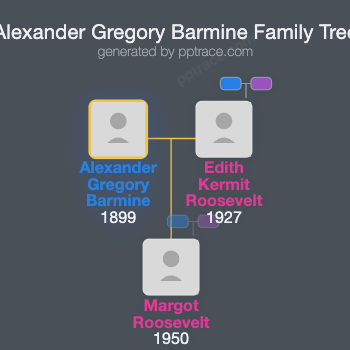
Barmine married Olga Federovna, a widow with notable Communist Party connections; they traveled to Soviet Turkestan for work in the party apparatus. The couple suffered from malaria during their service abroad. They had twin boys before Olga died in childbirth. In 1948, Barmine married Edith Kermit Roosevelt, granddaughter of President Theodore Roosevelt; they had a daughter, Margot Roosevelt, before divorcing in 1952. Subsequently, he married Halyna Barmine.
**Writings and Publications**
Barmine authored several anti-Stalinist and anti-communist works, beginning with a short critique of the Moscow Trials published shortly after his defection. His first book, *Memoirs of a Soviet Diplomat*, was published in 1938, describing Soviet political repression and his experiences. His 1945 memoir, *One Who Survived*, recounts his life in the Soviet Union and his escape. These writings aimed to expose Soviet atrocities and the nature of Stalinist repression.
**Death**
Alexander Barmine died at age 88 on December 25, 1987, in Rockville, Maryland.
**Selected Writings**
- *Memoirs of a Soviet Diplomat: Twenty Years in the Service of the USSR* (1938)
- *One Who Survived: The Life Story of a Russian Under the Soviets* (1945)
**See Also**
- Moscow Trials
- Margot Roosevelt
- Whittaker Chambers
**References**
[This section would include the list of references used for the article, typically omitted here.]