Senkō-in
| Name | Senkō-in |
| Title | spouse of Tokugawa Ienari |
| Gender | Female |
| Birthday | 1797-01-01 |
| nationality | — |
| Source | https://www.wikidata.org/wiki/Q11458463 |
| pptrace | View Family Tree |
| LastUpdate | 2025-11-17T09:49:18.605Z |
Family Tree
Tap  to expand more relatives
Introduction
Senko-in (born in 1797, the 9th year of the Kansei era – died June 11, 1872, the 5th year of Meiji) was a woman of the Edo period in Japan. She was a concubine of Ichijo Tokugawa and her original name was Ine; her childhood name was Miyo.
There are various theories and pieces of information about her life. Some suggest she was the daughter of Jisen-in’s chief monk, Nikkō, while others oppose this. Her connection to the Nakano family’s temple, Jisō-in, where Nikkō served as chief priest, led her to initially serve at Nakano Kiyoshige’s residence in Surugadai. Later, she was adopted as the foster daughter of Kiyoshige and began working in the Ōoku (the women’s chambers in the shogun’s palace).
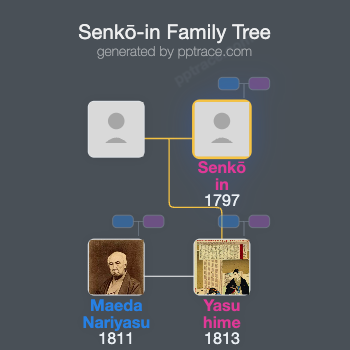
Eventually, she became a concubine of Tokugawa Ichijō. She gave birth to her first daughter, Yōkō (Yōhime), on March 27, 1813 (Kaei 10). She had a second daughter, Naka-hime, on October 16, 1815 (Kaei 12), and a third, Sue-hime, on September 18, 1817 (Kōka 4). Naka-hime died young, but Yōkō married Maeda Nariyoshi, the lord of Kaga. Sue-hime married Asano Saisetsu, the lord of Hiroshima.
Ichijō was very fond of her. He designated Jisen-in, where Nikkō served as the resident priest, as a prayer site for the shogunate. Additionally, he arranged for the women of the Ōoku, who were generally not allowed to go outside, to visit Jisen-in under the pretense of religious visits, giving them a chance to relax. This led to an environment where young women in the Ōoku engaged in clandestine meetings and entertainment with young monks, which gradually became a problem.
There is a theory that the temple Kannon-ji, which Miyo supposedly had built at her urging and where Nikkō was the abbot, was used for similar activities. However, later research has shown this to be false. Kannon-ji was a sub-temple of Ikegami Honmon-ji, and there is no evidence that Nikkō ever served as its monk.
Yōkō married Maeda Nariyoshi, and their son was Maeda Keining. There was a popular suspicion that Miyo forged Ichijō’s will to make her grandson, Keining, the future successor of the 12th shogun, Iemachi, aiming to secure his succession. However, this theory has been discredited. It is said that this plan was later foiled by Higashiai-in and Tadakuni Mizuno, an elder statesman.
After Ichijō’s death, Miyo also moved with the other consorts and the main wife to Nishi-no-Maru Ōoku (the Western Palace Courtyard). Following his death, she took Buddhist vows and resided in Ninki-in (also known as Senkō-in) in the second ward of Edo Castle.
When the shogun Keiyō (Tsunayoshi) seized political power, the Tenpō reforms began, and around that time, the Jisen-in incident (Jisen-in jiken) was investigated. The chief priest Nikkō was arrested, exiled, and died in prison. As a result of these events, Nakano Seikun was banned from entering Edo Castle and retreated to Mukojima, where he soon died. There were also reports suggesting that Senkō-in was expelled from Edo Castle; however, some testimonies indicate she may have remained within the Ōoku of Edo Castle.
She died in 1872 (Meiji 5).