Yasu-hime
| Name | Yasu-hime |
| Title | daughter of Tokugawa Ienari, wife of Maeda Nariaki (1813-1868) |
| Gender | Female |
| Birthday | 1813-04-27 |
| nationality | — |
| Source | https://www.wikidata.org/wiki/Q11564521 |
| pptrace | View Family Tree |
| LastUpdate | 2025-11-17T06:48:02.701Z |
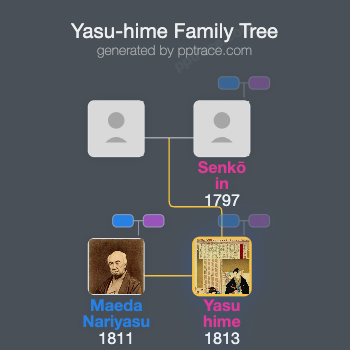
Family Tree
Tap  to expand more relatives
Introduction
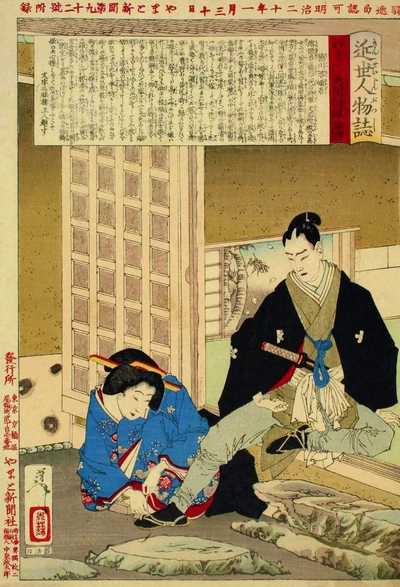
Yasuhime (also read as Yasu-hime or Yo-hime; born March 27, 1813, in the 10th year of Bunka, and died June 20, 1868, in the 4th year of Keio) was a relative of the Tokugawa shogunate during the mid-Edo period and the second daughter of the 11th shogun, Tokugawa Ienari. Her mother was Omiya, the adopted daughter of Shōkō Nakano (her biological father is unknown). She was the principal wife of Maeda Nariyoshi, the 12th lord of Kaga Domain (later the 13th head of the Maeda family), and the mother of Maeda Keihira, the 13th lord of Kaga, as well as Ikeda Yoshinaga, the 11th lord of Tottori. Her personal name was Tomoko, and her posthumous Buddhist name was Keitoku-in.
She was the half-sister of Tokugawa Ieke and the aunt of Tokugawa Iesada and Tokugawa Iemochi.
Her life is as follows: she was born in the Ōoku (the women's quarters) of Edo Castle in 1813. In 1817, she became the adopted daughter of the shōgun's chief wife, Lady Mie. On April 11, 1823 (Bunsei 6), her engagement to Maeda Nariyoshi, the lord of Kaga Domain, was arranged, and she was married (koshijū) at the age of 15 on January 13, 1828 (Bunsei 10). The main gate of the Kaga domain's residence in Hongo, within the Edo Castle grounds, was later called the "Akamon" (Red Gate), and served as a symbol of her marriage.
After her marriage, Yasuhime endeavored to integrate into Kaga Domain; however, records indicate that the maids dispatched from the Ōoku displayed an arrogant attitude, despising both samurai and maids of the domain. It is also recorded that Yasuhime herself looked down on her husband, Nariyoshi. She bore three sons: the eldest, Inukichiyo (later Maeda Keihira), born in 1830 (Tempō 1); Komajirō (Tsurajirō), born in 1832 (Tempō 3); and Kame Maru (Kyōshinmaru, Rinjū, later Ikeda Keie), born in 1834 (Tempō 5). Tsurajirō died shortly after birth, but Inukichiyo and Kyōshinmaru survived to adulthood.
After the death of her father, Tokugawa Ienari, her mother, Omiya, aimed to retain power within the shogunate by positioning her eldest son Inukichiyo as the successor to the shogunate. This plan was thwarted by Tokugawa Ienari’s widow, Empress Kōdaiin, as well as by Tadaaki Mizuno and her half-older brother, Shōgun Tokugawa Ieyoshi. Subsequently, Yasuhime took her mother Omiya into her care; her supporting her financially strained the domain’s finances and earned her the resentment of the samurai.
In 1848 (Kaei 1), Rinjū (Ikeda Keie) was adopted into the Tottori domain under imperial order. This was an unusual case of adoption between outwardly daimyo of different domains, but Rinjū was under the protection of the shogunate. Rinjū is said to have died at 17 en route to his domain in 1850 (Kaei 3), with rumors suggesting he was poisoned. Yasuhime deeply mourned Rinjū’s death and composed a lament in poetic form.
In August of 1862 (Bunkyu 2, 8th month), due to reforms during Bunkyu that relaxed the sankin-kōtai (alternate attendance) system, daimyō wives and children were permitted to reside in their home provinces. However, Yasuhime did not immediately return to her domain due to her kinship with the shogun family and her mother. In April 1863 (Bunkyu 3), Yasuhime borrowed 35,000 ryō from the shogunate to fund her return, and she departed Edo with a grand procession. She arrived at Tsubata on June 10, where she met with Maeda Keining, the lord of Kaga, and entered the palace within Kanazawa Castle’s secondary enclosure.
However, after the Ikedō Incident (Genomoto Incident) in 1864, the shogunate reverted to the previous sankin-kōtai system, and Yasuhime wished to return to Edo. Due to rising political tensions and internal conflicts, she decided to leave Kanazawa and return to Edo. She arrived in Edo in December 1864.
In 1866 (Keio 2), Nariyoshi retired, and his eldest son, Keihira, became the lord of Kaga Domain. During this tumultuous period leading up to the end of the Tokugawa shogunate, the Kaga Domain adopted a pro-shogunate stance.