Nobusuke Kishi
| Name | Nobusuke Kishi |
| Title | 56th and 57th Prime Minister of Japan (1896-1987) |
| Gender | Male |
| Birthday | 1896-11-13 |
| nationality | Japan |
| Source | https://www.wikidata.org/wiki/Q315572 |
| pptrace | View Family Tree |
| LastUpdate | 2025-11-17T06:46:25.957Z |
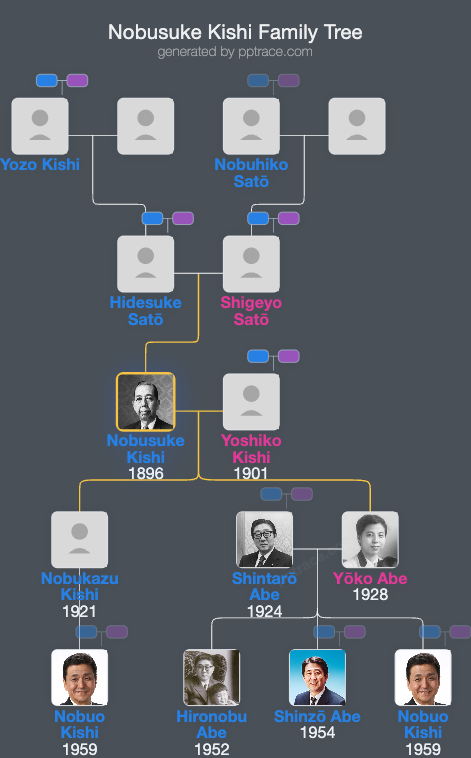
Family Tree
Tap  to expand more relatives
Introduction
Nobusuke Kishi (岸 信介, Kishi Nobusuke; born 13 November 1896, died 7 August 1987) was a Japanese bureaucrat and politician. He served as the Prime Minister of Japan from 1957 to 1960. Kishi is known for his administrative role in the economic development of Manchukuo during the 1930s, his detention as a suspected war criminal following World War II, and his involvement in the 1960 U.S.–Japan Security Treaty revision, which led to the Anpo protests.
Kishi was born in Yamaguchi Prefecture, Japan. His birth name was Nobusuke Satō. He was the son of a sake brewer from a family with samurai ancestry; his great-grandfather, Satō Nobuhiro, was a retainer of the Chōshū Domain and the first governor of Shimane Prefecture following the Meiji Restoration. The family experienced financial decline prior to his birth. His older brother, Ichirō Satō, became a Vice Admiral in the Imperial Japanese Navy, and his younger brother, Eisaku Satō, later became Prime Minister of Japan.
Kishi attended elementary and middle schools in Okayama and Yamaguchi before being adopted by his paternal uncle, Nobumasa Kishi, which resulted in his name change. He gained placement at the First Higher School in Tokyo and subsequently entered Tokyo Imperial University’s Faculty of Law, graduating in 1920 as the top of his class. During his university years, he studied under the ultranationalist legal scholar Shinkichi Uesugi, adopting views favoring German-style statism.
Following graduation, Kishi entered the Ministry of Agriculture and Commerce, diverging from the common career path of bureaucrats aiming for high-ranking positions in the Home Ministry. He was particularly interested in Japan’s economic development. Between 1926 and 1927, Kishi traveled internationally to study industrial policies in the United States, Germany, and the Soviet Union, gaining insights into state-led economic planning and labor management theories.
In the 1930s, Kishi became a prominent figure among reformist bureaucrats advocating for a statist model of economic development. His career advanced within the Ministry of Commerce and Industry, where he held positions such as chief of the industrial policy section and head of the Industrial Affairs Bureau by 1935. In 1936, he moved to Manchukuo, then a puppet state controlled by Japan after the Manchurian Incident of 1931. There, Kishi served as Vice Minister of Industrial Development and was responsible for overseeing the industrial expansion of Manchukuo, with a focus on heavy industry supporting military needs.
Kishi played a central role in designing Manchukuo's Five-Year Plan, modeled after Soviet economic plans, emphasizing automotive and steel industries. He promoted a model of a state-guided economy with significant private sector involvement, establishing corporations such as the Manchurian Industrial Development Company (MIDC). His efforts attracted substantial private investment, notably from Nissan Group founder Yoshisuke Aikawa.
After World War II, Kishi was detained as a suspected Class A war criminal but was not prosecuted or convicted by the Allied authorities. He was released in 1948 during the U.S. occupation's Reverse Course. Following the end of the occupation in 1952, he was de-purged and entered electoral politics. In 1953, Kishi was elected to the Japanese National Diet.
He was one of the founders of the Liberal Democratic Party (LDP) in 1955, which has remained Japan's dominant political party since. Kishi served as the first secretary-general of the LDP and was Japan's foreign minister under Prime Minister Tanzan Ishibashi before becoming Prime Minister himself in 1957. His domestic policies generally supported industry and commerce, and he maintained strong ties to business interests.
During his premiership, Kishi sought to expand police powers, but the legislation was withdrawn due to public opposition. His tenure was marked by a contentious handling of the 1960 revision of the U.S.–Japan Security Treaty, which led to the large-scale Anpo protests. Following the protests, Kishi resigned as Prime Minister.
He continued to serve as a member of the House of Representatives until 1979. Throughout his political career, Kishi was known for his staunch anti-communism and conservative views, maintaining close links with right-wing groups. His political legacy includes establishing a political dynasty that would include his brother Eisaku Satō and his grandson Shinzo Abe, both of whom served as Prime Ministers of Japan.