Katō Tomosaburō
| Name | Katō Tomosaburō |
| Title | Japanese admiral (1861-1923) |
| Gender | Male |
| Birthday | 1861-04-01 |
| nationality | Japan |
| Source | https://www.wikidata.org/wiki/Q335203 |
| pptrace | View Family Tree |
| LastUpdate | 2025-11-17T10:08:27.271Z |
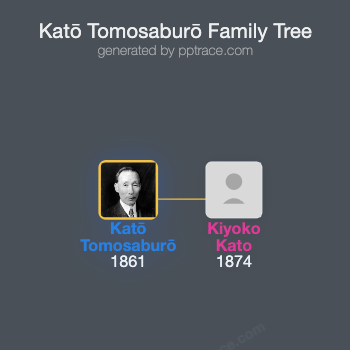
Family Tree
Tap  to expand more relatives
Introduction
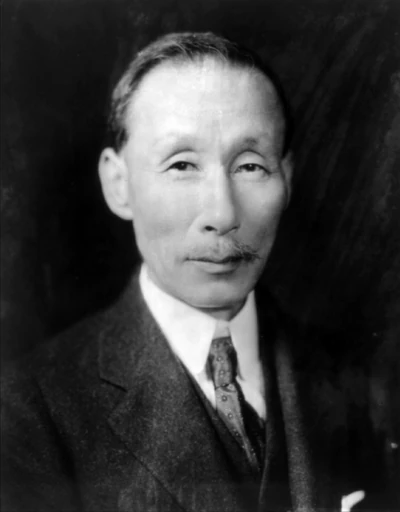
Marshal-Admiral Viscount Katō Tomosaburō (加藤 友三郎) was born on 22 February 1861 in Hiroshima, Aki Province, which is now part of Hiroshima Prefecture. His family belonged to the samurai class. He enrolled in the 7th class of the Imperial Japanese Naval Academy, from which he graduated second out of thirty cadets. His specialization during his naval education was in artillery and navigation.
Following his graduation, Katō was commissioned as a lieutenant. In 1887, he served aboard the corvette Tsukuba, and subsequently aboard the cruiser Takachiho. During the First Sino-Japanese War, he served as a gunnery officer on the cruiser Yoshino. After the conflict, he held various staff positions and was promoted to the rank of commander. He served as the executive officer on the battleship Yashima and as captain of the Tsukushi. Katō was promoted to rear admiral on 1 September 1904.
During the Russo-Japanese War, Katō held the position of chief of staff to Admiral Tōgō Heihachirō aboard the battleship Mikasa. He played a role in Japan's victory at the Battle of Tsushima. Throughout this period, he suffered from a weak stomach and reportedly experienced vomiting while issuing orders during the battle, despite taking medication.
In 1906, Katō was appointed Vice Minister of the Navy. He was promoted to vice admiral on 28 August 1908. In 1909, he was assigned as commander of the Kure Naval District. By 1913, he had become Commander in Chief of the Combined Fleet. In August 1915, he was appointed Minister of the Navy, shortly before his promotion to full admiral on 28 August 1915. He served as Minister of the Navy under the cabinets of Ōkuma Shigenobu, Terauchi Masatake, Hara Takashi, and Takahashi Korekiyo.
As Japan's chief commissioner plenipotentiary to the Washington Naval Conference, Katō collaborated with Ambassador Shidehara Kijurō in negotiations that resulted in the Five-Power Treaty. His diplomatic work during this period was instrumental in aligning Japan with the naval agreements reached.
In 1922, Katō was appointed Prime Minister of Japan. His cabinet mainly comprised bureaucrats and members of the House of Peers, which was unpopular among the Imperial Japanese Army. During his tenure, he implemented the provisions of the Washington Naval Agreement, withdrew Japanese forces from Shandong in China, and ceased Japanese participation in the Siberian Intervention.
Katō died on 24 August 1923 from late-stage colon cancer, approximately one year after assuming office. The day before his death, he was awarded the honorary rank of Marshal Admiral. Posthumously, he was conferred the Grand Cordon of the Supreme Order of the Chrysanthemum, and his title was elevated to shishaku (viscount). His death occurred just one week prior to the Great Kantō earthquake, leaving Japan without a prime minister during that disaster. His remains are interred at Aoyama Cemetery in Tokyo.
Throughout his career, Katō received numerous honors, including the Order of the Golden Kite, 2nd class; the Grand Cordon of the Order of the Sacred Treasure; the Grand Cordon of the Order of the Rising Sun; the Grand Cordon of the Order of the Paulownia Flowers; and the Grand Cordon of the Order of the Chrysanthemum. He was also elevated to the peerage as a baron (danshaku) and later as a viscount (shishaku).