Thomas Law
| Name | Thomas Law |
| Title | Anglo-American reformer |
| Gender | Male |
| Birthday | 1756-10-23 |
| nationality | — |
| Source | https://www.wikidata.org/wiki/Q7791735 |
| pptrace | View Family Tree |
| LastUpdate | 2025-11-17T06:38:07.592Z |
Family Tree
Tap  to expand more relatives
Introduction
Thomas Law was born on October 23, 1756, in Cambridge, England. He was the youngest son of a clerical family; his father was Edmund Law, Bishop of Carlisle, and his brothers held notable ecclesiastical and political positions, including John Law, Bishop of Clonfert and Kilmacduagh in Ireland; Ewan Law, Member of Parliament; Edward Law, 1st Baron Ellenborough, Lord Chief Justice; and George Henry Law, Bishop of Bath and Wells.
Law emigrated to India in 1773, initially serving as a "writer" or clerk in the service of the British East India Company. Over time, he advanced to roles including revenue collector and judge in the province of Bihar. From 1773 to 1791, he served as the first collector of the districts of Gaya and Rohtas, serving a population of approximately two million. His duties encompassed fiscal, judicial, and executive responsibilities. During his tenure in India, Law established a long-term relationship with an Indian woman, with whom he fathered three sons—George, John, and Edmund. These sons were baptized at St. John's Church in Calcutta, and Law's sons are recorded as having been born between 1784 and 1790.
As a policy-maker, Law contributed to the development of the "Permanent Settlement," a land tenure and taxation policy that aimed to secure revenue for the British authorities while transforming landholding practices among Indians. The policy was adopted across British India as a result of its success. Law amassed a significant fortune—reports estimate it ranged from £50,000 to over £100,000—partly through trading activities. He maintained bonds with a bank in Calcutta to support his Indian mistress and provide for his sons' education.
Law returned to England in 1791 due to declining health. Upon returning, he encountered difficulties, including disagreements with the East India Company and disputes over unpaid funds, partly due to his opposition to a projected war with France. He was also involved in financial negotiations related to bonds and investments.
In 1794, Law emigrated to the United States, initially settling in New York. He brought with him his eldest sons, George and John, leaving his youngest son Edmund temporarily in England. In the United States, Law became a prominent real estate investor and developer, participating in the nascent Washington, D.C., capital development. He invested in land trading ventures, notably with the Greenleaf Syndicate, which filed for bankruptcy in 1797. Law was part of the speculative land boom and contributed to the civic and cultural development of the city.
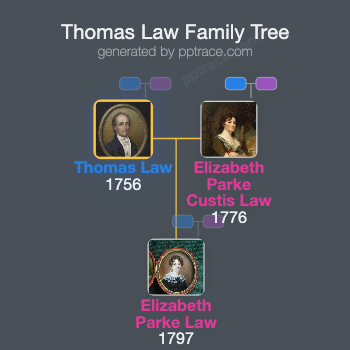
Law married Elizabeth Parke Custis on March 20, 1796, in Virginia. Elizabeth was the eldest granddaughter of Martha Washington and step-granddaughter of George Washington. The couple resided briefly at a house on 6th Street SW, later moving to a custom-built residence. Their marriage produced one daughter, Elizabeth Law, born in 1797, who later married Nicholas Lloyd Rogers of Baltimore. Law and Elizabeth separated in 1804 and divorced in 1811. Elizabeth Law died in 1822.
Following his divorce, Law maintained relationships with other women, including Mary E. Robinson, with whom he had a son, Joseph E. Law. Law's personal life included relationships and property holdings in Washington, D.C., and the surrounding areas. He engaged in various business ventures, including constructing buildings, investing in waterfront properties, and developing commercial enterprises like a sugar mill.
Law was also active in civic and intellectual pursuits in the capital. He helped establish the first theater in Washington, contributed to the founding of a dancing society, and was involved with the Columbian Institute for the Promotion of Arts and Sciences. He advocated for the creation of a national paper currency, public debt financing, and an agricultural society to promote economic development. His advocacy and investments earned him a reputation as an energetic promoter of the young nation's progress.
He died in 1834, leaving behind a legacy marked by his roles in early British India's land policies and the development of Washington, D.C., as a capital city.