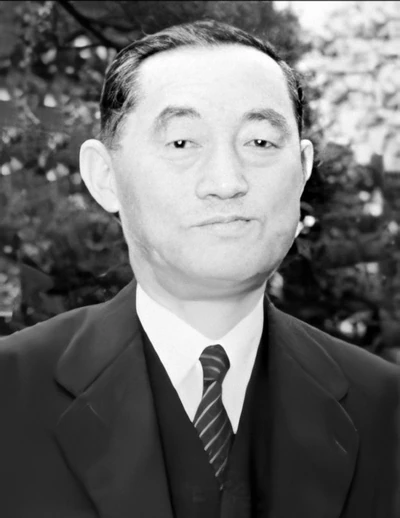
Mitsumasa Yonai
| Name | Mitsumasa Yonai |
| Title | Prime Minister of Japan (1880-1948) |
| Gender | Male |
| Birthday | 1880-03-02 |
| nationality | Japan |
| Source | https://www.wikidata.org/wiki/Q715231 |
| pptrace | View Family Tree |
| LastUpdate | 2025-11-17T10:09:08.645Z |
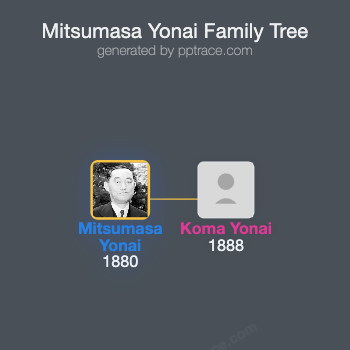
Family Tree
Tap  to expand more relatives
Introduction
Mitsumasa Yonai (米内 光政, Yonai Mitsumasa) was born on March 2, 1880, in Mitsuwari, Iwate Prefecture, Japan. He was the first son of Yonai Nagamasa, a former samurai who had served the Nanbu clan of the Morioka Domain. Yonai attended Kajichō Elementary School starting in 1886 and Morioka Middle School from 1890. After completing middle school, he entered the Imperial Japanese Naval Academy, from which he graduated in 1901 as part of the 29th class, ranking 68th out of 125 cadets.
Following graduation, Yonai served as a midshipman on the corvette Kongō and cruiser Tokiwa. He was commissioned as an ensign in January 1903. During the Russo-Japanese War of 1904–1905, he served in administrative roles and later participated at sea aboard the destroyer Inazuma and cruiser Iwate. After the war, he held positions such as chief gunnery officer on cruiser Niitaka, battleship Shikishima, and cruiser Tone.
In December 1912, after being promoted to lieutenant commander, Yonai graduated from the Naval War College and was appointed as a naval attaché to Russia, serving from 1915 to 1917 during World War I. During his overseas service, he attained the rank of commander. After the collapse of the Russian Empire, he was recalled to Japan and served as the executive officer on the battleship Asahi.
Yonai was promoted to captain in December 1920. He served as naval attaché to Poland from 1921 to 1922. Upon returning to Japan, he commanded several ships, including cruisers Kasuga (1922–1923), Iwate (1923–1924), and battleships Fusō (1924) and Mutsu (1924–1925). He was promoted to rear admiral on December 1, 1925. Subsequent appointments included Chief of the 3rd Section of the Imperial Japanese Navy General Staff in 1926, and participation in the Navy Technical Council.
In December 1928, Yonai was appointed Commander-in-Chief of the First Expeditionary Fleet, sent to the Yangtze River in China. He was promoted to vice admiral in December 1930 and commanded the Chinkai Guard District in Korea. He later commanded the IJN 3rd Fleet in December 1932, and held commanding positions at Sasebo Naval District (from November 1933), IJN 2nd Fleet (from November 1934), and Yokosuka Naval District (from December 1935).
In December 1936, Yonai was appointed Commander-in-Chief of the Combined Fleet and concurrently commanded the IJN 1st Fleet. During his tenure at Sasebo, the Tomozuru Incident exposed flaws in the design of the Chidori-class torpedo boats, raising questions about the navy’s shipbuilding standards. While serving at Yokosuka, the February 26 Incident broke out in Tokyo. Yonai was visiting his mistress in Shinbashi at the time and learned of the coup only upon returning to his base.
Yonai was promoted to full admiral in April 1937 and appointed Navy Minister under Prime Minister Senjūrō Hayashi. He continued to serve as Navy Minister under subsequent cabinets led by Fumimaro Konoe and Kiichirō Hiranuma until August 1939. As Navy Minister, he was noted for brief speeches and was known for his opposition to the Axis alliance, advocating for peace with Western powers. His stance made him unpopular with ultranationalist factions, resulting in multiple assassination attempts. He supported the construction of the Yamato-class battleships to maintain a naval balance among world powers.
Yonai became Prime Minister of Japan on January 6, 1940, with backing from Emperor Hirohito. He maintained a pro-British and pro-American policy stance, opposing the Tripartite Pact. His government faced pressure from the Japanese Army, which was dissatisfied with his anti-German and anti-Italian policy. As tensions in Europe escalated, disagreements within the government led to Yonai’s resignation on July 21, 1940, after the signing of the Tripartite Pact on September 27, 1940.
Later in his career, Yonai served as Deputy Prime Minister and again as Navy Minister under Prime Minister Kuniaki Koiso from July 22, 1944. During this period, he rejoined the active duty list as Japan faced military defeats, including the fall of Saipan. He supported Japan’s surrender, advocating acceptance of the Potsdam Declaration. He continued to serve in government roles during the final days of World War II, including in the cabinets of Prime Ministers Kantarō Suzuki, Prince Naruhiko Higashikuni, and Kijūrō Shidehara.
Following Japan’s surrender, Yonai participated in the International Military Tribunal for the Far East, working with defendants such as Prime Minister Hideki Tōjō to coordinate testimonies aimed at protecting Emperor Hirohito from indictment. After the war, he dedicated himself to Japan’s reconstruction. Yonai died of pneumonia on April 20, 1948, at the age of 68. His burial site is located at Enko-ji Temple in Morioka.