Tanaka Giichi
| Name | Tanaka Giichi |
| Title | Japanese general (1864-1929) |
| Gender | Male |
| Birthday | 1864-07-25 |
| nationality | Japan |
| Source | https://www.wikidata.org/wiki/Q145416 |
| pptrace | View Family Tree |
| LastUpdate | 2025-11-17T10:08:38.789Z |
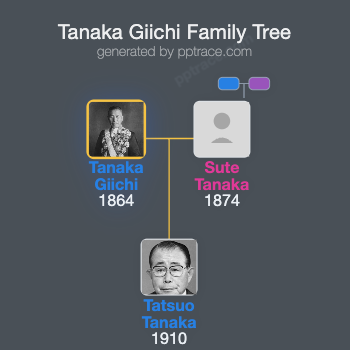
Family Tree
Tap  to expand more relatives
Introduction
Baron Tanaka Giichi (Japanese: 田中 義一; IPA: [ta̠na̠ka̠ ɡʲiːt͡ɕi]) was a Japanese military officer and politician born on June 22, 1864, and died on September 29, 1929. He served as the Prime Minister of Japan from 1927 to 1929.
Early Life and Military Career:
Tanaka was born as the third son of a low-ranking samurai family affiliated with the Chōshū Domain, in Hagi, Nagato Province (modern-day Yamaguchi Prefecture). At age 13, he participated in the Hagi Rebellion. From an early age, he showed an interest in politics, serving on a village council and working as an elementary school teacher. He joined the Imperial Japanese Army at age 20, graduating from the 8th class of the Imperial Japanese Army Academy and from the 8th class of the Army War College in 1892.
During the First Sino-Japanese War, Tanaka served as a junior officer. Following the war, he was assigned as a military attaché to Moscow and Petrograd, where he became proficient in Russian, attending Russian Orthodox church services and engaging in social events. His fluency in Russian contributed to his role as an expert in Russian affairs within Japan's military. He maintained a close friendship with Takeo Hirose of the Imperial Japanese Navy during this period. Tanaka served as aide to General Kodama Gentarō in Manchuria and was involved in drafting a defense plan in 1906, which was highly regarded by the Japanese Army General Staff and adopted as a basic policy until World War I. He was awarded the Order of the Golden Kite (3rd class) in 1906.
He was promoted to major general in 1911, and as Director of the Military Affairs Bureau at the Ministry of the Army, he advocated increasing the standing army. In 1918, he received the Order of the Sacred Treasure (1st class). He served as Army Minister under Prime Minister Hara Takashi from September 1918 to June 1921, during which he was promoted to full general in 1920 and awarded the Order of the Rising Sun (1st class). Tanaka was granted the peerage title of danshaku (baron) under the kazoku system.
Political and Ministerial Career:
After retiring from active military service, Tanaka returned as Army Minister in the 2nd Yamamoto administration (September 1923 - January 1924). In 1925, he was invited to serve as president of the Rikken Seiyūkai, a major conservative political party, and in January 1926, he was appointed to the House of Peers. A planned promotion to Field Marshal was denied due to reports of a monetary bonus he received upon joining the Seiyūkai party.
Prime Ministership (1927–1929):
Tanaka assumed the office of Prime Minister on April 20, 1927, amid the Shōwa financial crisis. He also served concurrently as Foreign Minister, later taking on roles as Home Minister (May 1928) and Colonial Affairs Minister (June 1929). His domestic policy focused on suppressing communist and socialist movements through arrests, exemplified by incidents such as the 15 March 1928 and 19 April 1929 crackdowns.
In foreign policy, Tanaka adopted a hawkish stance, diverging from his predecessor Shidehara. He emphasized military intervention in conflicts where Japan had interests, notably involving the Kuomintang's Northern Expedition in China. He sent troops multiple times to intervene in Shandong Province in 1927 and 1928, including the Jinan Incident.
The instability escalated after the assassination of Manchurian warlord Zhang Zuolin in 1928 by a Kwangtung Army officer, an event that surprised Tanaka and was characterized by a military cover-up. Due to loss of support and criticism from the diet and the Emperor Hirohito, Tanaka and his cabinet resigned en masse on July 2, 1929.
Death and Legacy:
He was succeeded by Hamaguchi Osachi and died shortly afterward on September 29, 1929. His grave is located at Tama Cemetery in Fuchū, Tokyo. Posthumously, he received the Order of the Paulownia Flowers.
Controversies and Allegations:
In 1929, China accused Tanaka of authoring the "Tanaka Memorial," a document alleged to outline plans for Japanese conquest of Manchuria, Mongolia, and China. Most historians regard this document as a forgery. The claim was spread in wartime propaganda, including the film series "Why We Fight," which depicted the plan as a blueprint for eventual global conquest.
Honors and Decorations:
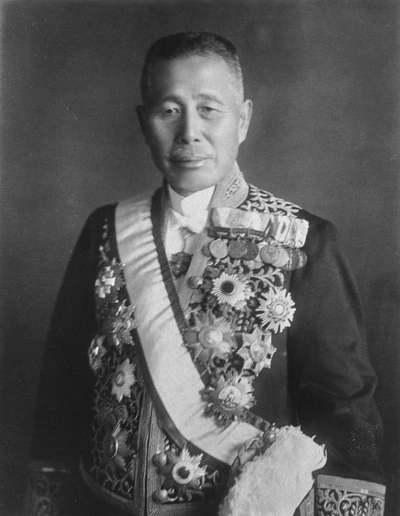
Tanaka received numerous awards, including orders and medals from Japan and other countries. Notably, he was awarded the Grand Cordon of the Order of the Rising Sun in 1920, the Order of the Paulownia Flowers in 1929, and foreign honors including the Grand Cross of the Legion d'Honneur (France), the Grand Cross of the Order of George I (Greece), and the Distinguished Service Medal from the United States. He was also granted the peerage title of Baron on September 7, 1920.